

For independent consultants, strategic advisors, and solo professional service providers, time tracking is not a payroll clock; it is an auditable record of commercial value. When advisory time tracking is disorganized, consultants routinely leak billable capacity through unrecorded phone calls, quick email critiques, and unscheduled advisory sessions. More critically, vague or defensive timesheet logs trigger client payment friction, invoice audits, and delayed approvals.
Establishing a defensible consultant time-tracking workflow requires three foundational disciplines: a standardized 3-tier activity taxonomy, explicit contractual billing increments (such as tenth-of-an-hour rounding), and a daily capture habit that eliminates memory-based end-of-week reconstruction. Whether you bill by the hour, draw against a monthly advisory retainer, or track hours internally against fixed-fee caps, clean time tracking protects your revenue and preserves client trust. For the contractual side of a recurring engagement, see our consulting retainer agreement template, which explains base-hour allocations, pre-authorized overages, and monthly reconciliation.
This practical guide provides an end-to-end framework for structuring client-ready timesheets. It covers the legal distinctions governing independent contractor billing, reconciles a complete 20-hour monthly retainer worked example, details audit-proof task descriptions, and provides an ungated, copy-ready consultant timesheet template.
The 3-Tier Activity Taxonomy for Auditable Billing
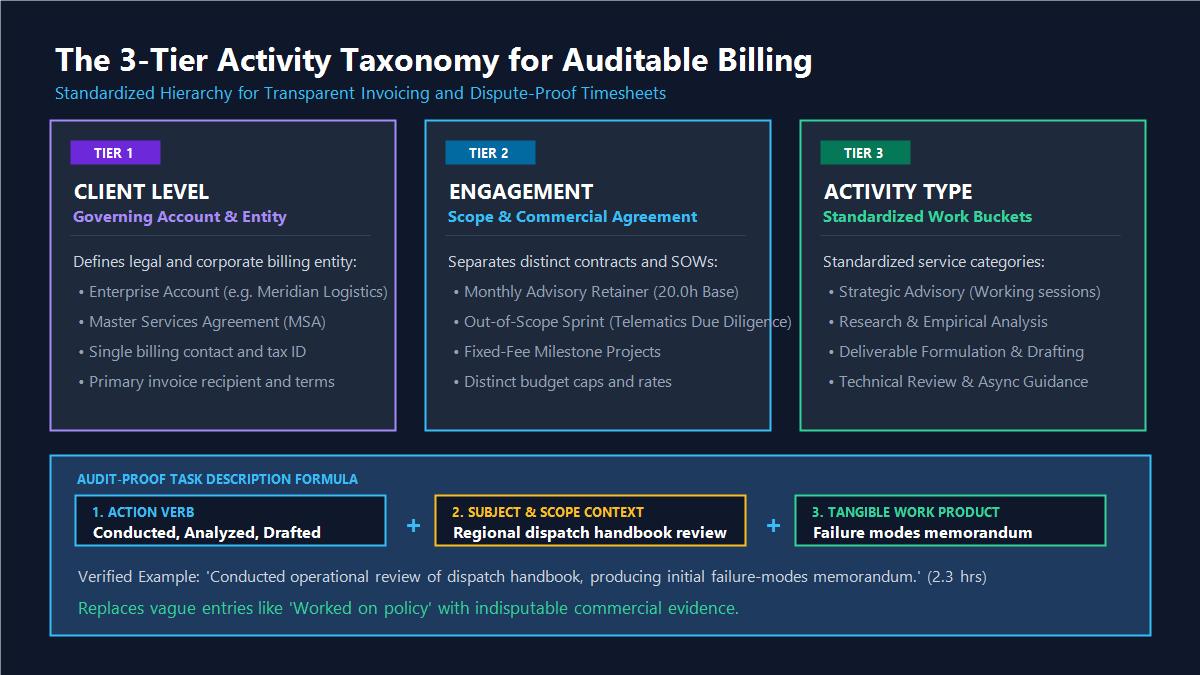
If you allow yourself or your team to log time using freeform notes without standardized categories, your billing records will inevitably drift into ambiguous jargon that confuses clients. A defensible time-tracking workflow relies on a strict 3-tier hierarchy: Client, Engagement, and Activity Type.
[TIER 1: CLIENT]
  └── Meridian Logistics Group
      [TIER 2: ENGAGEMENT]
        ├── Monthly Operations Advisory Retainer
        └── Fleet Telematics Due Diligence (Approved Out-of-Scope Sprint)
            [TIER 3: ACTIVITY TYPE]
              ├── Strategic Discovery & Stakeholder Interviews (Billable)
              ├── Governance Drafting & Policy Review (Billable)
              ├── Executive Steering Committee Presentation (Billable)
              └── Engagement Admin & Invoicing (Non-Billable Internal)
Standardizing Tier 3 activity types allows you to distinguish billable client delivery from non-billable business administration with complete transparency. As detailed in our billable time tracking guide, separating active advisory hours from internal operational overhead is essential for calculating accurate utilization and realization rates.
1. Billable Advisory Activities
Billable activities represent professional services delivered directly within the agreed project scope. Standardize these into four broad, recognizable buckets:
- Strategic Advisory & Working Sessions: Scheduled consulting calls, client workshops, executive working sessions, and stakeholder interviews.
- Research & Empirical Analysis: Data auditing, vendor proposal reviews, operational benchmarking, and document review.
- Deliverable Formulation & Drafting: Authoring governance frameworks, strategic roadmaps, technical memos, and presentation decks.
- Implementation Guidance & Technical Review: Reviewing client execution drafts, testing system workflows, and providing async technical feedback.
2. Non-Billable Overhead & Business Development
Tracking non-billable time is equally critical for independent consultants. If you do not record non-billable overhead, you cannot accurately calculate your effective hourly rate (EHR) or identify operational bottlenecks. Standard non-billable categories include:
- Pre-Sale Scoping & Proposals: Introductory calls, proposal drafting, and contract negotiations prior to signed authorization. To establish clear advisory boundaries and pricing before work begins, consult our guide on how to write a consulting proposal.
- General Practice Administration: Bookkeeping, invoicing, software maintenance, and tax preparation. For guidance on selecting platforms that support fee caps, retainers, and ACH transfers, see our evaluation of invoicing software for consultants.
- Professional Development: Attending industry conferences, pursuing technical certifications, and conducting non-client research.
Contractual Billing Increments and Legal Boundaries
One of the most frequent sources of dispute in consulting engagements is how fractional hours are rounded. Consultants and clients often bring conflicting assumptions to the table unless billing increments are explicitly defined in the governing agreement.
Distinguishing Elapsed Time, Upward Rounding, and Nearest-Increment Rounding
To maintain transparency and prevent billing friction, consultants must distinguish between three distinct timekeeping concepts:
- Recording Actual Elapsed Time: The foundational practice of logging the exact minutes spent on an advisory task (for example, logging 14 actual minutes on a phone consultation) before any contract rule is applied.
- Contractual Rounding Upward (Ceiling / Minimum Unit Rounding): An express contractual term providing that any fraction of a billing increment rounds upward to the next full increment. For example, in a 6-minute (0.1-hour) system:
- 1 to 6 minutes elapsed =
0.10 hrbilled - 7 to 12 minutes elapsed =
0.20 hrbilled - 13 to 18 minutes elapsed =
0.30 hrbilled - 19 to 24 minutes elapsed =
0.40 hrbilled - 25 to 30 minutes elapsed =
0.50 hrbilled
Upward rounding compensates the consultant for cognitive switching costs on short advisory tasks. However, it is strictly a negotiated contractual privilege, never an automatic legal entitlement.
- Rounding to the Nearest Increment (Midpoint Rounding): A neutral mathematical formula where times below the midpoint round down, while times at or above the midpoint round up. In a 6-minute (0.1-hour) midpoint system:
- 1 to 2 minutes elapsed =
0.00 hr - 3 to 8 minutes elapsed =
0.10 hr - 9 to 14 minutes elapsed =
0.20 hr - 15 to 20 minutes elapsed =
0.30 hr - 21 to 26 minutes elapsed =
0.40 hr - 27 to 32 minutes elapsed =
0.50 hr
6-Minute (0.1-Hour) Versus 15-Minute (0.25-Hour) Rounding Standards
Professional consulting practices standardly adopt one of two fractional billing intervals:
| Billing Interval | Fractional Hour | Common Application | Client Perception & Advantage |
|---|---|---|---|
| Tenth of an Hour (6 Minutes) | 0.10 hr | High-frequency advisory, phone calls, document reviews | Highly favored by corporate legal, financial, and executive clients; perceived as exact and fair |
| Quarter of an Hour (15 Minutes) | 0.25 hr | Deep-work consulting, on-site workshops, technical sprints | Clean arithmetic; best suited for extended blocks of uninterrupted project work |
Regulatory Distinction: Contractual Terms Versus FLSA Wage Rules
A critical legal distinction must be maintained between independent consultant contracts and statutory employment law.
Under federal labor standards, 29 C.F.R. § 785.48(b) governs the rounding of employee time clocks under the Fair Labor Standards Act (FLSA, 29 U.S.C. § 201 et seq.). The regulation permits employers to round employee starting and stopping times to the nearest 5 minutes, 6 minutes (tenth of an hour), or 15 minutes (quarter of an hour), provided that the rounding policy is neutral and averages out over time so employees are fully compensated for all actual hours worked.
However, 29 C.F.R. § 785.48(b) applies strictly to statutory employees, not to bona fide independent contractors.
On November 19, 2026, the U.S. Department of Labor announced a revised final rule governing independent contractor classification under the FLSA, slated to take effect 60 days following formal publication in the Federal Register. Per official guidance from the U.S. Department of Labor Independent Contractor Classification Guidance, the rule rescinded the 2024 unweighted multifactor test and returned to a core economic reality framework focusing on two primary factors:
- The nature and degree of control over the work (including the independent ability to set schedules, choose projects, and work for multiple clients).
- The opportunity for profit or loss based on managerial skill, business initiative, and capital investment.
For genuine independent consultants operating under an executed Master Services Agreement (MSA) or Statement of Work (SOW), time-tracking rules and billing increments are negotiated contractual terms, not statutory wage mandates. If you choose to adopt 6-minute upward rounding, you must define it explicitly in your contract rather than assuming common law or labor statutes authorize it by default:
Contractor records billable advisory services in minimum increments of one-tenth of an hour (0.10 hour, or 6 minutes). Fractions of an increment round up to the next full tenth of an hour. All telephone consultations, written technical reviews, and strategic correspondence will be logged and billed according to this standard.
Time Tracking Across Three Core Consulting Billing Models
Different engagement structures require distinct time-tracking disciplines. Tracking time is not exclusive to hourly billing; it is equally vital on retainers and fixed-fee projects.
[TIME TRACKING BY BILLING MODEL]
  ├── Hourly Engagements
  │   └── Primary Objective: Line-item justification and invoice backup
  ├── Retainer Engagements
  │   └── Primary Objective: Capacity burn monitoring and scope boundary enforcement
  └── Fixed-Fee Projects
      └── Primary Objective: Effective Hourly Rate (EHR) calculation and scope creep defense
1. Hourly Engagements (Direct Line-Item Billing)
In hourly billing, your timesheet is the direct invoice source document. Every line item must provide a clear date, duration, rate, and specific deliverable reference. As demonstrated in our sample invoice for hours worked, attaching an itemized timesheet schedule directly to your billing statement provides the auditable substantiation enterprise accounting departments require.
2. Monthly Advisory Retainers (Prepaid Capacity Tracking)
Under an advisory retainer, the client pays a fixed monthly fee upfront to reserve a defined allotment of advisory hours or executive availability. Time tracking on a retainer serves two distinct operational functions:
- Capacity Burn Tracking: Monitoring whether the client is utilizing their allotted hours evenly across the month or exhausting capacity early.
- Scope Boundary Enforcement: Proving when client requests exceed the agreed retainer capacity, triggering a pre-authorized out-of-scope billing rate.
3. Fixed-Fee Engagements (Internal Profitability & Scope Control)
On fixed-fee projects, clients do not receive itemized timesheets. However, tracking internal hours is essential to calculate your Effective Hourly Rate (EHR):
Effective Hourly Rate (EHR) = Total Fixed Fee ÷ Actual Hours Worked
If you quote $6,000 for a strategic roadmap expecting 30 hours of work ($200/hr EHR), but unrecorded client revisions drive your actual delivery time to 50 hours, your realized rate drops to $120/hr. Tracking internal hours gives you the empirical data needed to price future proposals defensibly.
Worked Example (Hypothetical): 20-Hour Monthly Advisory Retainer
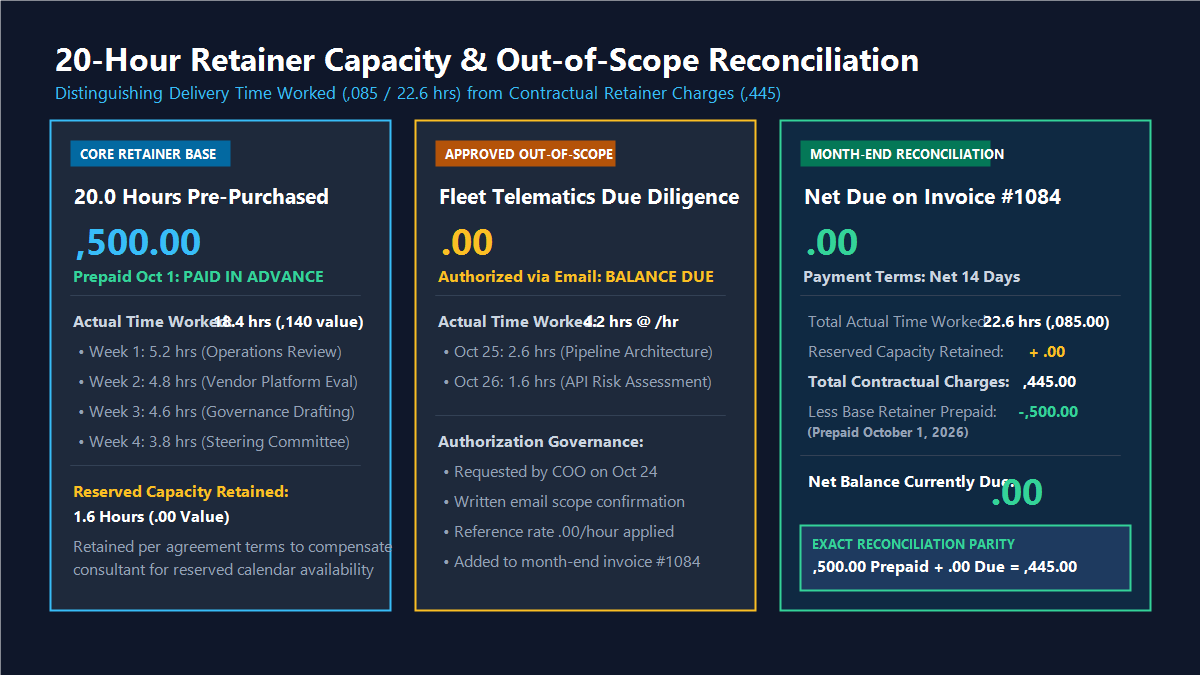
To illustrate how contractual increments, core delivery capacity, unutilized reserved availability, and out-of-scope work reconcile in practice, examine this realistic hypothetical scenario.
Engagement Context
- Client: Meridian Logistics Group (Hypothetical enterprise client).
- Consultant: Strategic Operations Advisory LLC (Hypothetical solo management consultant).
- Agreed Reference Rate: $225.00 per hour.
- Base Retainer Fee: $4,500.00 prepaid on the first calendar day of the month, reserving up to 20.0 hours of strategic operational advisory.
- Billing Increment: 0.10-hour (6-minute) contractual upward rounding.
- Contract Terms on Unused Hours: Unused hours within the 20.0-hour base do not roll over or convert to cash refunds; the fee compensates the consultant for reserving dedicated calendar availability.
- Contract Terms on Out-of-Scope Work: Additional specialized projects require written email authorization and are billed at the standard $225.00/hour reference rate on the month-end statement.
Part a: Core Retainer Activity Log (20.0 Hours Pre-Purchased)
Part A: Core Retainer Timesheet Log (20.0 Hours Pre-Purchased)
Itemized timesheet log showing 18.4 hours worked across 4 weeks with 1.6 hours reserved capacity ($4,500 prepaid base fee).
========================================================================================
STRATEGIC OPERATIONS ADVISORY LLC | MONTHLY TIMESHEET LOG
Client: Meridian Logistics Group | Engagement: Monthly Operations Retainer
Month: October 2026 | Reference Rate: $225.00/hr | Allotted Base: 20.0 hrs
========================================================================================
DATE        HOURS   ACTIVITY TYPE          AUDIT-PROOF TASK DESCRIPTION
----------------------------------------------------------------------------------------
02 Oct 2026 1.4 hrs Strategic Advisory     Discovery session with COO on dispatch bottlenecks
04 Oct 2026 2.3 hrs Research & Analysis    Policy critique of regional dispatch handbook
06 Oct 2026 1.5 hrs Deliverable Drafting   Formulated memorandum on driver scheduling failure modes
[Week 1 Subtotal: 5.2 hrs]

09 Oct 2026 2.8 hrs Research & Analysis    Evaluated two automated dispatch routing platforms
11 Oct 2026 1.2 hrs Strategic Advisory     Mid-month operational alignment call with fleet leads
13 Oct 2026 0.8 hrs Technical Review       Reviewed client correspondence regarding route rules
[Week 2 Subtotal: 4.8 hrs]

16 Oct 2026 1.9 hrs Strategic Advisory     Working session on revised terminal communication protocols
19 Oct 2026 2.7 hrs Deliverable Drafting   Drafted cross-terminal freight coordination governance
[Week 3 Subtotal: 4.6 hrs]

23 Oct 2026 2.2 hrs Deliverable Drafting   Built executive steering committee slide deck
27 Oct 2026 1.6 hrs Strategic Advisory     Presented findings to monthly steering committee
[Week 4 Subtotal: 3.8 hrs]
----------------------------------------------------------------------------------------
CORE SCOPE HOURS ACTUALLY WORKED:           18.4 hrs ($4,140.00 delivery equivalent)
PREPAID BASE RETAINER CAPACITY:            20.0 hrs ($4,500.00 prepaid base fee)
UNUTILIZED RESERVED CAPACITY:               1.6 hrs ($360.00 retained for availability)
CORE RETAINER BASE CONTRACT CHARGE:        $4,500.00 (Prepaid Oct 1: PAID IN ADVANCE)
========================================================================================
Part B: Separately Approved Out-Of-Scope Advisory Sprint
On October 24, Meridian’s COO requested an emergency technical due diligence review on a target fleet acquisition telematics system. The COO authorized 4.2 hours of specialized technical review via email at the agreed $225.00/hour rate:
Part B: Separately Approved Out-of-Scope Advisory Sprint
Itemized due diligence log showing 4.2 hours worked, authorized via COO email at $225.00/hr reference rate ($945.00 due).
========================================================================================
OUT-OF-SCOPE SPRINT: TARGET FLEET TELEMATICS DUE DILIGENCE (APPROVED VIA EMAIL OCT 24)
========================================================================================
DATE        HOURS   ACTIVITY TYPE          AUDIT-PROOF TASK DESCRIPTION
----------------------------------------------------------------------------------------
25 Oct 2026 2.6 hrs Technical Due Diligence Architectural review of target telematics data pipeline
26 Oct 2026 1.6 hrs Technical Due Diligence Risk assessment memo on proprietary API compatibility
----------------------------------------------------------------------------------------
OUT-OF-SCOPE HOURS ACTUALLY WORKED:         4.2 hrs @ $225.00/hr = $945.00 DUE
========================================================================================
Part C: Month-End Engagement Financial Reconciliation
Part C: Month-End Engagement Reconciliation Statement
Comprehensive three-way mathematical parity statement showing $4,500 base prepaid + $945 out-of-scope due = $5,445 total contractual charges.
========================================================================================
MONTH-END RECONCILIATION STATEMENT | INVOICE #1084
========================================================================================
1. Base Monthly Retainer Fee (Prepaid Oct 1, 2026):               $4,500.00 (PAID)
   - Core Retainer Hours Actually Worked: 18.4 hrs ($4,140.00 delivery value)
   - Unutilized Reserved Capacity Retained: 1.6 hrs ($360.00 availability fee)
   - Total Core Retainer Charge: $4,500.00 (Paid in advance on Oct 1)

2. Additional Approved Out-of-Scope Advisory Services:              $945.00 (DUE)
   - Telematics Due Diligence Sprint: 4.2 hours worked @ $225.00/hr

3. Total Actual Delivery Time Worked:                              22.6 hrs
   - 18.4 core hours + 4.2 sprint hours = $5,085.00 actual delivery equivalent

4. Total Contractual Charges for Month (Charges Rendered):        $5,445.00
   - $5,085.00 delivery equivalent + $360.00 reserved capacity retained = $5,445.00
   - Equivalently: $4,500.00 prepaid base + $945.00 out-of-scope balance = $5,445.00

5. Less Base Retainer Previously Paid:                           -$4,500.00
----------------------------------------------------------------------------------------
NET AMOUNT CURRENTLY DUE ON INVOICE #1084:                          $945.00
========================================================================================
Three-Way Reconciliation and Mathematical Parity
- Hours Actually Worked: 18.4 core retainer hours + 4.2 out-of-scope sprint hours = 22.6 total hours worked, representing $5,085.00 of actual delivery time at the $225.00/hr rate.
- Reserved Capacity Charge: 1.6 unutilized retainer hours = $360.00, retained per agreement terms to compensate for reserved calendar availability.
- Total Contractual Charges: $4,500.00 base retainer + $945.00 out-of-scope sprint = $5,445.00 total contractual billing value.
- Net Invoice Due: $5,445.00 total contractual charges less $4,500.00 prepaid base = $945.00 balance due.
- Arithmetic parity is 100% reconciled down to the cent with zero discrepancy.
When presenting month-end reconciliations or invoicing additional out-of-scope advisory sprints, establish clear payment expectations early. Outlining explicit payment terms on invoice statements (such as Net 15 or Net 30 with defined invoice dispute windows) ensures supplemental consulting hours are remitted promptly without delaying core retainer renewals.
Writing Dispute-Proof Activity Descriptions
The single most common cause of client invoice friction is the vague time entry. When a corporate controller or project sponsor sees a line item reading “Client prep: 3.5 hrs”, their natural reaction is skepticism.
Audit-proof task descriptions follow a simple three-part formula:
- Action Verb: State the exact professional task performed (Conducted, Analyzed, Formulated, Drafted, Reviewed).
- Subject and Scope Context: Identify the document, stakeholder, or system evaluated (dispatch handbook, regional fleet leads, telematics data pipeline).
- Outcome or Work Product: State the tangible deliverable or business objective (reconciled failure modes memo, steering committee slide deck).
Good Versus Bad Timesheet Log Entries
| Activity and Duration | Weak / Vague Entry | Audit-Proof Consulting Description |
|---|---|---|
| Strategy Call (1.4 hrs) | Call with client | Discovery session with COO regarding regional dispatch workflow bottlenecks and driver turnover drivers. |
| Document Review (2.3 hrs) | Reviewing documents | Operational policy review of regional dispatch handbook and shift handoff procedures to identify compliance gaps. |
| Vendor Evaluation (2.8 hrs) | Software research | Technical evaluation of two automated routing platforms; evaluated API integration limits and dispatch cost structures. |
| Deliverable Draft (2.7 hrs) | Working on report | Drafted governance framework for cross-terminal freight coordination; detailed escalation procedures for dispatch delays. |
| Client Presentation (1.6 hrs) | Meeting | Presented operational efficiency findings to monthly executive steering committee; facilitated leadership Q&A on route rules. |
By providing specific, professional descriptions, you demonstrate immediate value and preempt billing inquiries before invoices are sent.
The Daily Logging Routine Versus the "Friday Reconstruction Trap"
Independent consultants often procrastinate on time tracking, intending to fill out their records at the end of the week. This habit, known as the “Friday Reconstruction Trap”, is financially devastating.
When reconstructing hours on Friday afternoon:
- Consultants systematically underestimate time spent on short advisory phone calls, asynchronous messaging, and unscheduled critiques, forfeiting legitimate billable advisory time.
- Task descriptions become generic (“project work”, “follow-up”) because specific details have been forgotten.
- Consultants feel anxious and defensive about their numbers, fearing that clients will challenge inaccurate estimates.
The 2-Minute Daily Cutoff Routine
Replace weekly reconstruction with a frictionless end-of-day routine:
- Anchor to Calendar Events: At the end of each working day, open your calendar and match scheduled client sessions against your time tracker.
- Review Communication Channels: Check sent emails and Slack messages to capture quick 0.1-hour or 0.2-hour advisory interactions.
- Commit and Close: Log the specific 3-part activity descriptions and lock the day’s entries. The entire process takes less than two minutes when performed daily.
Managing Revisions, Scope Overruns, and Client Approvals
When an engagement approaches its allotted budget or retainer capacity, proactive communication separates experienced advisors from struggling freelancers.
1. the 75% Capacity Threshold Warning
Never allow a client to discover an overrun on an invoice. When a project or monthly retainer reaches 75% of allocated hours (for example, 15 hours on a 20-hour retainer), send a brief status update:
Good morning [Client Name], we have completed 15.0 hours of our 20.0-hour monthly advisory allocation, with primary focus on the dispatch policy overhaul. We have 5.0 hours remaining in our core retainer for the month. Scheduled steering committee preparation will consume approximately 3.8 hours, leaving 1.2 hours of available capacity. Please let me know if you would like to prioritize any specific items for the remaining time.
2. Formalizing Out-Of-Scope Approvals
When a client requests work that exceeds the agreed scope or available capacity:
- Immediately pause and identify the request as an out-of-scope addition.
- Estimate the required hours and total fee based on your agreed reference rate.
- Obtain explicit written authorization (an email confirmation is legally sufficient) before executing the work.
Frequently Asked Questions
Should I track hours if I bill fixed fees or value-based pricing?
Yes. Tracking internal hours on fixed-fee and value-based projects is essential to evaluate project profitability. Without tracking your actual hours, you cannot determine your Effective Hourly Rate (EHR) or identify whether scope creep is eroding your profit margins.
How do I handle travel time for on-site consulting?
Travel billing policies must be established in your written contract. Common industry standards include billing travel time at 50% of your standard hourly rate or billing portal-to-portal travel expenses with standard per diem reimbursements. Always log travel hours as a distinct Tier 3 activity type.
What should I do if a client disputes a timesheet entry?
If a client questions a time entry, provide your detailed daily activity notes and cross-reference calendar invites, sent deliverables, or email exchanges. Demonstrating a disciplined daily logging routine and 3-part task descriptions resolves the vast majority of client inquiries professionally.
Ungated Copy-Ready Consultant Timesheet Template
Use this structured plain-text template directly in your practice. Copy the template into your spreadsheet, project management software, or billing documentation, and replace the bracketed placeholders with your engagement details.
Ungated Plain-Text Consultant Timesheet Template
Standardized plain-text timesheet container formatted with 3-tier activity logging, out-of-scope tracking, and month-end reconciliation.
========================================================================================
[YOUR BUSINESS NAME] | CONSULTING TIMESHEET RECORD
========================================================================================
Consultant: [YOUR NAME], [YOUR TITLE]
Email: [YOUR EMAIL] | Phone: [YOUR PHONE]
Client Business: [CLIENT BUSINESS NAME]
Billing Contact: [CLIENT CONTACT NAME], [CLIENT TITLE]
Engagement Title: [PROJECT / ENGAGEMENT TITLE]
Governing Agreement: [MSA / SOW TITLE] dated [DATE]
Billing Period: [START DATE] to [END DATE]
Agreed Hourly Rate: $[HOURLY RATE] / hour
Billing Increment Standard: [0.10 hr (6 min) upward rounding / 0.25 hr (15 min) nearest]
========================================================================================
DATE        HOURS   TIER 3 ACTIVITY TYPE        AUDIT-PROOF TASK DESCRIPTION
----------------------------------------------------------------------------------------
[DATE]      [HRS]   [Strategic Advisory]        [Action verb + Subject context + Output]
[DATE]      [HRS]   [Research & Analysis]       [Action verb + Subject context + Output]
[DATE]      [HRS]   [Deliverable Formulation]   [Action verb + Subject context + Output]
[DATE]      [HRS]   [Technical Review]          [Action verb + Subject context + Output]
----------------------------------------------------------------------------------------
CORE SCOPE HOURS WORKED:                        [CORE HOURS WORKED] hrs
PREPAID RETAINER CAPACITY:                      [BASE CAPACITY] hrs
UNUTILIZED RESERVED CAPACITY:                   [UNUTILIZED HRS] hrs
BASE RETAINER FEE CHARGED:                      $[BASE RETAINER FEE]

ADDITIONAL APPROVED OUT-OF-SCOPE SPRINT (IF APPLICABLE):
----------------------------------------------------------------------------------------
[DATE]      [HRS]   [Approved Scope Add]        [Authorized task + Client email approval ref]
----------------------------------------------------------------------------------------
TOTAL OUT-OF-SCOPE HOURS WORKED:                [TOTAL SPRINT HOURS] hrs
OUT-OF-SCOPE AMOUNT DUE:                        $[SPRINT AMOUNT DUE]

ENGAGEMENT RECONCILIATION SUMMARY:
----------------------------------------------------------------------------------------
1. Base Retainer Fee (Prepaid):                $[BASE PREPAID AMOUNT]
2. Total Additional Scope Balance Due:         $[ADDITIONAL AMOUNT DUE]
3. Total Contractual Charges for Period:       $[TOTAL CONTRACTUAL CHARGES]
4. Less Base Retainer Previously Paid:        -$[BASE PREPAID AMOUNT]
----------------------------------------------------------------------------------------
NET AMOUNT CURRENTLY DUE ON INVOICE:            $[NET CURRENT DUE]
========================================================================================
CLIENT ACKNOWLEDGMENT & APPROVAL
Approved By: ___________________________   Title: ___________________________
Signature:   ___________________________   Date:  ___________________________
========================================================================================
Free Consultant Timesheet Downloads
Choose a blank timesheet template or a reconciled worked example. Available as editable Word documents and print-ready PDFs. No signup required.
Blank Consultant Timesheet
Clean, customizable consulting timesheet with 3-tier activity logging, out-of-scope sprint tracking, and month-end reconciliation ledger.
Worked Example Timesheet
Completed $5,445 monthly advisory record with 20.0h base retainer ($4,500 paid), 18.4h worked, 1.6h reserved capacity, and 4.2h out-of-scope sprint ($945 due).