

Table of Contents
A scope of work template (SOW) serves as the binding operational engine of a commercial service contract when executed as a standalone agreement or incorporated into a Master Services Agreement (MSA). While an exploratory sales proposal pitches conceptual value and high-level strategy to secure client buy-in, the Scope of Work establishes the definitive technical specifications, sequential milestone schedules, objective acceptance criteria, and bilateral change control protocols that govern project execution. Under Section 33 of the Restatement (Second) of Contracts, contractual terms are legally enforceable when reasonably certain under applicable state law. A disciplined Scope of Work supplies that certainty, ensuring both parties share an identical understanding of what deliverables are included, what tasks are explicitly excluded, and precisely when milestone payments are earned.
Without an explicit scope boundary, fixed-fee and milestone projects frequently suffer from scope creep, where small client requests accumulate into substantial unpaid labor. Professional contractors protect their profit margins by pairing a formal SOW structure with rigorous time records. To monitor how budgeted capacity aligns with active development, consult our complete guide to billable time tracking.
The 7 Core Sections of a Scope of Work Template
To eliminate ambiguity, every commercial scope of work template must follow a logical, modular hierarchy. Each section serves a distinct governance role that bridges client business objectives with day-to-day engineering deliverables.
1. Project Overview and Background Context: The opening section establishes commercial context and mutual intent. It summarizes the client’s current operational baseline, identifies the core business friction being resolved, and defines measurable project outcomes. Grounding technical work in explicit business objectives provides essential context under Restatement Section 204 if an omitted term requires judicial interpretation.
2. Scope Boundaries and Work Breakdown Structure (WBS): Granular decomposition of project phases into specific tasks. Defensible scopes pair included tasks with an explicit list of non-deliverables (such as legacy data migration, manual content entry, or third-party API subscription costs) to clarify what falls outside the agreed base fee.
3. Specific Deliverables and Technical Formats: Concrete inventory of physical or digital assets transferred to the client upon milestone completion. Specifications must detail exact file formats, hosting staging environments, code repositories, and documentation standards rather than vague conceptual descriptions.
4. Objective Acceptance Criteria and Review Windows: Testable standards defining deliverable completeness. Establishing clear verification protocols prevents clients from withholding milestone sign-offs based on subjective aesthetic preferences.
5. Project Timeline and Sequential Milestones: Realistic calendar mapping indicating start dates, delivery checkpoints, and client review windows. Milestones must be linked to verified deliverable handoffs rather than arbitrary calendar intervals.
6. Pricing, Payment Triggers, and Invoicing Terms: Commercial remuneration terms defining deposit amounts, progress draws, final balances, and invoicing mechanics. Explicit billing triggers ensure contractors are compensated predictably as each phase completes. For ongoing advisory services billed on a recurring basis, see our consulting retainer agreement template for a worked example of monthly fees, hour drawdowns, and overage controls.
7. Change Control and Scope Governance Protocol: Establish a bilateral change control mechanism governing all out-of-scope requests. Under contract modification principles reflected in Section 89 of the Restatement (Second) of Contracts, a promise modifying a duty under an executory contract is binding if fair and equitable in view of unanticipated circumstances, without requiring new consideration; Section 279 governs novation where a new contract replaces prior obligations. In commercial practice, managing changes through a structured, written Change Order clarifies revised pricing and timelines, preventing disputes over oral modifications.
| SOW Section | Core Operational Purpose | Common Failure Mode Avoided | Governing Legal Framework |
|---|---|---|---|
| 1. Project Overview | Defines baseline problem, business goals, and measurable success metrics | Misaligned business expectations and shifting stakeholder goals | Grounds interpretation under Restatement § 204 |
| 2. Scope Boundaries | Establishes included deliverables alongside explicit negative boundaries | Uncontrolled scope creep from unstated client assumptions | Provides certainty of terms under Restatement § 33 |
| 3. Specific Deliverables | Catalogs technical file types, source code assets, and staging environments | Ambiguity over source file ownership and hosting infrastructure | U.C.C. Article 2 deliverable specifications |
| 4. Acceptance Criteria | Sets objective, testable verification standards and review windows | Subjective client rejection and delayed milestone draw approvals | Objective commercial reasonableness standards |
| 5. Project Timeline | Maps sequential phases, client review windows, and delivery dates | Client feedback delays stalling contractor calendar availability | Conditional dependency scheduling rules |
| 6. Pricing & Billing | Specifies deposit amounts, progress billing triggers, and net terms | Unfunded development work and delayed final milestone releases | Milestone payment conditioning principles |
| 7. Change Control | Establishes mandatory 5-step process for evaluating out-of-scope work | Informal verbal scope expansion without compensation adjustments | Restatement § 89 & § 279 modification frameworks |

Using a Scope of Work Template to Define Acceptance Criteria
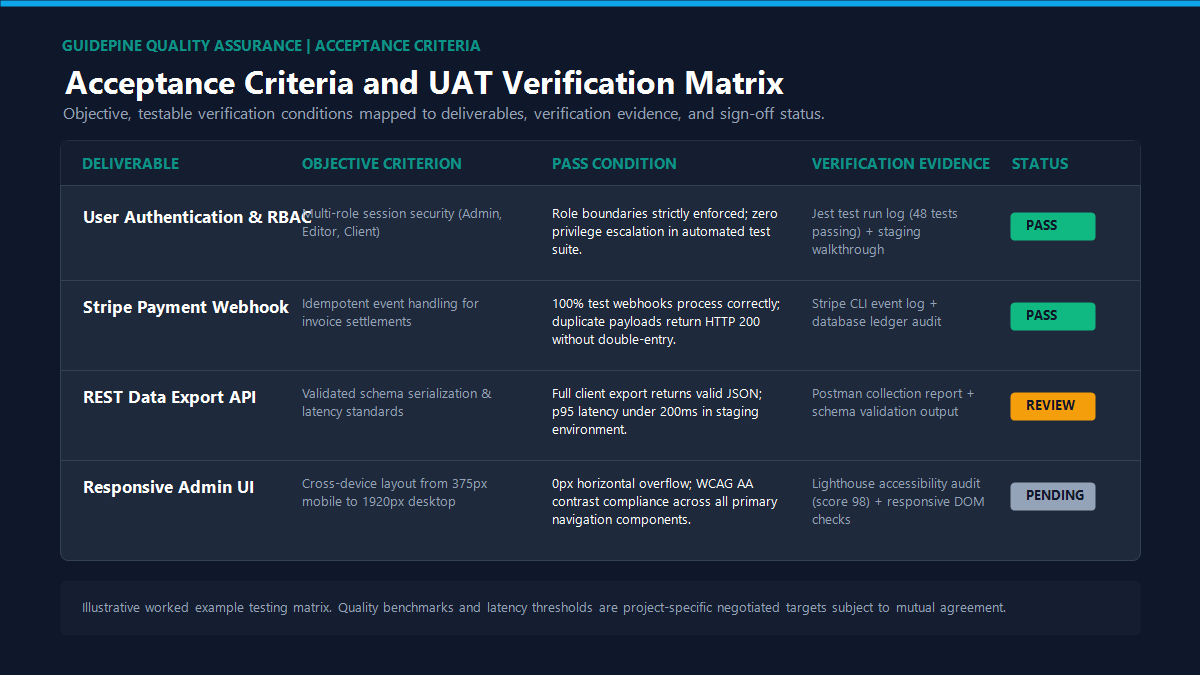
The single greatest operational hazard in fixed-price service contracts is allowing client acceptance to remain subjective. When a contract states that deliverables must meet “client satisfaction,” you grant the client an open-ended option to withhold milestone draws based on personal aesthetic preferences or shifting internal committees.
To establish defensible boundaries, replace subjective language with verifiable technical tests agreed upon by both parties. For software and web development builds, illustrative targets might include automated test coverage on critical business endpoints, defined server response latency thresholds (such as sub-200ms in staging), responsive layout rendering across specified mobile viewports, and documented UAT script sign-offs. These metrics should be tailored to the project requirements rather than treated as universal industry standards. To align contractual acceptance milestones with daily internal project execution, review our project management plan framework.
Every Scope of Work must also incorporate an express deemed acceptance clause. Specify that upon notification of deliverable deployment to the staging environment, the client has a defined review window (typically 10 business days, or 14 calendar days if negotiated as a single calendar standard) to inspect the deliverable and submit a consolidated, written list of non-conforming defects. If no written notice of defects is delivered within that agreed window, the deliverable is treated as accepted under the contract terms subject to applicable state law, and the corresponding milestone payment becomes due in full. Establishing an unambiguous timeline prevents open-ended delays while preserving fair inspection rights.
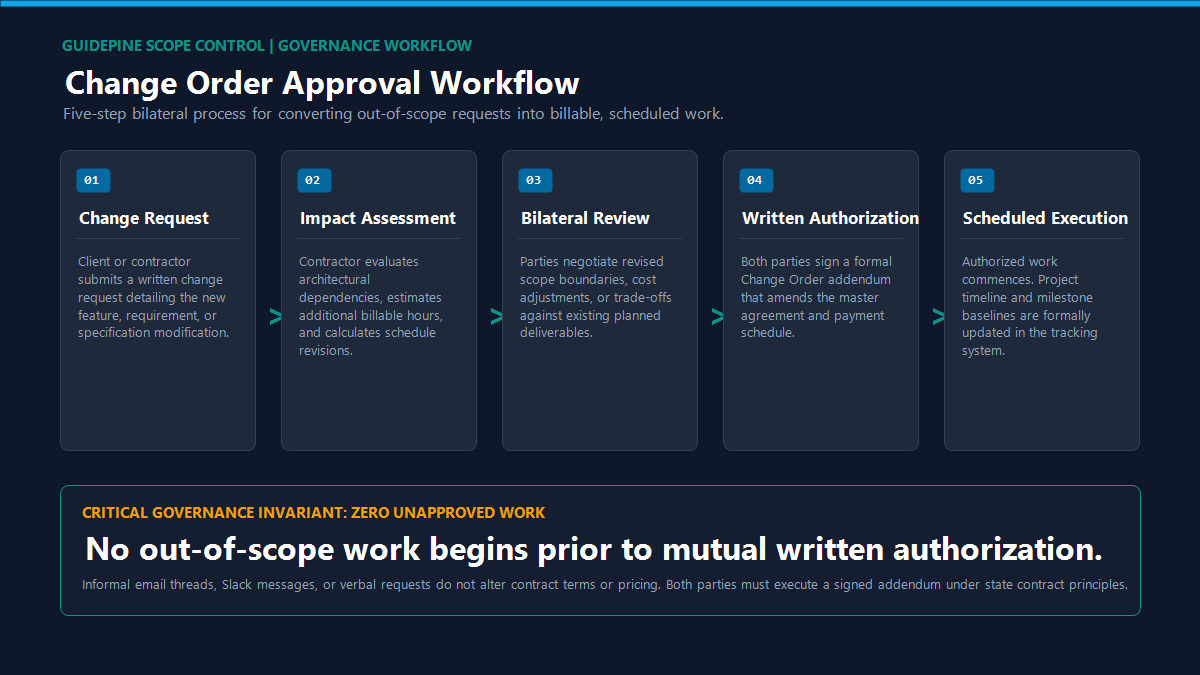
Change Control Architecture: Converting Scope Creep into Paid Work
Under Section 89 of the Restatement (Second) of Contracts, modifying contractual duties in an executory contract is binding when fair and equitable in view of unanticipated circumstances. When an out-of-scope request arises, follow a disciplined 5-step change control protocol: (1) identify that the request falls outside baseline SOW exclusions, (2) prepare a formal written Change Order estimating billable hours, fee impact, and timeline adjustments, (3) conduct bilateral review with the client, (4) execute signed counter-authorizations, and (5) invoice the change order before implementation begins. For detailed financial management strategies when project costs drift, see our guide on preventing project budget overruns.
Worked Example: $14,500 Scope of Work Template in Practice
To examine how these principles operate in commercial practice, consider a realistic hypothetical case study: Apex Digital Engineering replatforming an internal dispatch portal for Meridian Logistics Solutions Inc. The total fixed-fee investment is $14,500.00, structured across 4 sequential milestones that balance cash flow and delivery risk.
Milestone 1 is a 30% deposit ($4,350.00) due upon contract execution prior to development kickoff, funding the architectural blueprint and database schema design phase. The subsequent schema sign-off marks completion of Phase 1 and triggers authorization to proceed to Phase 2 development. Milestone 2 is a 30% draw ($4,350.00) due upon deployment of the core REST API and PostgreSQL staging database passing automated unit tests. Milestone 3 is a 25% draw ($3,625.00) due upon frontend portal integration and user acceptance testing sign-off. Milestone 4 is a 15% final draw ($2,175.00) due upon production deployment and successful completion of the agreed review window. Notice the exact mathematical reconciliation: $4,350.00 + $4,350.00 + $3,625.00 + $2,175.00 equals $14,500.00 (100.0%).
| Milestone Phase | Deliverable Description | Allocation | Payment Amount | Payment Trigger & Acceptance Standard |
|---|---|---|---|---|
| Milestone 1 | Architecture Blueprint & PostgreSQL Schema | 30.0% | $4,350.00 | Deposit due upon contract execution prior to kickoff; schema sign-off completes Phase 1 |
| Milestone 2 | Core REST API & Staging DB Deployment | 30.0% | $4,350.00 | Due upon deployment of staging API passing automated unit test suite |
| Milestone 3 | Frontend Portal Integration & UAT Testing | 25.0% | $3,625.00 | Due upon user acceptance testing completion against documented test scripts |
| Milestone 4 | Production Cutover & Acceptance Window Support | 15.0% | $2,175.00 | Due upon production deployment and completion of the agreed 10-business-day review window |
| Total SOW | Full-Stack Web Application Replatforming | 100.0% | $14,500.00 | Exact Parity: $4,350 + $4,350 + $3,625 + $2,175 = $14,500.00 |

Legal Protections: Scope of Work Template Risk Governance
Under U.S. copyright law (17 U.S.C. Section 204(a)), an assignment of copyright ownership requires an instrument in writing signed by the owner of the rights conveyed. While Section 204(a) statutorily mandates the signed writing, conditioning copyright transfer upon cleared receipt of full payment is an essential, negotiated contractual term that independent contractors must establish in their SOW. Prior to final invoice settlement, the client holds only a temporary, revocable non-exclusive license to inspect the staging deployment. To review how invoice due dates, Net 14 terms, and late fees interact with milestone draws, explore our guide on payment terms on an invoice.
Project cancellations require equally balanced protections. Under Section 356 of the Restatement (Second) of Contracts, liquidated damages clauses are enforceable only if they satisfy a common law reasonableness test: the agreed figure must be reasonable in light of anticipated or actual loss caused by cancellation, and the loss must be difficult to prove. Rigid clauses that demand 100% of unearned fees upon early termination are disfavored as unenforceable penalties. Instead, align cancellation terms with concrete project progression: retain the initial deposit for calendar reservation, invoice for completed milestone drafts, reimburse documented nonrecoverable server commitments, and apply an illustrative capacity reservation charge equal to 25% of the remaining unbilled contract balance, ensuring it does not duplicate recovery for work already billed or commitments reimbursed. Liquidated damages remain subject to judicial review under governing state law.
Download Your Free Scope of Work Template Suite
Download ready-to-use Scope of Work templates in customizable Word (.docx) and print-ready PDF formats. Each file includes complete deliverable containers, objective acceptance testing rules, 17 U.S.C. Section 204(a) copyright clauses, and bilateral change order terms.
Free Scope of Work Documents
Download free, fully formatted Scope of Work templates in Word and PDF formats.
Scope of Work Template (DOCX)
Customizable Word document with 7-section structure and generic placeholders.
Scope of Work Template (PDF)
Clean, printable SOW template formatted for immediate client onboarding.
$14,500 Web App SOW (DOCX)
Fully populated Word example featuring the 4-milestone engineering schedule.
$14,500 Web App SOW (PDF)
Complete reference agreement of the $14,500.00 web application project.
Copyable Scope of Work Text Template
Frequently Asked Questions
What is the primary difference between a project proposal and a scope of work?
A project proposal is an exploratory sales instrument used to demonstrate capability, recommend solutions, and secure conceptual alignment. In contrast, a Statement of Work is an operational governance document that details exact technical specifications, milestone payment triggers, acceptance benchmarks, and change control procedures under state contract law.
Is a scope of work legally binding as a standalone document?
An SOW is legally enforceable when it satisfies standard contract formation principles: mutual assent, consideration, and reasonably certain terms under Restatement Section 33. In commercial practice, an SOW is typically executed as an exhibit governed by an overarching Master Services Agreement (MSA) that establishes standard warranties, indemnification, and dispute resolution rules.
How should contractors handle client requests that fall outside the agreed scope?
Do not perform unbilled work or rely on informal verbal agreements. Follow the SOW change control procedure: notify the client in writing that the task falls outside Section 3 exclusions, issue a formal Change Order detailing additional billable hours and calendar impact, execute bilateral signatures, and invoice the change before beginning work. Keep related delivery risks, unresolved issues, and external dependencies visible in a shared register with our project management RAID log guide and free Excel template.
Can a client withhold milestone payment if deliverables meet specifications?
When milestone acceptance is tied to verifiable benchmarks (such as automated test passes or staging deployment checklists), the client’s payment obligation is triggered upon meeting agreed criteria. While clients cannot arbitrarily withhold payment for conforming work, withholding may occur in cases of bona fide disputes, offset rights, or material breach as provided under the agreement and governing state law. Contractual provisions should outline dispute escrow or cure periods rather than asserting unconditional prohibitions. Subjective dissatisfaction with aesthetic elements outside the agreed specifications constitutes an out-of-scope request governed by change control.