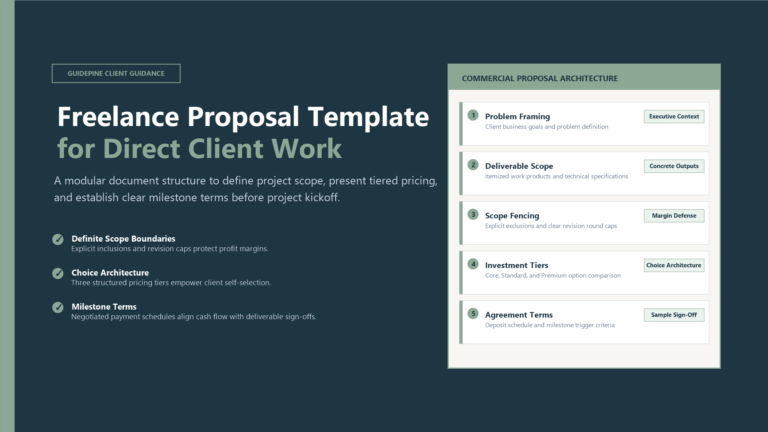

A freelance writing proposal template provides an objective commercial framework that outlines editorial project objectives, defines deliverable specifications, establishes research parameters, and sets milestone payment terms before writing begins. In independent editorial and copywriting practices, casual email agreements often leave project scope, revision expectations, and copyright ownership ambiguous. Without a formal freelance writing proposal template, professional writers frequently face scope creep, uncompensated structural rewrites caused by shifting client briefs, and delayed invoice settlements.
A disciplined freelance writing proposal template creates mutual assent on editorial boundaries while protecting professional creative capacity. It ensures that both the independent writer and the corporate client share an identical understanding of what articles are being produced, how feedback is collected, and when ownership of draft text transfers. When using an unbracketed freelance writing proposal template, writers transform subjective pitches into defensible commercial contracts.
This comprehensive guide provides an operational walkthrough for customizing a freelance writing proposal template. It covers the seven essential sections every proposal must include, provides actionable rules for bounding editorial revisions, explains statutory copyright assignment standards under 17 U.S.C. Section 204(a) alongside contractual payment conditions, and presents a complete, mathematically reconciled $3,600.00 B2B thought leadership worked example alongside an ungated, copy-ready template and verified downloads.
Table of Contents
- The 7 Core Sections of a Freelance Writing Proposal
- Bounding Editorial Revisions: Line Edits vs Structural Rewrites
- Worked Example: $3,600 Freelance Writing Proposal Template Package
- Legal Protections: Copyright Transfer and Cancellation Kill Fees
- Following Up on Submitted Writing Proposals
- Free Downloadable Freelance Writing Proposal Resources
- Copy-Ready Plain-Text Freelance Writing Proposal Template
- Frequently Asked Questions
The 7 Core Sections of a Freelance Writing Proposal Template
Every commercial writing engagement requires definitive contractual boundaries. While creative requirements vary across corporate blog posts, white papers, case studies, and executive ghostwriting, an effective freelance writing proposal template relies on seven structural pillars:
1. Project Background and Editorial Objectives
The proposal begins with a clear statement of the client’s business challenge and content strategy goals. Rather than summarizing generic marketing platitudes, frame the project around specific commercial objectives. These may include establishing search visibility for high-intent B2B keywords, educating enterprise buyers during complex procurement cycles, or positioning internal executives as industry authorities.
Identifying the target audience persona and distribution channels in the opening section of your freelance writing proposal template ensures that both parties agree on the intended tone, technical complexity, and strategic purpose of the writing.
2. Deliverable Scope and Word Count Boundaries
Vague deliverable descriptions are the primary driver of freelance scope disputes. A professional freelance writing proposal template must state exact deliverable formats and establish strict target word count bands rather than open-ended commitments.
State word counts as defined ranges, such as 1,400 to 1,600 words per article, with an explicit variance tolerance of +/- 10%. Specify whether deliverables include supporting assets such as optimized title tags, meta descriptions, social media promotional snippets, or suggested internal link anchors. Clearly stating these inclusions prevents clients from expecting unbudgeted multi-channel promotional copy after the manuscript is delivered.
3. Research, Source Interviews, and Fact-Checking Parameters
High-quality editorial content requires rigorous research, but unbudgeted research hours quickly erode a writer’s effective hourly rate. The freelance writing proposal template must define the exact research inputs included within the fixed fee.
Specify the number and duration of subject matter expert (SME) interviews included per piece (for example, one 30-minute interview per article). Define client responsibilities for providing source materials, internal data points, and technical documentation. State explicitly that extensive transcript analysis, secondary interviews, or proprietary data synthesis beyond the agreed allocation will be billed as out-of-scope advisory work.
4. Production Milestones and Editorial Review Schedule
Writing projects require structured progression through sequential checkpoints. A complete freelance writing proposal template divides the engagement into four disciplined phases:
- Topic Brief and Detailed Outline: Delivery of working title, target keywords, core thesis, section headings, and proposed source citations for client sign-off.
- First Full Draft Delivery: Delivery of the complete, fact-checked manuscript formatted according to client editorial style guides.
- Consolidated Client Review Window: A defined 10 to 14 calendar day review period during which the client provides synthesized editorial feedback.
- Final Polished Manuscript Delivery: Delivery of the revised, publication-ready draft incorporating agreed adjustments.
Establishing concrete calendar turnaround windows prevents drafts from languishing in client review queues for months while tying up your scheduled production capacity.
5. Revision Boundaries: Line Edits vs Structural Rewrites
Every professional freelance writing proposal template must define the difference between included editorial adjustments and billable project rewrites. Standard agreements include up to two rounds of minor line edits, tone adjustments, and factual clarifications requested within the initial review window.
The proposal must state unequivocally that structural changes resulting from altered client briefs, newly introduced brand guidelines, or shifted target audiences constitute new creative work billed at an agreed hourly rate or separate milestone fee.
6. Pricing, Milestone Invoicing, and Payment Terms
Professional freelance writers bill fixed-fee packages using structured milestone payments. Never begin research or drafting without an upfront deposit. In your freelance writing proposal template, establish a three-part milestone structure that balances cash flow with project momentum: a 50% upfront deposit upon signing, a 25% interim draw upon delivery of complete first drafts, and a 25% final balance upon file approval.
Specify accepted payment methods (such as direct ACH bank transfer), invoice payment terms (Net 7 or Net 14), and illustrative contractual late-payment terms subject to applicable state commercial lending rules.
7. Intellectual Property Transfer, Kill Fees, and Acceptance
Under U.S. copyright law (17 U.S.C. Section 204(a)), an assignment of copyright ownership requires an instrument in writing signed by the owner of the rights conveyed. While Section 204(a) mandates the signed writing, conditioning copyright transfer upon cleared receipt of full payment is an essential, negotiated contractual term that independent writers should establish in their freelance writing proposal template.
Include an explicit cancellation and kill fee provision structured as agreed liquidated damages. Rather than imposing arbitrary penalties, frame cancellation fees around the anticipated loss of reserved calendar capacity. Qualify that all cancellation terms represent reasonable pre-estimates of harm subject to applicable state contract law. Conclude with a clear signature block that manifests mutual assent to the proposal terms.
Bounding Editorial Revisions: Line Edits vs Structural Rewrites
The single greatest operational challenge facing freelance writers is revision creep. When clients purchase written content, non-technical stakeholders often assume that unlimited rewrites are included until internal committee consensus is reached. Establishing explicit boundaries in your freelance writing proposal template protects both your creative integrity and your business profitability.
Included revisions must be confined to polishing and refining the approved direction. Line edits encompass rephrasing individual sentences to align more closely with brand tone, swapping vocabulary terms, correcting factual inaccuracies, or trimming paragraphs to meet target length tolerances. Conversely, a structural rewrite occurs when foundational assumptions change: introducing a new angle after outline sign-off, pivoting target reader personas, or re-architecting article structure due to internal client disagreements.
| Revision Dimension | Included Line Edits (Within Scope) | Structural Rewrites (Billable Out-of-Scope) |
|---|---|---|
| Primary Trigger | Word choice, tone polish, phrasing, factual corrections | Altered client brief, new angle, shifted target audience |
| Outline Alignment | Preserves approved heading structure and thesis | Discards or heavily restructures approved outline |
| Research Impact | Utilizes existing interview and research notes | Requires conducting new interviews or secondary research |
| Allocated Rounds | Up to two consolidated feedback rounds | Quoted separately or billed at out-of-scope hourly rate |
| Turnaround Window | Submitted within 10 to 14 calendar days of draft | Rescheduled based on current calendar availability |
| Financial Impact | Included in fixed project fee ($0.00 additional) | Billed at $125.00/hour or quoted as a separate package |
To establish standardized proposal structures across other freelance service disciplines, review our guide on the freelance proposal template framework. Requiring clients to submit consolidated feedback is equally vital: ensure that feedback is synthesized by a single project lead into a unified, conflict-free review document before revision rounds commence.
Worked Example (Hypothetical): $3,600 B2B Thought Leadership Content Package
To understand how these commercial principles function in practice, consider an illustrative worked example. In this hypothetical scenario, an independent freelance writer uses a standardized freelance writing proposal template to quote an executive thought leadership initiative for an enterprise software client.
In this scenario, Apex Workflow Solutions Inc. (a hypothetical B2B SaaS platform) commissions Beacon Editorial Studio LLC (a hypothetical freelance writing consultancy) to produce a four-part thought leadership article series on enterprise automation. The series targets Chief Information Officers (CIOs) and enterprise IT Directors, establishing technical authority and supporting organic search visibility.
The engagement encompasses four comprehensive, research-backed articles (1,500 words each, target band: 1,400 to 1,600 words) priced at a fixed rate of $900.00 per article ($3,600.00 total package value, representing an effective per-word rate of $0.60 based on the 1,500-word midpoint). Each article includes one 30-minute SME interview, a detailed working outline, first full draft, up to two rounds of consolidated line edits, and metadata summaries.
| Deliverable Phase | Specific Milestone Description | Percentage Allocation | Fee Amount | Payment Trigger |
|---|---|---|---|---|
| Milestone 1 | Project Initiation, Topic Research & Outline Production | 50.0% | $1,800.00 | Due upon signing prior to calendar scheduling |
| Milestone 2 | Delivery of First Complete Drafts for All 4 Articles | 25.0% | $900.00 | Due upon delivery of initial full drafts |
| Milestone 3 | Delivery of Approved Final Files & Asset Handover | 25.0% | $900.00 | Due upon delivery of final approved files or 14 days following final delivery under agreed deemed-acceptance terms |
| Total Package | 4-Part B2B Thought Leadership Content Package | 100.0% | $3,600.00 | Exact Parity: $1,800 + $900 + $900 = $3,600 |
To analyze how detailed time tracking protects target realization rates across research, drafting, and revisions on fixed content packages, explore our analysis of consultant time tracking methodologies. Establishing an out-of-scope capacity rate ($125.00 per hour in this worked example) provides clear commercial protection if client stakeholders request additional revision rounds or extra SME interviews.
Legal Protections: Copyright Transfer and Cancellation Kill Fees
An effective freelance writing proposal template serves as a commercial offer that forms a legally enforceable agreement upon mutual acceptance. Writers must incorporate specific contractual safeguards to protect their intellectual property and economic security.
Copyright Assignment Under 17 U.S.C. Section 204(A)
Under United States copyright law, the author of an original written work holds copyright ownership from the moment of creation. For independent contractors, written copy is not automatically a work made for hire unless statutory categories are satisfied and an explicit written agreement is executed. Under 17 U.S.C. Section 204(a), a transfer of copyright ownership is valid only if an instrument of conveyance, or a note or memorandum of the transfer, is in writing and signed by the owner of the rights conveyed.
Importantly, while 17 U.S.C. Section 204(a) statutorily mandates the signed written instrument, conditioning that transfer upon cleared receipt of full payment is an agreed contractual condition precedent, not a statutory requirement. Independent writers should structure this contractual protection deliberately in their freelance writing proposal template:
- Contractual Condition Precedent: State as an express contractual condition that copyright assignment takes effect only upon receipt of full, cleared payment for all project milestones.
- Protection of Drafts and Discarded Angles: Unused concepts, preliminary outlines, and draft manuscripts that are not settled remain the exclusive intellectual property of the writer.
- Interim Non-Exclusive License: Prior to final payment, the client receives only a temporary, revocable non-exclusive license to inspect drafts for editorial review and feedback.
If a client fails to settle the final invoice, the contractual condition precedent for assignment has not been met, and no statutory transfer of copyright ownership occurs under Section 204(a).
Kill Fees, Liquidated Damages, and the Reasonableness Test
Content initiatives are vulnerable to sudden cancellation when corporate priorities pivot, marketing leaders depart, or quarterly budgets are frozen. Without contractual protection, a writer who reserves two weeks of exclusive production capacity may find their work abruptly halted without compensation. A kill fee represents agreed compensation for reserved capacity and completed deliverables. However, Section 356 of the Restatement (Second) of Contracts does not automatically validate all cancellation fees.
Under common law and applicable state contract rules, liquidated damages provisions are legally enforceable only if they satisfy a two-part reasonableness test: the agreed amount must be reasonable in light of anticipated or actual loss caused by cancellation, and the actual loss (such as unrecoverable reserved calendar time and turned-down client engagements) must be difficult to calculate or prove with precision. If a cancellation charge is disproportionate to anticipated loss, courts will strike it down as an unenforceable penalty designed to deter breach through punishment.
To ensure enforceability under state law, avoid rigid clauses that accelerate 100% of the contract fee regardless of when work is canceled. Instead, align cancellation terms with concrete project progression: retain the initial deposit for calendar reservation, invoice for completed milestone drafts, reimburse documented nonrecoverable research expenses, and apply a reasonable capacity reservation charge (such as 25% of the remaining contract balance). To understand how formal project charters and execution boundaries transition from accepted commercial proposals, see our guide on proposal vs statement of work distinctions.
Following Up on Submitted Writing Proposals
Submitting an editorial proposal is not the final step of the sales process. Prospective clients frequently delay review due to competing internal priorities, organizational bureaucracy, or shifting quarterly timelines. A structured follow-up process embedded in your freelance writing proposal template workflow maintains professional momentum without appearing desperate.
Proposal Validity Windows as Optional Commercial Terms
Every proposal should specify a validity window, commonly set at 14 or 30 calendar days from issuance. Stating a validity timeframe is an optional commercial term established by the writer, rather than a statutory or legally mandated duration. Under Section 41 of the Restatement (Second) of Contracts, an offeree’s power of acceptance terminates upon the lapse of a specified time, or a reasonable time if no time is specified.
Establishing an optional 14-day validity window in your freelance writing proposal template protects your editorial calendar. It ensures that the commercial offer lapses automatically after two weeks, preventing a prospective client from resurfacing months later demanding immediate delivery at outdated rates when your schedule is already committed to other clients.
When a client goes quiet after receiving a proposal, deploy an organized, value-focused follow-up cadence: confirm document receipt on Day 3, share an angle refinement on Day 7, and issue a calendar expiry notification on Day 14. For complete email copy and response protocols for unresponsive prospective clients, consult our detailed walkthrough on how to follow up on a proposal.
Free Downloadable Freelance Writing Proposal Resources
Free Freelance Writing Proposal Downloads
Download ready-to-use editorial proposal templates in Word (.docx) and PDF formats. Each file includes complete deliverable specifications, two included revision rounds, 17 U.S.C. Section 204(a) copyright clauses, and liquidated damages provisions.
Writing Proposal Template (DOCX)
Customizable Word document with standard editorial deliverable containers and legal terms.
Writing Proposal Template (PDF)
Clean, printable standard proposal template ready for quick client onboarding.
$3,600 B2B Writing Proposal (DOCX)
Fully populated Word example featuring the four-article B2B package and milestone schedule.
$3,600 B2B Writing Proposal (PDF)
Complete PDF representation of the $3,600.00 content package for immediate client reference.
Copy-Ready Plain-Text Freelance Writing Proposal Template
Use this unbracketed plain-text freelance writing proposal template for direct email pitching, proposal generation, or digital contract formatting. Replace the generic placeholder text with your specific project parameters:
Freelance Writing Proposal Template
Copyable text template featuring deliverable boundaries, milestone payments, and copyright safeguards.
Frequently Asked Questions
What should be included in a freelance writing proposal template?
An effective freelance writing proposal template must include client business objectives, explicit deliverable specifications with target word count bands, research and interview parameters, milestone production schedules, two included revision rounds, clear investment amounts with milestone payment triggers, and intellectual property terms conditioning copyright assignment on full payment.
How do freelance writers protect themselves from endless revisions?
Freelance writers protect their capacity by explicitly defining the difference between line edits and structural rewrites in their initial freelance writing proposal template. Include up to two rounds of consolidated line edits submitted within a 14-day window. State clearly that structural changes resulting from altered client briefs or shifted angles constitute billable out-of-scope work billed at an hourly rate.
When does copyright transfer to the client for freelance writing?
Under 17 U.S.C. Section 204(a), a transfer of copyright ownership requires an instrument in writing signed by the copyright owner. The timing and conditions of that transfer, however, are governed by contract. In professional freelance practice, writers establish a contractual condition precedent stating that copyright assignment takes effect only upon cleared receipt of full payment. Prior to final settlement, the client holds only a temporary, revocable non-exclusive license to inspect the manuscript for feedback.
What is a standard deposit for a freelance writing project?
A standard deposit in a freelance writing proposal template is 50% of the total project fee, due upon contract signing prior to calendar scheduling and research. For larger multi-month initiatives, a 33% upfront deposit followed by monthly or milestone-based payments is common. Writers should never begin research or drafting without cleared deposit funds.