

Payment terms on an invoice tell your client when payment is due and how to pay. A clear invoice pairs a label such as Net 15 or Net 30 with an exact calendar due date and a usable payment method. This guide explains the common terms, shows how to calculate a deadline, and provides five wording examples you can adapt to your agreement.
The dates, clients, and sample clauses below are illustrative, not actual billing records. This article provides general information, not legal advice.
What Are Payment Terms on an Invoice?
Payment terms set expectations for the payment deadline, methods, and any conditions you and your client agree on. Both Xero’s guide to invoice payment terms and QuickBooks’ explanation of payment terms discuss these basics.
Three details are worth separating:
- Payment term: a label such as Net 30 or due upon receipt.
- Due date: the specific date payment is expected under that term.
- Payment method: the agreed way to pay, with any necessary instructions or payment link.
Do not rely on the term label alone. An invoice that says only “Net 30” can leave the client calculating the date or wondering when the count begins. Writing the exact due date beside the term helps prevent that confusion.
Net 15 vs Net 30 vs Due Upon Receipt
These are three common payment terms for client work. The example dates assume an invoice issued on November 18, 2026, with calendar days counted from the invoice date. They do not override a different starting point agreed with your client.
| Term | What it usually means | Example payment deadline |
|---|---|---|
| Net 15 | Full payment is due 15 calendar days after the invoice date. | December 3, 2026 |
| Net 30 | Full payment is due 30 calendar days after the invoice date. | December 18, 2026 |
| Due upon receipt | Payment is requested as soon as the client receives the invoice. | Payment is due upon receipt, which may differ from the issue date. |
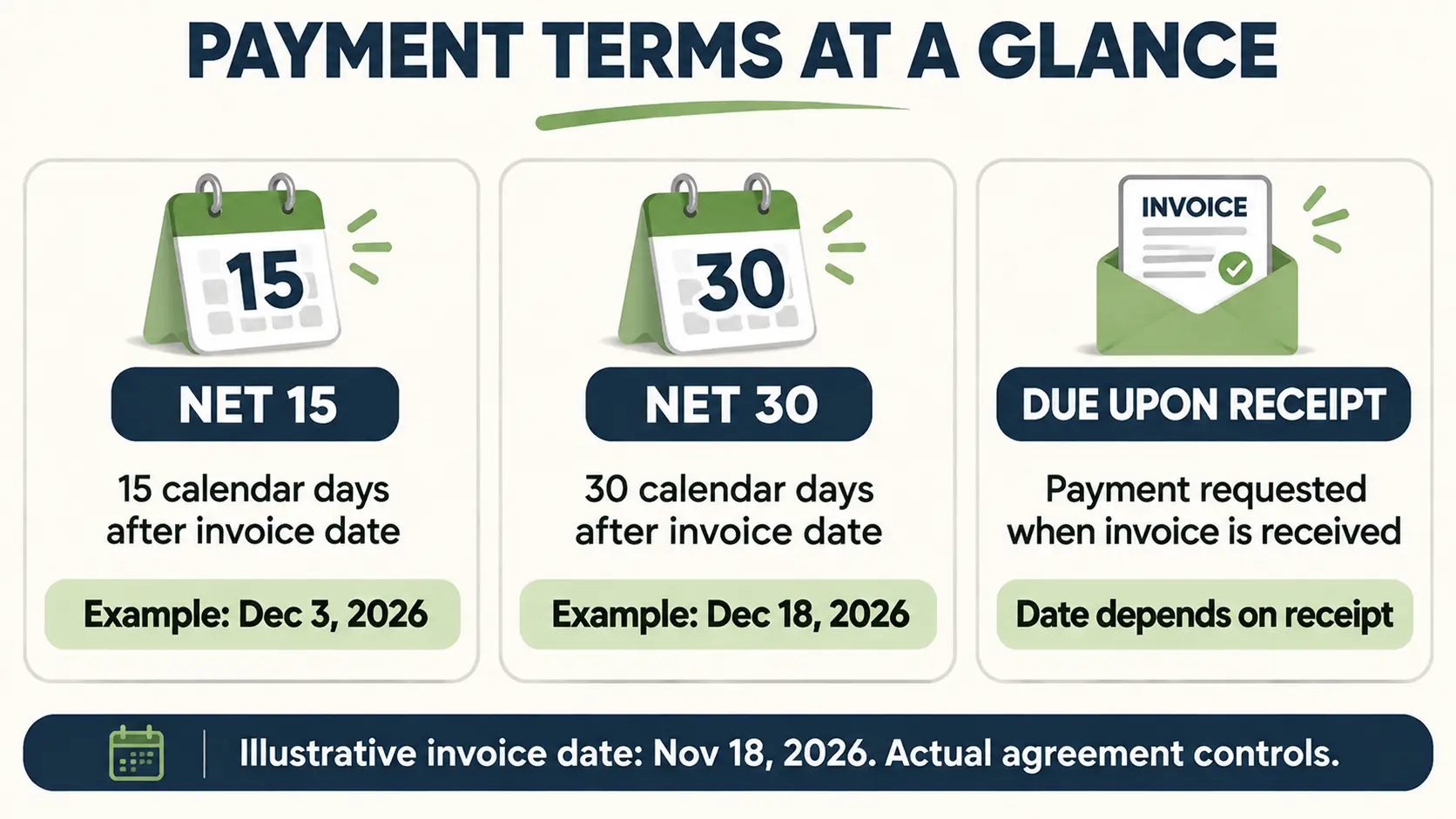
A Net 15 deadline arrives earlier than a Net 30 deadline for an invoice issued on the same date. That does not guarantee the client will pay earlier. A longer payment window may suit a client’s accounts-payable process, but it also means you have agreed to wait longer before payment is due.
“Due upon receipt” asks for prompt payment. It does not guarantee that a card payment, bank transfer, or other payment method will settle in your account on the same day.
How to Calculate the Actual Due Date
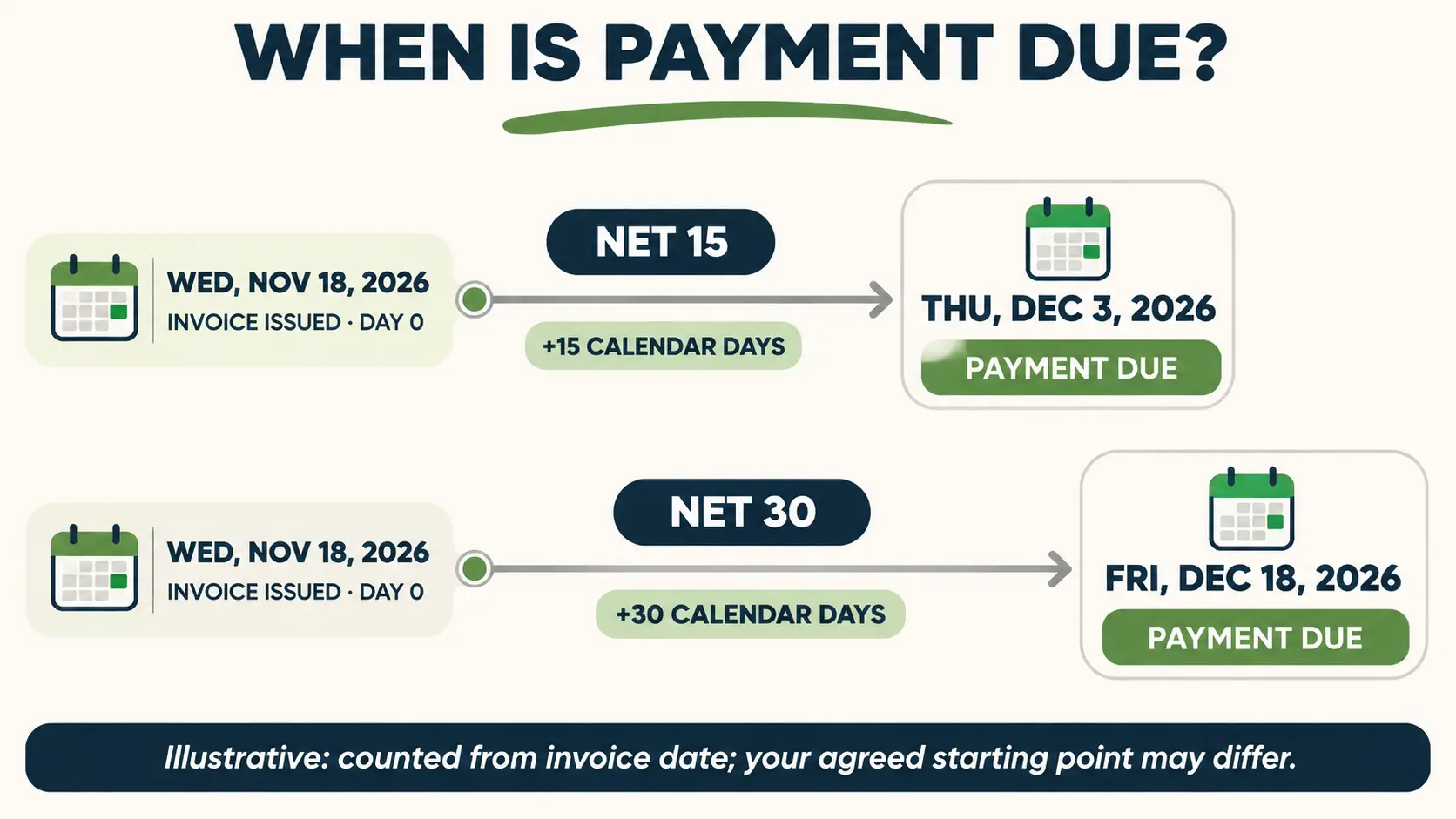
In the usual Net 15 or Net 30 convention, you count calendar days, including weekends, starting after the invoice date. For the following fictional example, the invoice date is day zero, and the next date is day one.
- Invoice issued: Wednesday, November 18, 2026.
- Net 15: November 19–30 accounts for 12 days. Add three more days in December. Due Thursday, December 3, 2026.
- Net 30: The same 12 November days plus 18 December days gives Friday, December 18, 2026.
The calculation changes if your accepted agreement starts the countdown from invoice receipt, completion of an approval step, or another event. It can also change if the agreement specifies business days instead of calendar days. Follow the agreed wording, then put the resulting date on the invoice.
For example, a practical line would be: “Terms: Net 15. Payment due December 3, 2026.” The date is more useful than an abbreviation by itself.
Where to Put Payment Terms on an Invoice
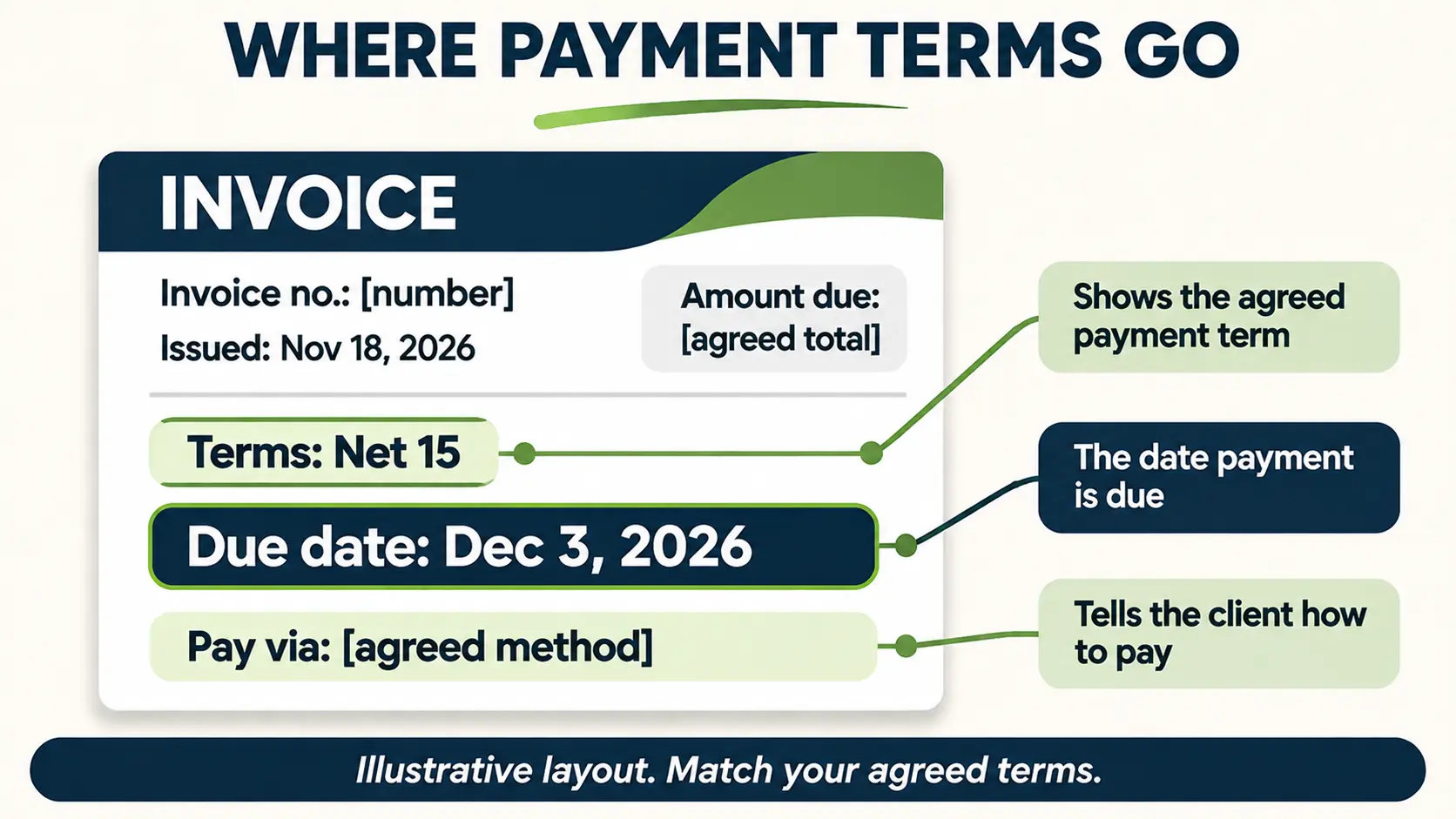
Place the payment deadline where the client can find it without searching, usually near the invoice summary or total. Stripe’s guide to invoicing as a freelancer also recommends clearly stating invoice dates, the due date, and payment information.
Keep these details easy to scan:
- Invoice number and issue date.
- Client name and total amount due.
- Specific payment due date and the term used to calculate it.
- Accepted payment method, payment link, or necessary bank details.
- Any deposit or milestone terms that actually form part of the agreement.
These are practical invoicing recommendations, not a claim that the same fields are legally mandatory for every U.S. transaction.
If you bill for hours worked, our sample invoice for hours worked includes a fully itemized example and a downloadable spreadsheet. You can place the same payment terms alongside that invoice’s total without recreating its time-entry details here.
Five Payment-Term Wording Examples You Can Adapt
These are illustrative clauses, not legal boilerplate. Replace the bracketed details with your actual information, and use only wording that matches the terms your client accepted.

1. Net 15 with a Specific Due Date
“Terms: Net 15. Payment is due by December 3, 2026 (invoice dated November 18, 2026). Please pay by [accepted method] using [payment instructions].”
2. Net 30 with a Specific Due Date
“Terms: Net 30. Payment is due by December 18, 2026 (invoice dated November 18, 2026). Please pay by [accepted method] using [payment instructions].”
3. Due Upon Receipt
“Terms: Due upon receipt. Please submit payment when you receive this invoice using [accepted method] at [payment link or details].”
If you and the client have also agreed on a specific final date, state it plainly. Do not introduce a new deadline as though it was already accepted.
4. Agreed Deposit and Remaining Balance
“As agreed in our accepted proposal dated [date], the deposit of [amount] is due by [date]. The remaining balance of [amount] is due by [specific date]. Payment method: [details].”
Use this format only when the amounts and payment stages match the agreement. If a deposit has already been paid, show it accurately rather than invoicing it again.
5. Milestone Payment Under an Accepted Proposal
“Milestone [number]: [milestone name], under our accepted proposal dated [date]. Amount due: [amount]. Payment due by [specific date]. Payment method: [details].”
Use the same milestone name and acceptance conditions as the proposal so the invoice and project agreement match.
How to Choose Terms for a Freelance or Service Client
Start with the client’s payment process. Some organizations use scheduled accounts-payable runs, while other clients can process an approved invoice directly. Ask about those routines before agreeing to a deadline.
Then consider your cash flow and the project size. A long payment window on a large invoice can leave more money outstanding. Depending on the relationship, you might propose Net 15, Net 30, a deposit, or staged payments. These are options to negotiate, not automatic rights.
Agree on the schedule before work begins, then include it in the signed proposal or contract and repeat it on the invoice. If your client asks to change the schedule, confirm the new terms in writing instead of quietly changing the due date.
Match the Invoice to Your Agreement and Avoid Common Mistakes
Payment-term problems often start when the invoice says something different from what the parties agreed to. Check for these mistakes:
- Changing terms without agreement. If an accepted proposal says Net 30, sending a Net 15 invoice alone does not establish a mutually agreed change.
- Leaving out the calendar date. A shorthand term without an exact deadline makes the client calculate the due date.
- Confusing issue date and receipt date. Do not silently start Net 30 from project completion or invoice receipt when your agreement says otherwise.
- Adding an unexpected fee. Late fees and other charges depend on the actual agreement and applicable law. Do not assume a standard percentage applies across the United States.
- Making payment unnecessarily difficult. Missing or hard-to-find payment instructions can create avoidable questions and delays.
For example, a freelancer may prefer 14 days while a client’s accounts-payable team requests 30. Check the accepted terms first. If the agreement is unclear, discuss the schedule, document the outcome, and use a matching invoice. For an actual dispute over enforceability, seek advice from a qualified professional in the relevant jurisdiction.
If a payment is overdue, you can begin with a short, factual reminder:
“Hi [name], a quick reminder that invoice [number] for [amount] was due on [date]. The invoice includes the payment instructions, or you can use [agreed method]. Please let me know if anything needs clarification.”
A reminder keeps the request clear but cannot guarantee payment.
Quick Invoice Payment-Terms Checklist
Before sending, confirm that:
- The term was agreed with the client before the relevant work began.
- The invoice matches the accepted proposal or contract.
- The invoice number, issue date, and amount due are visible.
- The term label appears next to an exact due date.
- The date follows the starting event and day-count convention you agreed on.
- The client can easily find usable payment instructions.
- Any deposit or milestone amount is accurate and not charged twice.
- No unagreed fee or condition has been added.
Frequently Asked Questions
Is Net 30 Counted from the Invoice Date or When the Client Receives It?
Usually, it starts on the invoice date and counts 30 calendar days. Your particular agreement may instead specify receipt or another event. Use that agreed starting point and show the corresponding due date clearly on the invoice.
Can a Freelancer Use Due Upon Receipt?
Yes, if it is agreed as part of the client’s payment terms. It requests payment as soon as the invoice is received, but it does not guarantee funds will settle in your account that day. Confirm that the timing works for the client and make the payment instructions clear.
Before your next invoice goes out, compare its terms with the accepted agreement. If the dates or conditions differ, resolve that difference before sending it.