

A project management plan puts the goal, deliverables, schedule, approvals and change rules for one project in a single place that everyone can point to. This project management plan example walks through a complete one for a small client job, from scope to sign-off. The whole case is fictional, and it’s built so you can copy the structure and swap in your own details. It is not a case study, and there is no template download attached.
Project Management Plan Example at a Glance
Everything in this article is invented for illustration, including the business, the roles, the hours and every approval. The hours are planning estimates, not timesheet records, prices or benchmarks.
The table summarizes the working plan. The sections that follow explain the decisions behind each element.
| Plan element | Fictional example |
|---|---|
| Project goal | Give a fictional consulting business a simpler, more consistent client-onboarding experience |
| Stakeholders | The consulting business (the client), represented by one Client Approver, and the three-person provider team |
| Team | Project Lead, Writer, Designer |
| Time window | Four weeks, used here as an illustration and not a promise of how long any project takes |
| Baseline deliverables | D1 six-question intake questionnaire document, D2 one-page welcome PDF, D3 two onboarding email drafts, D4 handoff checklist |
| Out of scope | CRM integration, hosted intake portal or form, email-sending automation, paid media, a third onboarding email, extra revision rounds |
| Approval rule | Only the Client Approver approves. Feedback arrives as one consolidated set per round |
| Baseline estimate | 28 estimated hours |
The project management plan outline below follows the same order as this table, so you can watch each row turn into a working part of the plan.
A Filled-In Project Management Plan for a Small Client Team
The seven parts below show what the fictional team could agree with the Client Approver during Week 1, before drafting begins.
1. Goal, Deliverables and Acceptance Criteria
The goal is simple. The consulting business wants new clients to move from “yes, let’s work together” to “here’s what happens next” without confusion. The team will produce four deliverables to get there.
| ID | Deliverable | Acceptance check |
|---|---|---|
| D1 | One intake questionnaire, delivered as a document (not a live hosted form) | Contains six questions, and the Client Approver has accepted all six |
| D2 | One welcome PDF | Is one page, with copy and branding approved by the Client Approver |
| D3 | Onboarding emails, each with a subject line and a full body | Contains exactly two complete emails, and the Client Approver has approved both. No email automation is set up |
| D4 | One handoff checklist | Points to the approved final versions of D1, D2 and D3, with a version identifier and approval status for each |
Acceptance checks make the review more specific. Each deliverable can be compared with what was agreed rather than relying only on subjective impressions. These checks cover content and counts, not technical performance, accessibility, privacy compliance or legal requirements.
2. Scope, Exclusions and Assumptions
In scope: planning, writing and design of D1 to D4, one consolidated round of revisions across the draft deliverables, quality checks and handoff of approved files.
Out of scope: new CRM integration, a hosted intake portal or form, email-sending automation, paid media, a third onboarding email, and any revision round beyond the one agreed.
Assumptions in this fictional plan:
- The client supplies its logo and brand guidelines before design work starts in Week 2.
- One Client Approver returns one consolidated set of feedback per round.
- Each client feedback cycle takes two business days. This assumption is written into this fictional plan, not an industry rule.
- The plan includes one revision round.
Guidance from the Association for Project Management on scope management separates in-scope work from out-of-scope work and recommends recording assumptions. It doesn’t say any particular clause must appear in a client contract. Treat this example as planning structure, not legal wording.
3. People, Responsibilities and One Client Approver
| Role | Responsibilities |
|---|---|
| Project Lead (provider) | Owns the plan, runs kickoff, is the single point of contact, keeps the change log, runs QA and handoff |
| Writer (provider) | Drafts the D1 questions, the D3 emails, and the D2 copy, then makes included copy revisions |
| Designer (provider) | Designs D2, lays out the D1 document, then makes included design revisions |
| Client Approver (client) | Supplies brand inputs, returns consolidated feedback, decides on change requests, gives final approval |
The Client Approver sits on the client’s side and is not one of the three provider roles. That matters more than it looks. If two people at the client’s company disagree about an email’s tone, they settle it before feedback reaches the team. Without a designated decision-maker, the provider team may receive conflicting requests that are difficult to resolve.
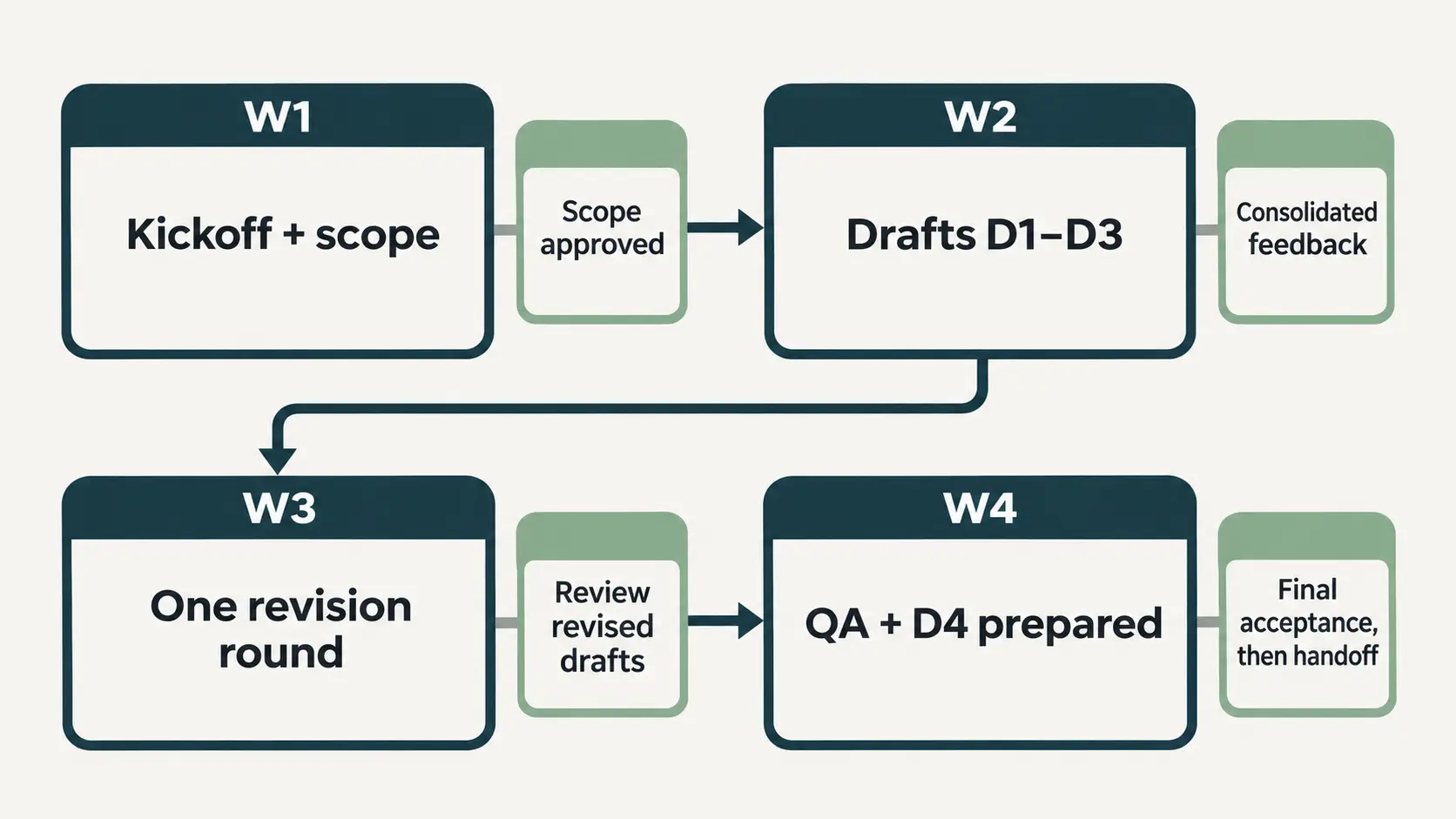
4. Four-Week Milestones and Client Review Gates
| Week | Owner | Output | Dependency or approval |
|---|---|---|---|
| 1 | Project Lead | Kickoff and scope baseline (this plan) | Client Approver approves the scope baseline before work starts and supplies brand inputs |
| 2 | Writer and Designer | First drafts of D1, D2 and D3 | Client Approver returns one consolidated feedback set within two business days of receiving drafts (assumption) |
| 3 | Writer and Designer | One included revision round applied to the drafts | Client Approver reviews revised drafts within two business days (assumption) |
| 4 | Project Lead | QA, completed D4, file handoff | Client Approver gives final approval against the acceptance checks |
The Association for Project Management describes planning as an integrated effort that brings together success checks, scope, quality, timing, resources, costs, risks, and communications. Its guidance explains that dividing work into phases and intermediate deliverables helps with scheduling, resource assignments, milestones and reviews. This example is deliberately small. It leaves out a cost section because the fictional plan states no prices.
What happens if client feedback is late? Say the consolidated feedback is due Wednesday and nothing arrives. The Project Lead points out in writing that Week 3 depends on that feedback and asks when it can be expected. They then talk through what a later date means for the timeline and record what both sides agree. The plan doesn’t give the team the right to move dates or add a fee on its own. Any change to either has to be agreed.
5. Estimated Hours and Risk Owners
| Week | Role | Task | Estimated hours |
|---|---|---|---|
| 1 | Project Lead | Kickoff and scope | 3 |
| 2 | Writer | Drafts | 8 |
| 2 | Designer | First design | 9 |
| 3 | Writer | Included revisions | 2 |
| 3 | Designer | Included revisions | 3 |
| 4 | Project Lead | QA and handoff | 3 |
| Baseline total | 28 |
The arithmetic is 3 + 8 + 9 + 2 + 3 + 3 = 28 hours. By role, that’s Project Lead 6 hours, Writer 10 hours, and Designer 12 hours, which again totals 28. These numbers are made up for the example.
Four risks are worth logging for a project this size. Each has one owner and an observable trigger. For a practical way to track those risks alongside assumptions, issues and dependencies, see our project management RAID log guide and free Excel template.
| Risk | Owner | Observable trigger | Mitigation |
|---|---|---|---|
| Late client feedback | Project Lead | Consolidated feedback not received by the end of the two-business-day window | Raise the dependency, discuss a revised timeline, record what is agreed |
| Missing brand inputs | Designer | Logo or brand guidelines not received before design starts in Week 2 | Flag to the Project Lead the same day, who requests the files from the Client Approver and records the agreed timing |
| Conflicting feedback | Project Lead | Two comments in the consolidated set ask for opposite changes | Ask the Client Approver to choose one and note the decision in the log |
| New deliverables | Project Lead | A request that doesn’t map to D1 to D4 | Log it as a change request, estimate the impact, and get the Client Approver’s decision before starting the work |
6. Revisions, Client Feedback and One Approved Scope Change
A useful boundary to define early is the difference between an included revision and a new deliverable.
An included revision is a change to something already in D1 to D3, made during the one agreed round. Rewording an email’s opening or swapping a headline in the welcome PDF both qualify. An extra deliverable is something that doesn’t appear in D1 to D4 at all.
CR-01 is an extra deliverable. Midway through, around the start of Week 3, the client asks for a third onboarding email. That isn’t a correction to either existing email, so it falls outside the baseline. The team records it like this:
| Field | CR-01 (illustrative) |
|---|---|
| Requested addition | A third onboarding email |
| Reason | The client wants one more onboarding touchpoint after the welcome message |
| Decision owner | Client Approver |
| Estimated effort | Writer 2 hours + Designer 1 hour = 3 hours |
| Schedule or pricing implications | Possible. Any change happens only as actually agreed |
| Status | Pending the client’s decision |
There are two ways this can go.
- If the client declines: the baseline stays at 28 hours and two emails. The log shows the request and the decision, and the plan doesn’t change.
- If the client accepts CR-01 in writing: the scope changes to three emails and the revised estimate becomes 28 + 3 = 31 hours. By role, that’s Project Lead 6, Writer 10 + 2 = 12, and Designer 12 + 1 = 13, and 6 + 12 + 13 = 31. The D3 acceptance check is updated to three complete emails. Schedule and fee changes are added only if both sides actually agree to them.
The 31 hours are a revised estimate. It isn’t time worked, and it isn’t automatically charged.
This follows the Association for Project Management’s change control guidance, which describes logging a change, evaluating it, approving, rejecting, or deferring it, and updating the plan if it’s approved. That guidance doesn’t say an added deliverable is automatically billable or that late approval automatically extends a contract, so this plan doesn’t either.
Revision time is easy to lose track of on creative work. If that sounds familiar, the guide to time tracking for designers covers it.

7. Final Sign-Off, File Handoff and What Gets Invoiced
In Week 4 the Project Lead checks D1, D2 and D3 against their acceptance criteria and prepares D4 with links to the proposed final files and their version identifiers. The Client Approver then reviews all four deliverables, including D4, against the agreed checks.
If the client accepts the package, the Project Lead:
- Records the Client Approver’s acceptance and date in D4.
- Confirms that D4 points to the accepted versions of D1, D2 and D3, then completes the final handoff.
- Reconciles actual time records with the agreed scope and payment terms before preparing any invoice.
If something is not accepted, the Project Lead records what remains, then resolves it under the agreed revision or change-control process. Final sign-off should not be assumed.
Estimates and actuals must stay separate. The 28 estimated hours (or 31 if CR-01 was approved) describe planned effort, not time already worked. For time-based billing, the invoice should reflect actual agreed billable work. For fixed-fee or milestone billing, it should follow the agreed fee and payment terms rather than simply converting estimated hours into charges. GuidePine’s guide to billable and non-billable time tracking explains the distinction, and its sample invoice for hours worked shows an hourly billing example.

How to Adapt This Sample Project Management Plan to Your Own Client Project
Work through these in order. Each step maps to a part of the example above.
- Choose the outputs. List what the client will receive in concrete terms, with counts where you can. “Two emails” is easier to agree on than “some email content.”
- Write an acceptance check for each output. One sentence per deliverable, phrased so the client can answer yes or no.
- Specify exclusions. Name the things the client might reasonably assume are included but aren’t. Integrations, automation, and extra rounds are common ones.
- Assign approval roles. Name one person on the client side who can say yes, and one person on your side who owns the plan.
- Estimate milestones and resources. Break the work into weeks or phases, assign an owner to each, and estimate hours by role. Label them as estimates.
- Agree feedback windows. Pick a response time that suits your client and write it down as an assumption. Two business days works in this fictional plan, but a client with a committee may need longer.
- Document how changes are handled. Decide where requests get logged, who evaluates them, and who decides. Record accepted, declined, and deferred outcomes.
- Define final sign-off. State what “done” means, where the accepted files are saved, and how time will be reviewed before invoicing.
Project Management Plan vs a Proposal, a Schedule, and a Budget
These documents overlap in practice, and people use the terms loosely. The distinctions below are editorial shorthand, not legal classifications.
| Document | What it mainly does | Question it answers |
|---|---|---|
| Project management plan | Documents how the work will be carried out and controlled | How will we deliver this, and how will we handle changes? |
| Proposal | Offers the work before it’s agreed, usually as a sales document | What are you offering, and on what terms? |
| Schedule | Organizes tasks and milestones over time | When does each thing happen? |
| Budget | Organizes projected and actual financial resources | What is this expected to cost, and what has it cost? |
In the example above, the plan contains a schedule (the four-week milestones) and effort estimates, but no prices. Writing a full proposal, controlling a budget, and comparing scheduling tools are separate topics. If you are tracking project expenses, see our guide on preventing project budget overruns, or consult our practical guide on project budget tracking to monitor planned versus actual burn rates across milestones.
Mistakes That Make a Simple Client Project Plan Fail in Practice
- No named client decision-maker. When approval authority is unclear, feedback may arrive in separate or conflicting pieces.
- Unstated exclusions. What you leave out is as important as what you include. An unstated exclusion can create different expectations about what is included.
- Vague “unlimited revisions.” Without an agreed limit, revision expectations may be difficult to manage. Name the number of rounds and what counts as one.
- A missing approval window. If the plan never says how long feedback should take, it’s hard to raise a late reply as a dependency.
- Mixing estimates and actuals. Estimated hours belong in the plan. Actual hours belong in the time record. Blending them makes invoices hard to defend.
- Changing the plan without logging the decision. A verbal “sure, add that” leaves no trail. Even a one-line log entry saves a lot of confusion at sign-off.
Frequently Asked Questions
What Should a Simple Project Management Plan Include?
For a small client project like this example, a useful plan covers the goal, deliverables and acceptance checks, scope boundaries, assumptions, responsibilities, milestones, estimated effort, risks, changes and final sign-off. Larger or regulated projects may need more detailed controls, so use this as an adaptable starting point rather than a universal minimum.
Who Needs to Approve a Client Project Plan?
In this example, the client designates someone authorized to approve the plan, while the provider’s Project Lead owns the working document. If the client’s company needs several stakeholders to agree, they should align among themselves before the Client Approver responds. This is a planning practice and not legal advice.
What if Client Feedback Is Late?
Raise it as a dependency rather than letting it slide. In the example, the Project Lead flags in writing that the next phase relies on that feedback, asks when it can be expected, discusses a revised timeline, and records what’s agreed. Moving dates or adding a fee are outcomes both sides agree to, not something the plan grants automatically.
Is a Project Management Plan the Same as a Project Proposal or a Template?
No. A proposal is the offer made before work is agreed. A template is a reusable blank structure. A project management plan describes how a particular project will be carried out and controlled. This article shows a filled-in example rather than offering a downloadable blank template. If you need a formal contractual document to define deliverables and acceptance criteria before executing your plan, review our practical scope of work template.
Quick Checklist and Next Move
- Goal stated in one or two plain sentences
- Every deliverable has a count and an acceptance check
- Out-of-scope items are named
- Assumptions are written down and labeled as assumptions
- One client approver is named
- Milestones have owners and review gates
- Hours are labeled as estimates
- Changes get logged with a decision owner
- Final sign-off and invoicing basis are defined
Your next move: open a current client project and fill in the “at a glance” table from this article first. If the out-of-scope row is unclear, review it with your client before treating the plan as agreed.