

A project budget overrun happens when the actual cumulative cost of a project exceeds the approved financial baseline. For a freelancer, consultant, or small agency, that gap is not an abstract accounting line. It is lost profit on a fixed-fee job or a disputed invoice on an hourly one.
Most overruns do not arrive as a single mistake. They build through small, unrecorded decisions: a “quick” extra revision, a feature agreed to in a chat message, a client who takes three weeks to send assets. This guide covers what causes overruns, the early warning signals that show up before the money is gone, practical prevention frameworks, a fully reconciled hypothetical $10,000 project, and copy-ready client scripts. Good prevention starts before kickoff, so it helps to pair this guide with a project management plan example and a clear understanding of proposal vs statement of work boundaries.
What Is a Project Budget Overrun (and How Does It Happen)?
A project budget overrun, also called a cost overrun, is the condition where actual incurred cost exceeds the approved cost baseline. The cost baseline is the time-phased budget that a project is measured against, and cost management standards such as the Project Management Institute’s PMBOK Guide treat it as the reference point for judging cost performance. The Project Management Institute also publishes an overview of earned value analysis for readers who want the formal corporate version of these ideas.
That formal version was built for large organizations. Most search results on this topic focus on capital projects, defense contracts, multi-variable Earned Value Management equations, and project management offices. A solo consultant or a five-person agency has none of those layers, and needs something lighter.
For an independent operator, there is no finance department to absorb a miss. When a project runs over, the overrun comes straight out of the owner’s margin, the team’s capacity for other clients, or the client relationship itself. That is why the controls in this guide are deliberately lean: a baseline, a simple variance check, a few written thresholds, and honest communication.
Scope Creep vs. Budget Overruns: The Critical Difference
Scope creep is the unauthorized or unmanaged expansion of project deliverables without matching adjustments to time, cost, or resources. A budget overrun is the financial outcome. Scope creep is a cause; the overrun is the consequence.
The distinction matters because they are fixed in different ways. Scope creep is controlled with boundaries, written approvals, and change orders. A budget overrun is controlled with monitoring, reserves, and early renegotiation.
Not every overrun comes from scope creep. Estimation errors, delays, rework, and third-party problems can all push costs above baseline even when the scope never changed. Treating every overrun as “the client asked for too much” misses the cases where the estimate itself was too optimistic.
Fixed-Price vs. Hourly Overruns: Where the Financial Hit Lands
The same overrun hurts differently depending on the contract model. Knowing where the damage lands tells you which controls to prioritize.
Fixed-fee overruns. The client fee is capped, so every extra hour is an internal cost with no matching revenue. The result is fixed-price margin erosion, uncompensated labor, and often burnout as the same deliverable absorbs more and more unpaid effort. Extra internal cost cannot automatically be billed to the client. Unless a mutually approved change order exists, the client is generally entitled to the agreed deliverables for the agreed price.
Hourly or time and materials (T&M) overruns. Here the client is billed for hours incurred, so the contractor’s margin is usually safe but the relationship is not. Unchecked overruns lead to client invoice shock, disputed billable hours, delayed payment, and damaged trust. Early variance communication and written budget caps are the protection.
The 5 Primary Causes of Budget Overruns in Client Services
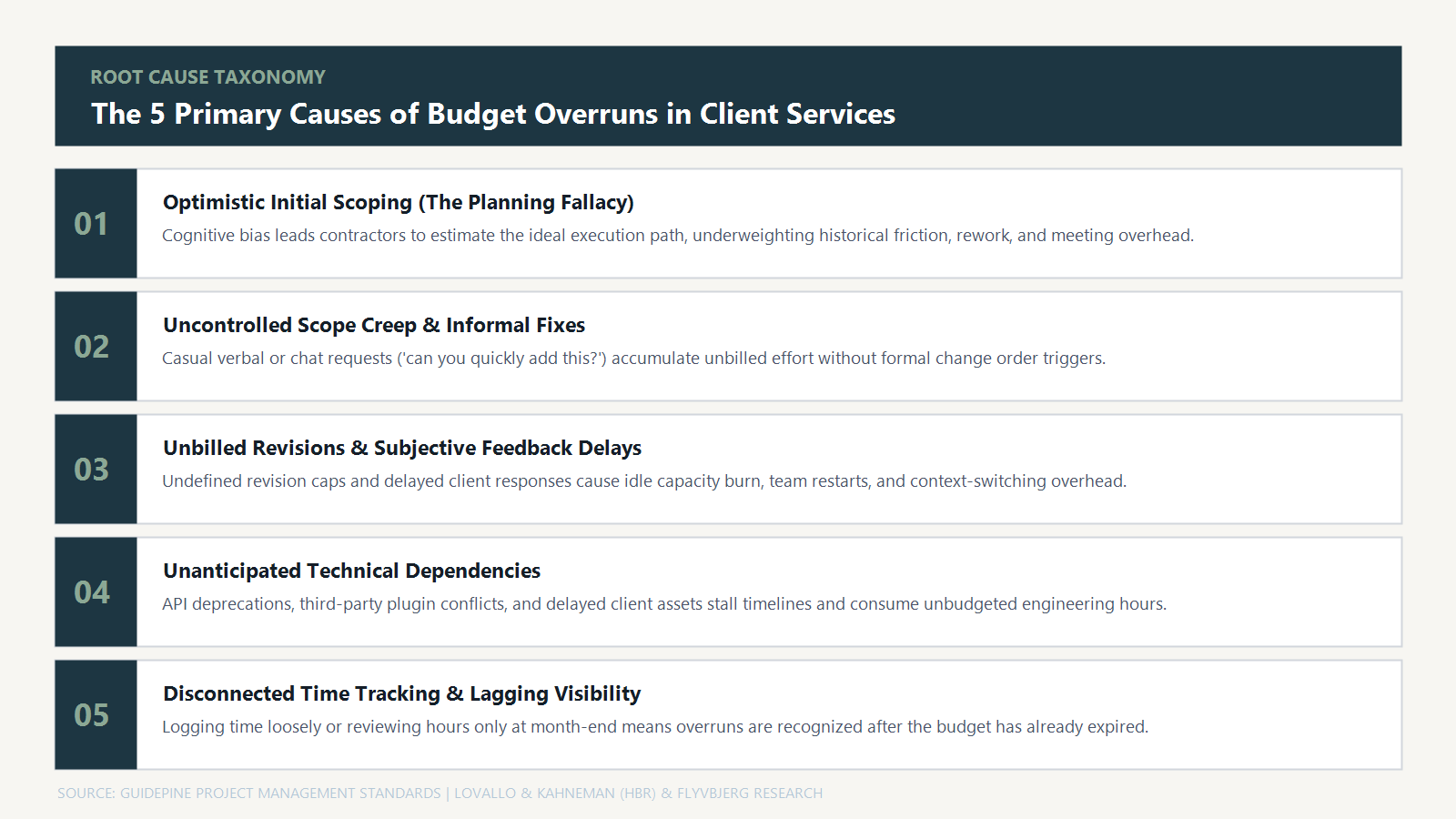
1. Optimistic Initial Scoping
Estimates tend to be too low for a predictable reason. Planners focus on the plan in front of them and underweight the friction that has hit comparable projects before. Dan Lovallo and Daniel Kahneman describe this pattern, often called the planning fallacy, in their Harvard Business Review article Delusions of Success: How Optimism Undermines Executives’ Decisions. Related research by Bent Flyvbjerg and others documents systematic underestimation of project costs.
For a service business, the practical lesson is simple. An estimate built only from the ideal path will usually miss meetings, clarifications, rework, and handoff delays. Comparing a new estimate against the actual hours of similar past projects is more reliable than trusting a fresh, hopeful breakdown.
2. Uncontrolled Scope Creep and Informal "Quick Fixes"
Small requests are the most dangerous because they feel too small to document. A verbal “can you also add this?” or a Slack message asking for one more page rarely seems worth a formal process. Ten of them can consume an entire milestone.
The fix is not to refuse small requests. It is to have a visible rule for when a request becomes a change order, so that saying “let me price that” feels routine rather than adversarial. A later section sets out an illustrative threshold.
3. Unbilled Revision Cycles and Subjective Feedback Delays
Revision loops are a classic source of invisible cost. When “revisions” are undefined, a client can reasonably ask for a third, fourth, or fifth round, and subjective feedback (“make it pop”) can keep a deliverable open indefinitely. Each round carries not only the work itself but the cost of reloading context.
Delayed feedback has its own cost. When a client takes weeks to respond, the team loses momentum, re-learns the project, and sometimes holds capacity idle. Both problems are addressed by stating the number of included revision rounds and the feedback window in writing before work starts, as covered in the guide to a freelance proposal template.
4. Unanticipated Technical and Third-Party Dependencies
Work that depends on other systems inherits their surprises. Examples include an API that deprecates an endpoint, a CMS plugin that conflicts with a theme, or client-supplied assets and credentials that arrive late or incomplete. None of these are the contractor’s fault in a moral sense, but they still consume hours.
Exclusions and assumptions in the proposal are the first line of defense. A contingency reserve, discussed below, is the second.
5. Disconnected Time Tracking and Lagging Financial Visibility
If hours are reviewed only at month end, the overrun is already history by the time anyone sees it. Teams that track time loosely or reconstruct it from memory also tend to under-record the very hours that cause the drift. Real-time logging makes burn rate visible while there is still time to act. To establish weekly earned value and variance milestones that keep costs visible, follow our practical guide on project budget tracking.
Daily logging hygiene is covered in the guide to billable time tracking. This article focuses on the next layer up: turning those logged hours into project-level budget decisions.
Early Warning Signs: How to Spot Budget Drift Before the Money Runs Out
Tracking Burn Rate vs. Milestone Progress
Burn rate is how quickly a project consumes its budget, measured in hours or dollars over time. On its own it says little. It becomes useful when compared against milestone progress: if 60% of the budget is spent and only 40% of the deliverables are done, the project is burning faster than it is producing.
A simple habit is to record, for each milestone, the planned hours and the hours logged so far. When logged hours approach the planned figure while the milestone is visibly unfinished, that is the signal to pause and re-forecast rather than keep working and hope.
Calculating Cost Variance: A Lean Client-Service Formula
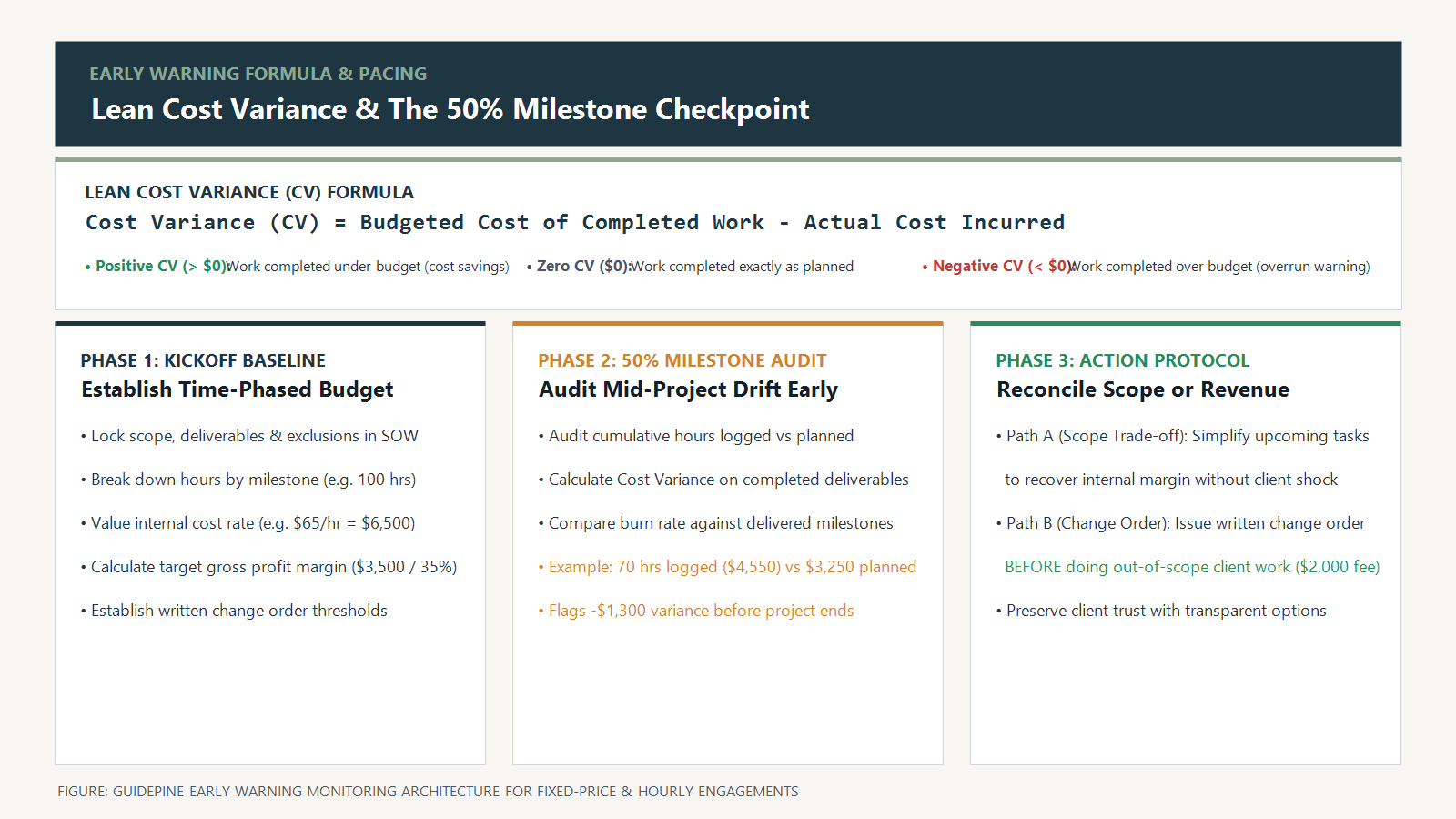
For client work, a lightweight version of cost variance is enough:
Cost Variance (CV) = Planned Budgeted Cost of Completed Work – Actual Cost Incurred
Cost variance compares what the finished work was supposed to cost against what it actually cost. Use internal cost (hours multiplied by your internal cost rate), not the client price, so the number reflects margin pressure rather than revenue.
- Positive CV: the completed work cost less than planned. The project is running under budget on that work.
- Zero CV: completed work cost exactly what was planned.
- Negative CV: completed work cost more than planned. This is the early flag of an impending overrun, visible before the project ends.
The worked example later in this guide applies the formula to a $10,000 project.
The 50% Milestone Checkpoint Rule
A useful audit point for multi-phase projects is the halfway mark. While not mandatory or practical for every small, single-sprint assignment, scheduling a formal review when roughly half of the planned deliverables are complete allows you to compare cumulative planned cost to cumulative actual cost, calculate the variance, and re-forecast the full project cost if current trends continue.
The halfway point is an effective compromise. It is late enough in delivery to produce a meaningful trend, but early enough that scope can still be adjusted and the client can still make choices. Waiting for the final milestone leaves only bad options.
Qualitative Warning Signs
Numbers are not the only signal. Several patterns tend to appear before the variance does:
- Email threads get longer, with more participants and more “one more thing” additions.
- Feedback becomes vaguer or more frequently contradicts earlier approvals.
- Requests start referring to deliverables that are not in the agreement.
- The client starts asking whether something is “included” instead of asking for a price.
- Feedback or asset handoffs slip past agreed dates without comment.
None of these prove an overrun is coming. Any of them is a reason to check the hours log and re-read the scope.
Practical Frameworks to Prevent Budget Overruns
The figures in this section are illustrative operational examples, not universal industry standards or legal rules. Actual percentages and thresholds should be set based on project complexity, team size, and mutual agreement with the client.
Building an Illustrative Contingency Reserve (the 10% Buffer Rule)
A contingency reserve is time or money set aside for uncertainty that cannot be fully planned. As an illustrative example, a 10% buffer on a 100-hour estimate would add 10 hours of planned effort. The 10% figure is a planning example only. It is not a mandatory or statutory standard, and riskier or less familiar work may justify more.
Contingency is meant for technical uncertainty and discovery, such as a plugin conflict or an unclear data format. It is not a place to hide scope creep. Once the reserve starts being used, that is information: record what consumed it and decide whether the remaining reserve still covers the remaining risk. A RAID log can help keep those risks, assumptions, active issues, and dependencies visible during the project. See our project management RAID log guide and free Excel template for a practical register.
How the reserve is presented to the client is a business decision. Some contractors build it into the stated estimate, while others hold it internally. Whichever approach is used, it should be a conscious choice rather than an accident.
Setting an Explicit Change Order Threshold
A written change order documents a mutually agreed change to deliverables, price, or schedule before the out-of-scope work begins. A threshold is a rule that says when informal agreement is no longer enough. As an illustrative example, a team might require a written change order for any request estimated at $500 or more, or 5 or more hours, whichever comes first.
The legal reasoning is straightforward. Contract modification generally depends on mutual assent between the parties, and a written record is the clearest evidence of it. The Cornell Law School Legal Information Institute’s overview of contract law explains the basic concepts. This guide is general information, not legal advice, and contract rules vary by jurisdiction, so consult a licensed attorney about your own agreements.
A threshold also protects the relationship. When the rule is stated in the proposal, a change order is a normal process step, not a personal negotiation. A signed statement of work is the natural home for the change-control procedure.
Establishing Strict Client Review Windows
Idle time costs money even when no work is happening. A defined review window, for example 5 business days for feedback on a deliverable, gives the client a clear expectation and gives the contractor a basis for adjusting the schedule when feedback is late.
State what happens if the window passes. A common approach is that the schedule pauses or shifts by the number of delayed days, and that work resumes when feedback arrives. As with the other examples, the exact number should be agreed with the client and documented.
Weekly Internal Burn-Rate Audits
A weekly audit takes a few minutes. Compare logged hours against each active milestone’s baseline, note any milestone that has used more than its planned share, and decide whether a conversation with the client is needed.
Weekly cadence matters because overruns compound. A small variance caught in week two can be handled with a scope clarification. The same variance found in week eight usually requires a change order or an absorbed loss.
If billing is hourly, the same audit also feeds the invoice. Approved out-of-scope work and overages should be billed clearly, and a sample invoice for hours worked shows how to itemize them so the client can see what each charge covers. Pairing this with sensible payment terms on an invoice, such as milestone payments and Net 15 or Net 30 terms, keeps cash flow steady while scope is being discussed.
Worked Example (Hypothetical): $10,000 Client Web Redesign Cost Reconciliation
Hypothetical Worked Example for Illustrative Purposes. The numbers below are invented to show the arithmetic. They are not benchmarks for any real project, rate, or margin.
The Economic Structure
- Fixed client project fee: $10,000
- Planned total effort: 100 hours
- Planned internal cost rate: $65 per hour (representing internal labor cost, contractor pay, or a time valuation)
- Effective client billing rate: $100 per hour ($10,000 / 100 hours)
- Planned internal cost budget: 100 hours x $65 = $6,500
- Planned gross profit: $10,000 – $6,500 = $3,500, a planned gross profit margin of 35.0%
Milestone Baseline Breakdown
| Milestone | Planned Hours | Planned Cost | Client Value | Planned Margin |
|---|---|---|---|---|
| 1. Discovery and Strategy | 20 | $1,300 | $2,000 | $700 |
| 2. UI/UX Wireframes and Visual Design | 30 | $1,950 | $3,000 | $1,050 |
| 3. Frontend and Backend Development | 35 | $2,275 | $3,500 | $1,225 |
| 4. Testing, QA, and Launch | 15 | $975 | $1,500 | $525 |
| Baseline Total | 100 | $6,500 | $10,000 | $3,500 (35.0%) |
Mid-Project Drift (Week 4 Audit)
Milestone 1 finishes exactly on plan: 20 hours, $1,300 incurred, $2,000 of client value delivered.
Milestone 2 runs into three rounds of unplanned client revisions and extra mobile screen requests. The team logs 50 hours instead of the planned 30, which is 20 extra hours. Actual cost for Milestone 2 is 50 hours x $65 = $3,250, against a planned $1,950. The Milestone 2 cost variance is $1,950 – $3,250 = -$1,300.
At the 50% deliverable checkpoint (Milestones 1 and 2 complete), the cumulative position is:
- Hours logged: 20 + 50 = 70 hours
- Actual cost incurred: $1,300 + $3,250 = $4,550
- Planned cost of completed work: $1,300 + $1,950 = $3,250
- Cumulative Cost Variance: $3,250 – $4,550 = -$1,300
The remaining budgeted internal cost for Milestones 3 and 4 is $2,275 + $975 = $3,250, which is 50 hours.
If nothing changes, the projected outcome is:
- Projected total cost: $4,550 + $3,250 = $7,800 (120 total hours)
- Client fee: still $10,000
- Revised profit: $10,000 – $7,800 = $2,200, a margin of 22.0% (down from 35.0%)
- Profit lost: $3,500 – $2,200 = $1,300, a 37.1% reduction in net dollar profit ($1,300 / $3,500)
This is the fixed-price margin erosion described earlier. The client sees no change in the invoice, while the contractor absorbs 20 hours of unpaid work.
Reconciling the Overrun: Two Commercial Paths

An important rule applies to both paths: on a fixed-fee engagement, extra internal costs cannot automatically be billed to the client without mutual agreement.
Path a: Scope Trade-Off or Absorption
If the revisions arose from contractor misunderstanding or informal approvals, there is no basis for extra fees. Two outcomes are realistic.
Scope trade-off. The contractor and client agree to simplify Milestone 3 development features, saving 15 hours ($975). The remaining cost becomes $3,250 – $975 = $2,275. Total project cost resets to $4,550 + $2,275 = $6,825 (105 hours). Revised profit is $10,000 – $6,825 = $3,175, a margin of 31.75%.
Absorption. If the scope cannot be reduced, the contractor absorbs the $1,300. Profit stays at $2,200 (22.0%). Some contractors accept this deliberately to preserve client trust, and then tighten controls on the next engagement.
Path B: Formal Written Change Order for Extra Client-Requested Scope
If new client requests expand the project scope, the professional standard is to issue a written change order and secure client approval before performing the additional work. In this hypothetical scenario, suppose the client requested additional mobile screens and an interactive directory during Milestone 2:
If the contractor paused and secured an approved change order for 20 additional hours at the effective client rate of $100 per hour ($2,000 additional fee) before doing the work:
- If the client approves the change order: the revised client project fee becomes $12,000. With total incurred costs of $7,800 (120 hours at $65 per hour), revised gross profit is $12,000 – $7,800 = $4,200, preserving the original 35.0% gross profit margin.
- If work was already completed without prior approval: attempting to bill retroactively for unapproved hours is difficult to enforce legally and damages client goodwill. If the client declines retroactive billing, the contractor must absorb the $1,300 cost variance as uncompensated labor (as shown in Path A), while strictly enforcing written change orders for any remaining milestones.
Complete Mathematical Reconciliation Table
| Scenario | Planned Hours | Actual or Projected Hours | Planned Cost | Actual or Projected Cost | Client Value | Cost Variance ($) | Gross Profit | Margin % |
|---|---|---|---|---|---|---|---|---|
| Original baseline | 100 | 100 | $6,500 | $6,500 | $10,000 | $0 | $3,500 | 35.0% |
| Drift, no intervention (also Path A absorption) | 100 | 120 | $6,500 | $7,800 | $10,000 | -$1,300 | $2,200 | 22.0% |
| Path A, scope trade-off | 100 | 105 | $6,500 | $6,825 | $10,000 | -$325 | $3,175 | 31.75% |
| Path B, change order approved | 120 | 120 | $7,800 | $7,800 | $12,000 | $0 | $4,200 | 35.0% |
In the Path B row the planned figures reflect the revised baseline: 120 hours x $65 = $7,800 of planned cost, supported by a $12,000 fee. Measured against the original $6,500 baseline, the cost variance would still be -$1,300, but the change order means that variance is now funded by additional revenue.
Every figure above can be rebuilt from three inputs: hours, the $65 internal cost rate, and the client fee. If a reconciliation cannot be rebuilt that way, something is wrong with the tracking.
How to Handle an Active Overrun: Client Communication Scripts
The principle is to raise variance early, with numbers, and with options. A client who hears about a problem in week four can make a decision. A client who finds it on the final invoice can only react.
Keep the tone factual rather than apologetic or accusatory. Describe what was requested, what it affects, and what choices exist. Edit the placeholders to match your project, and review any language about fees or contract changes with a licensed attorney if the stakes are significant.
Script 1: Addressing Unbudgeted Client Requests (the Scope Boundary Notice)
Subject: Quick scope check on [FEATURE]
Hi [CLIENT NAME],
Thanks for the request to add [FEATURE]. This sits outside the scope we agreed in our [PROPOSAL / SOW] dated [DATE].
I estimate it at [HOURS] hours, or [ESTIMATED COST]. If you would like to include it, I will send a short change order for your approval and confirm any effect on the delivery date. Work on it will start once the change order is approved.
If you would prefer to keep to the current scope and schedule, we can add it to a later phase instead. Let me know which you prefer.
Best,
[YOUR NAME]
[YOUR BUSINESS NAME]
Script 2: Renegotiating When Project Scope Has Expanded Beyond the Baseline
Subject: Project budget update and options for [PROJECT NAME]
Hi [CLIENT NAME],
I reviewed our progress at the halfway point. The completed work has used [ACTUAL HOURS] hours against a plan of [PLANNED HOURS] hours, mainly because of [REASON, for example additional revision rounds and added mobile screens].
At the current pace, completing the remaining milestones would require about [REVISED HOURS] hours in total. I see two ways forward:
1. Adjust the scope. We simplify [REMAINING DELIVERABLE] to bring the project back within the original budget of [ORIGINAL FEE].
2. Approve additional budget. We keep the full scope, and I send a change order for [ESTIMATED COST] covering the additional work.
I am happy to talk through either option. Could we find 20 minutes this week so I can start the next milestone with a clear direction?
Best,
[YOUR NAME]
[YOUR BUSINESS NAME]
Fixed-Price vs. Time & Materials Budget Control Checklist
| Control Dimension | Fixed-Price Projects | Time & Materials (Hourly) Projects | Actionable Rule for Freelancers |
|---|---|---|---|
| Scope definition | Defined deliverables, exclusions, and revision limits in a signed SOW | Defined work areas plus an estimate range or budget cap | Write exclusions and revision counts into the agreement before work begins |
| Estimation buffer | Contingency built into the estimate or held internally | Estimate expressed as a range, with the cap stated | Choose a buffer based on project risk (10% is only an illustrative example) |
| Time tracking requirement | Required, for internal margin control | Required, for billing and client transparency | Log hours daily and review weekly against milestones |
| Change order trigger | Any request outside the SOW, or above an agreed threshold | Any work expected to exceed the stated cap or estimate | Put the threshold in writing (for example, illustrative $500 or 5 hours) |
| Client billing risk | Low invoice dispute risk, high risk of unbilled work | High risk of invoice shock and disputed hours | Share budget status before each invoice rather than after |
| Margin protection tactic | Mid-project variance checks and change orders | Budget cap notices and early variance alerts | Schedule a mid-project review on multi-phase engagements to assess cost variance before final milestones |
Frequently Asked Questions About Project Budget Overruns
What Is the Most Common Reason Project Budgets Run Over?
Industry research and empirical project studies frequently identify optimistic estimation paired with unmanaged scope changes as leading drivers of cost overruns. In client service engagements, initial estimates often reflect the ideal execution path while underweighting unexpected revisions and feedback delays. When informal client requests are added without pricing adjustments, unbilled hours accumulate quickly. Regular mid-project variance checks help catch that drift before it affects the final invoice.
Should Freelancers Charge Clients for Budget Overruns Caused by Estimation Errors?
Generally no, not on a fixed-fee project. The client agreed to a defined scope for a defined price, and an internal underestimate is usually the contractor’s risk unless the agreement says otherwise. Overruns caused by new client-requested work are different and belong in a written change order. Contract terms vary, so confirm your approach with a licensed attorney.
How Much Contingency Should Be Built into a Project Proposal?
There is no universal figure. A 10% buffer is a common illustrative planning example, but the right amount depends on how uncertain the work is, how familiar the team is with it, and how many outside dependencies exist. Base the number on your own past projects and agree on how it is presented with the client.
How Do You Tell a Client Their Project Is Going Over Budget?
Do it early, in writing, with specific numbers and clear options. State what has been used, what the cause is, what the projected total looks like, and what choices exist, such as reducing scope or approving more budget. The scripts above give a structure to follow.
What Is the Difference Between Cost Overrun and Cost Variance?
A cost overrun is the condition in which actual cost exceeds the budget. Cost variance is the measurement that detects and quantifies it, calculated by comparing planned cost of completed work with actual cost. A negative cost variance mid-project is an early indicator that an overrun is developing.
Can a Signed Contract Prevent All Budget Overruns?
No. A clear contract reduces disputes by defining scope, revisions, and change procedures, but it cannot remove estimation errors, delays, or outside dependencies. It also does not replace monitoring. Pair the agreement with weekly burn-rate reviews and a halfway checkpoint, and consult a licensed attorney or CPA about contract, tax, or accounting questions specific to your business.