
Sending a prospective client an informal price quote over email is one of the quickest ways to stall a deal. Without a clearly defined scope of work, clients hesitate to commit, and freelancers take on unnecessary financial risk when project requirements expand beyond original expectations.
A structured, two-to-three-page freelance proposal template eliminates this ambiguity. It clearly frames the client’s business objective, specifies exact deliverables, establishes transparent pricing options, and defines milestone payment terms in a format short enough for a decision-maker to read and sign promptly.
This guide explains the five essential components of a structured commercial proposal, demonstrates how to set defensible scope boundaries, and provides an ungated, copy-ready template. It also features an illustrative hypothetical worked example detailing an $8,500 project fee with a structured $4,250 initial deposit.
Why Lean Client Proposals Work for Solo Freelancers
Twenty-page proposal decks structured like corporate enterprise RFP responses often backfire for independent consultants and small service teams. Extensive documents prolong the review cycle, invite unnecessary internal committees, and obscure the primary decision: whether the client wishes to proceed and at what investment level.
A lean commercial proposal answers the five fundamental questions every client asks before signing:
- Do you thoroughly understand the problem we need solved?
- What concrete deliverables will you produce?
- Which specific tasks and services are excluded?
- What is the required investment across available options?
- What specific step is required to initiate the engagement?
Addressing these questions directly and concisely, in that exact sequence, builds professional trust far more effectively than generic agency background statements or padded methodology sections.
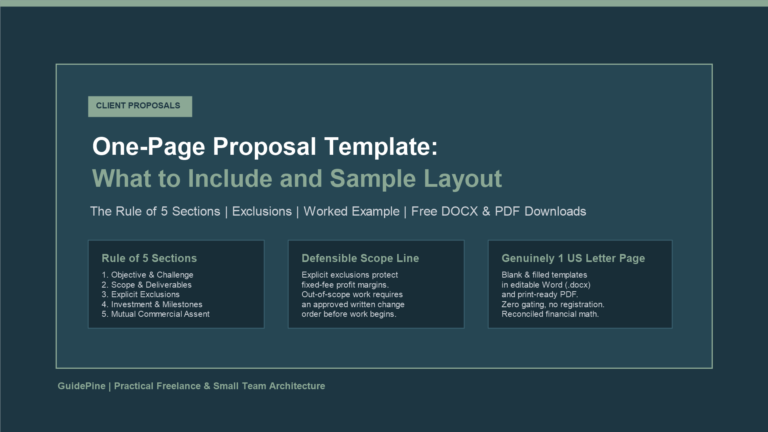
The diagram below illustrates how these five core elements assemble into an integrated proposal architecture.

The 5 Essential Sections of a Commercial Proposal
1. Executive Summary and Problem Framing
The opening section establishes immediate alignment by articulating the client’s current friction points and desired commercial outcome. It should not read like a promotional biography of your freelancing business. Instead, it must serve as an accurate, objective summary of the problem discussed during your discovery consultation.
A strong executive summary articulates the core business challenge, the commercial cost of leaving it unaddressed, and the measurable outcome this engagement delivers. Limit this section to two or three focused paragraphs.
Common mistake to avoid: Starting with generic introductory filler such as “Thank you for the opportunity to submit this proposal.” Begin immediately with the client’s business objective to demonstrate competence from the first sentence.
2. Deliverable Scope and Acceptance Criteria
This section itemizes exactly what you will build or deliver and, crucially, establishes verifiable acceptance criteria that define when each item is complete.
Ambiguous language invites project disputes. Writing “a redesigned client website” does not establish a measurable boundary. In contrast, specifying “five responsive page templates built in WordPress, delivered in a staging environment for review and migrated to production upon approval” provides an objective standard for completion.
Every deliverable description must specify three elements:
- The tangible output produced (focusing on concrete assets rather than open-ended activities)
- The delivery format or technical environment (such as production code, design files, or documentation)
- The explicit standard of completion required to trigger client sign-off
On fixed-price agreements, clear acceptance criteria are critical: they establish an objective standard showing you have fulfilled your baseline obligations and earned the corresponding milestone disbursement.
3. Scope Fencing and Change Control
An itemized list of explicit exclusions is not a defensive barrier; it is an essential communication tool that aligns client expectations before work begins.
Itemize the related services, technical tasks, and revision cycles that fall outside the baseline proposal. Precision prevents misunderstandings: “SEO copywriting for newly created pages” communicates boundaries far more clearly than a vague term like “content creation.” Similarly, “custom third-party API integration” is clearer than “miscellaneous development work.” For specialists pitching ongoing digital growth and campaign retainers, using a tailored freelance marketing proposal template helps establish defensible boundaries around monthly deliverables, ad spend responsibilities, and performance reporting. For copywriters and content strategists, adapting a specialized freelance writing proposal template ensures word count thresholds, interview access, and research scopes are clearly defined before drafting begins.
Include an unambiguous change-control clause establishing how out-of-scope requests are handled. The standard commercial approach specifies that additional requests require a formal written change order with agreed pricing. For example: “Services outside the agreed deliverables require a written change order approved by both parties. Additional work is scheduled based on current availability and billed at our standard change-order rate of [$RATE] per hour.”
The hourly rate stated in your template serves as an illustrative placeholder, not a mandatory market rate. Select a figure that reflects your specific discipline, experience level, and geographic market.
4. Investment Options and Tiered Pricing
Presenting a single project quote can limit flexibility. If a client’s available budget differs from a single quoted figure, negotiations may require ad hoc scope adjustments. Providing three structured tiers offers an optional presentation format, allowing prospects to compare predefined scope options against their resources.
A structured three-tier package model includes:
- Core Package: Delivers the fundamental baseline assets required to solve the primary problem.
- Standard Package: Adds the recommended enhancements and integrations that deliver complete value for the core project scope.
- Advanced Package: Offers premium features, expanded post-launch support, and specialized integrations for organizations seeking accelerated outcomes.
The critical rule is genuine deliverable differentiation: each tier must provide tangibly distinct outputs rather than arbitrary price markups for the same scope of work. Note that structured tiers represent an optional presentation strategy; some clients with predefined specifications may prefer a single, decisive quote.
5. Terms, Deposit Milestones, and Counter-Signature
The final section of your proposal establishes the commercial conditions that govern the contract upon signing. It specifies:
- Payment milestone schedule: Defining what percentage of the total fee is due at specific project milestones
- Proposal validity window: Stating how many calendar days the quoted scope and pricing remain open for acceptance
- Intellectual property rights: Distinguishing copyright ownership assignments from nonexclusive deliverable licenses. Under 17 U.S.C. § 204, copyright ownership transfers generally require an explicit signed writing (subject to narrow statutory exceptions); payment alone does not automatically transfer copyright
- Mutual signature block: Providing counter-signature fields to evidence mutual assent and formalize agreed commercial terms
In independent client services, requiring an initial deposit prior to scheduling work is standard commercial practice. Upfront deposits reduce contractor cash-flow risk and reserve capacity on your production calendar. The specific deposit percentage (whether 25%, 33%, or 50%) represents a negotiated term, not a statutory requirement. Whatever payment split you establish, document it explicitly to avoid ambiguity at contract execution.
Defining Scope Boundaries and Change-Order Workflows
Ambiguous language is a common source of project disputes and uncompensated scope expansion in independent service contracting.
The distinction between included versus excluded services must be immediately legible to both parties:
| Ambiguous Proposal Language | Precise Boundary Language |
|---|---|
| “Assist with website content” | “Edit up to 10 existing service page copy blocks (maximum 500 words each). Authoring new content pages is excluded.” |
| “Help with social media assets” | “Design 8 static Instagram post templates in Canva. Post scheduling, copywriting, and account management are excluded.” |
| “Provide launch support” | “Provide technical bug fixes on the delivered staging environment for 5 business days post-deployment. New feature requests require a change order.” |
| “Handle on-page SEO” | “Optimize on-page metadata for the 5 delivered page templates (title tags, meta descriptions, heading structure). Keyword discovery and backlink outreach are excluded.” |
Standard change-control workflow: When a client requests tasks outside the baseline deliverables, manage the request through a documented procedure rather than an informal discussion:
- The client submits an additional work request in writing via email or project management software.
- You assess the request against the baseline deliverables and confirm in writing that it represents an out-of-scope expansion.
- You issue a concise written change order detailing the additional deliverable, fixed price or hourly estimate, and timeline adjustment.
- The client approves the change order in writing prior to work commencement.
- The agreed fee is added to the upcoming milestone invoice or billed separately.
This process protects both parties: the client maintains control over their budget, and the contractor ensures every hour of work is properly authorized and compensated.

Complete Freelance Proposal Template (Copy-Ready)
The template below is ungated and free to use. Copy it directly into your preferred word processor or text editor, replace the bracketed placeholder fields with your project details, and present it to your prospective client.
[YOUR BUSINESS NAME OR PRACTICE]
[Office Address or Remote Service Region]
[Email Address] | [Telephone Number] | [Website URL]
PROPOSAL ISSUE DATE: [DATE]
PROPOSAL VALIDITY WINDOW: This proposal remains open for acceptance until [DATE + 14 DAYS] unless extended in writing.
PREPARED FOR: [CLIENT CONTACT NAME], [CLIENT COMPANY NAME]
Section 1: Project Objective and Background
[CLIENT COMPANY NAME] is seeking to [STATE CLIENT CORE BUSINESS CHALLENGE IN 1 OR 2 SENTENCES USING CONTEXT FROM DISCOVERY CALL].
The primary objective of this project is to [STATE MEASURABLE COMMERCIAL OUTCOME]. This proposal outlines the required deliverables, scope boundaries, and investment packages to achieve this objective efficiently.
Section 2: Scope of Work and Tangible Deliverables
The following deliverables are included in this engagement:
Deliverable 1: [SPECIFY TANGIBLE DELIVERABLE: detailed description, format, and explicit acceptance standard]
Deliverable 2: [SPECIFY TANGIBLE DELIVERABLE: detailed description, format, and explicit acceptance standard]
Deliverable 3: [SPECIFY TANGIBLE DELIVERABLE: detailed description, format, and explicit acceptance standard]
Section 3: Project Boundaries and Explicit Exclusions
The following services are explicitly excluded from the baseline proposal packages. Any requests for excluded items will be handled through a written change order:
- [EXCLUSION 1: Be specific, such as “Copywriting for new landing pages”]
- [EXCLUSION 2: Such as “Third-party software subscription or API licensing fees”]
- [EXCLUSION 3: Such as “Paid search or social ad campaign management”]
- [EXCLUSION 4: Such as “Ongoing maintenance or support beyond the agreed post-launch window”]
Change Order Procedure: Any work falling outside the itemized deliverables requires a written change order approved by both parties before work begins. Out-of-scope tasks are billed at our standard change-order rate of [$YOUR RATE] per hour and scheduled subject to developer availability.
Section 4: Investment Packages
Three structured engagement packages are available for this engagement:
| Service Component | Option A: Core | Option B: Standard | Option C: Advanced |
|---|---|---|---|
| [DELIVERABLE 1] | Included | Included | Included |
| [DELIVERABLE 2] | Excluded | Included | Included |
| [DELIVERABLE 3] | Excluded | Excluded | Included |
| [DELIVERABLE 4] | Excluded | Excluded | Included |
| Revision Cycles | 1 round | 2 rounds | 3 rounds |
| Post-Launch Support | None | [X] days | [X] days |
| Total Investment | $[TIER A PRICE] | $[TIER B PRICE] | $[TIER C PRICE] |
Note: Option B represents the recommended package designed to address all primary project requirements.
Section 5: Project Timeline and Milestone Schedule
Estimated total project duration: [X WEEKS] from receipt of signed agreement and initial deposit.
| Milestone Phase | Key Deliverables | Estimated Completion |
|---|---|---|
| 1. Discovery and Kick-Off | Brief alignment, account credentials, asset intake | Week [X] |
| 2. Architecture and Review | Wireframe review and layout sign-off | Week [X] |
| 3. Development Staging | Fully functional staging environment delivered | Week [X] |
| 4. Final Deployment | Production launch, DNS migration, asset handoff | Week [X] |
Project timelines are estimates dependent on timely feedback and asset approvals from the client team.
Section 6: Payment Terms and Deposit Schedule
| Payment Stage | Percentage and Amount | Trigger Condition |
|---|---|---|
| Initial Deposit | [50%] of agreed package total | Due upon signed contract (work commences upon receipt) |
| Progress Payment | [25%] of agreed package total | Due upon formal wireframe or design milestone approval |
| Final Balance | [25%] of agreed package total | Due upon deployment to staging or final file delivery |
Approved Payment Methods: [ACH bank transfer, corporate check, or wire transfer: specify preferred methods].
Payment Terms (Customizable): Net [X] calendar days from invoice presentation. Where agreed by the parties and permitted by applicable state law, overdue balances may accrue late interest at [AGREED LATE PAYMENT RATE, IF ANY].
Section 7: Terms of Agreement, Intellectual Property, and Mutual Sign-Off
Intellectual Property Rights (Sample Clause): Contractual IP terms should be customized to each engagement, distinguishing between ownership assignments and nonexclusive licenses. In this sample framework, [CLIENT COMPANY NAME] is granted a nonexclusive license to use the finalized deliverables upon receipt of full payment, while the contractor retains rights to pre-existing tools and methodologies. If the parties intend an outright assignment of copyright ownership, 17 U.S.C. § 204 generally requires an explicit signed writing (subject to narrow statutory exceptions); payment alone does not automatically transfer copyright ownership. Specific IP terms remain subject to mutual negotiation.
Confidential Information: Both parties agree to protect proprietary business information and client data disclosed during the performance of this agreement.
Governing Law and Jurisdiction: This agreement is governed by the laws of the State of [STATE]. Any formal legal disputes shall be brought before the competent state or federal courts located in [COUNTY, STATE].
Limitation of Liability (Sample Clause): Commercial contracts frequently incorporate mutual liability caps, such as limiting total liability to the fees actually paid under the agreement. Liability limitations are subject to state law requirements; consult legal counsel to ensure enforceability.
Termination and Deposit Provisions (Sample Clause): Service agreements typically specify notice periods for early termination and outline deposit treatment. Where agreed by the parties, completed deliverables may be billed on a pro-rata basis, and initial deposits may be retained to offset reserved production capacity. The applicability and enforceability of deposit retention depend on governing state contract law.
Contract Acceptance and Authorization
| Signature Field | Authorized Client Representative | Authorized Contractor |
|---|---|---|
| Authorized Signature | ___________________________ | ___________________________ |
| Printed Full Name | ___________________________ | ___________________________ |
| Corporate Title | ___________________________ | ___________________________ |
| Execution Date | ___________________________ | ___________________________ |
Selected Package: Option A / Option B / Option C
Agreed Total Contract Value: $_______________
Legal Disclaimer: This template provides a commercial starting point for freelance proposals and service agreements. It does not constitute formal legal advice. Contract enforceability varies by state jurisdiction, specific contractual language, and factual context. For high-liability or complex intellectual property agreements, consult a qualified attorney licensed in your state.
Worked Example (Hypothetical): $8,500 Web Redesign Proposal
The following scenario is a clearly labeled hypothetical worked example provided solely for illustrative purposes. All corporate entities, individual names, deliverables, and figures are fictional.
Scenario Background: Jordan Reyes, a solo WordPress designer operating as Horizon Studio, is responding to a consultation brief from Apex Growth Advisory, a management consulting firm. Following an initial 45-minute discovery consultation, Jordan delivers a formal proposal structured under the template above.
HORIZON STUDIO
Remote Design Services (U.S.-based)
hello@horizonstudio.example | horizonstudio.example
PROPOSAL DATE: November 15, 2026
VALIDITY WINDOW: Open for acceptance through November 29, 2026 (14 calendar days)
PREPARED FOR: Alex Chen, Managing Director, Apex Growth Advisory
Section 1: Project Objective
Apex Growth Advisory’s existing website no longer communicates the firm’s strategic positioning or meets the due-diligence standards expected by corporate procurement teams. The objective of this engagement is to design and develop a responsive website that establishes authority, integrates an automated lead capture workflow, and meets Google Core Web Vitals performance benchmarks.
Section 2: Scope of Work
- Deliverable 1: Custom responsive WordPress theme for 7 core pages (Home, About, Services Index, 3 Practice Area Pages, Contact). Built to Core Gutenberg standards and delivered on a password-protected staging server.
- Deliverable 2: Direct CRM lead capture integration connecting the primary contact form to Apex’s existing HubSpot account (single-form webhook; portal credentials supplied by client).
- Deliverable 3: Comprehensive on-page SEO foundation covering title tags, meta descriptions, heading structure, and image alt text for all 7 delivered pages. (Keyword research and content writing excluded.)
- Deliverable 4 (Option C Only): Custom case study post type with 2 editable layout templates, allowing internal staff to publish new case summaries without code modification.
Section 3: Explicit Exclusions
- Authoring original website copy (Apex supplies all finalized text prior to staging)
- Brand identity, logo design, or photography production
- Web hosting configuration, domain registrar transfer, or SSL renewal
- Custom CRM workflow automations beyond the single HubSpot contact form
- Ongoing technical maintenance following the 15-day post-launch support window
Section 4: Investment Options
| Deliverable Scope | Option A: Core Launch | Option B: Standard (Recommended) | Option C: Premium Authority |
|---|---|---|---|
| 7-Page Responsive Theme | Included | Included | Included |
| HubSpot CRM Form Integration | Excluded | Included | Included |
| On-Page SEO Optimization | Excluded | Included | Included |
| Custom Case Study Post Type | Excluded | Excluded | Included |
| Structured Revision Rounds | 1 round | 2 rounds | 3 rounds |
| Post-Launch Technical Support | None | 15 days | 30 days |
| Total Investment | $5,500 | $8,500 | $12,500 |
Section 5: Project Milestone Schedule
Estimated total delivery timeframe: 7 weeks from contract execution and deposit receipt.
| Milestone Stage | Scope Delivered | Target Week |
|---|---|---|
| 1. Discovery and Intake | Brief alignment, content collection, asset intake | Week 1 |
| 2. Design Presentation | Home and services layout presentation | Week 3 |
| 3. Wireframe Sign-Off | Formal approval of all 7 responsive layouts | Week 4 |
| 4. Staging Delivery | Complete functional site available on staging server | Week 6 |
| 5. Production Launch | DNS switch, production deployment, 15-day support window begins | Week 7 |
Section 6: Payment Schedule (Option B: $8,500)

| Disbursement Stage | Percentage and Amount | Trigger Condition |
|---|---|---|
| Initial Deposit (50%) | $4,250 | Due upon signed contract before work begins |
| Progress Payment (25%) | $2,125 | Due upon formal wireframe milestone sign-off |
| Final Payment (25%) | $2,125 | Due upon delivery of staging site prior to production launch |
| Total Investment | $8,500 | 50% + 25% + 25% = 100% exact mathematical balance |
Disbursements payable via ACH transfer. In this hypothetical worked example, invoices unpaid after 10 business days accrue late interest at an illustrative contractual rate of 1.5% per month, as an optional negotiated term subject to applicable state law.
End of hypothetical worked example. Corporate entities, personal names, and project figures are fictional.
Managing Post-Submission Follow-Up
Following proposal submission, an organized follow-up sequence helps maintain communication while the client reviews materials. A prospective client who has not replied after three business days has not necessarily rejected the quote; they are frequently coordinating internal approvals, comparing vendor options, or managing routine operational demands.
A structured three-touchpoint sequence maintains momentum without applying counterproductive pressure:
Touchpoint 1 (Day 3): Receipt Confirmation and Question Check
Subject: [YOUR BUSINESS NAME] proposal: any questions?
Hi [CLIENT NAME],
I wanted to confirm you received the proposal sent on [DATE] and check whether you have any questions regarding the scope or package options. I am glad to walk through any section by phone or video conference if helpful.
The proposal pricing remains open through [EXPIRATION DATE]. I look forward to hearing your thoughts.
Best regards,
[YOUR NAME]
Touchpoint 2 (Day 7): Follow-Up and Discussion Checkpoint
Subject: Re: [YOUR BUSINESS NAME] proposal
Hi [CLIENT NAME],
Following up on the proposal delivered on [DATE]. If your team has reviewed the package options, I would welcome a brief conversation to answer questions or refine deliverable boundaries. If your timeline has adjusted, I am glad to align with your revised schedule.
Best regards,
[YOUR NAME]
Touchpoint 3 (Day 14): Expiration Notice and Scheduling Check
Subject: Proposal expiration for [CLIENT COMPANY] website project
Hi [CLIENT NAME],
The proposal submitted on [DATE] reaches its validity date today. If you wish to proceed under the quoted pricing and schedule, please sign and return the document today, or let me know if an extension is needed to complete internal review.
If the timing is not right currently, I am glad to reconnect whenever your schedule permits.
Best regards,
[YOUR NAME]
This three-touchpoint sequence across fourteen days serves as an optional illustrative example. Freelancers should customize their follow-up frequency based on each client’s communication style, industry norms, and project urgency.
Handling discount requests: When a prospective client requests a lower fee, the professional response is to reduce deliverable scope rather than lowering your hourly or project rate. Offer to remove specific optional deliverables from Option B to match their target budget. Lowering your fee without adjusting scope compromises your margins and signals that your initial quote was arbitrary.
Transitioning from Signed Proposal to Project Kick-Off
When the client countersigns the proposal, the project officially begins, but production work should commence only after you confirm receipt of the initial deposit. To structure the full transition from countersigned contract to kickoff meeting, follow our client onboarding checklist.
Scheduling the kick-off milestone after deposit receipt protects the production capacity you have blocked and sets a professional operational standard from day one.
Client onboarding sequence following contract signing:
- Confirm initial deposit receipt and issue a formal payment confirmation receipt.
- Deliver an onboarding checklist outlining required client assets, account credentials, and the kick-off meeting agenda.
- If the client is a business entity anticipating payments exceeding annual IRS reporting thresholds, they may request a completed Form W-9 from your business to support year-end 1099-NEC tax filing. Maintain an updated W-9 on file and provide it promptly upon request. (Tax filing obligations fall upon the client as the payer; consult a certified CPA regarding your business tax obligations.)
- Publish the approved milestone timeline in your project tracking system and share access with the client team.
Once the deposit is received and onboarding begins, proposal management concludes and project governance takes over.
For complete guidance on managing project execution following proposal approval, see our comprehensive guide to a project management plan example. To establish ongoing billing schedules and late fee policies, review our guide to payment terms on invoice. For out-of-scope work billed on an hourly basis, format your invoices using our sample invoice for hours worked.
Summary: Proposal Preparation Checklist
Before delivering any proposal to a prospective client, verify the following six quality criteria:
- Client objective framed accurately: The executive summary reflects the client’s stated commercial goals rather than generic agency promotion.
- Deliverables itemized with acceptance criteria: Every deliverable defines tangible outputs, formats, and verifiable completion standards.
- Exclusions stated explicitly: The proposal contains an itemized exclusions list paired with a structured change-order clause.
- Tiered options genuinely differentiated: Each package tier provides distinct value rather than arbitrary price inflation for identical scope.
- Deposit and validity terms stated: The milestone schedule, upfront deposit percentage, and proposal expiration date are clearly documented.
- Counter-signature fields ready: Both signature blocks, package selection fields, and total contract amounts are formatted for immediate execution.
A proposal satisfying these six checks provides an objective framework that protects contractor margins and establishes a clear foundation for a successful client engagement.
Article Source Notes
The following authoritative sources inform the legal, commercial, and tax standards referenced throughout this guide. They are provided for educational purposes and do not constitute formal legal or tax counsel:
- Cornell Law School Legal Information Institute: Contract (Essential contract formation elements: offer, acceptance, consideration, and mutual assent).
- Internal Revenue Service: About Form W-9 (Taxpayer Identification Number collection for independent contractor tax reporting).
- Internal Revenue Service: Instructions for Form 1099-NEC (Reporting requirements for nonemployee compensation paid to independent contractors).
- United States Copyright Office: Circular 9: Works Made for Hire (Statutory requirements governing copyright ownership and independent contractor agreements).
- United States Copyright Office: 17 U.S. Code § 204 (Statutory requirement for signed written instruments in copyright assignment).
- Project Management Institute: PMBOK Guide (Foundational standards for project scope definition and change-control management).
- Harvard Business Review: The Good-Better-Best Approach to Pricing (Choice architecture and value differentiation in tiered commercial pricing).
- United States Small Business Administration: Manage Your Business Finances (Cash-flow management and contract practices for small service businesses).