

When evaluating a proposal vs statement of work (SOW), the primary distinction centers on project lifecycle timing and operational specificity. A business proposal is a persuasive pre-award sales document designed to persuade a prospective client to award an engagement by outlining a proposed solution, an estimated budget, and a high-level strategy. A Statement of Work (SOW) is an operational, post-award document that defines specific deliverables, project milestones, acceptance criteria, technical standards, and payment obligations. Knowing which document to send, and when, protects your scope, sets the right client expectations, and gives each document the contractual weight it deserves.
| Dimension | Business Proposal | Statement of Work (SOW) |
|---|---|---|
| Primary Purpose | Persuade a prospective client to award the engagement | Define the operational scope, deliverables, and payment obligations of an awarded engagement |
| Lifecycle Timing | Pre-award: sent before the client commits | Post-award: issued after agreement in principle and before work begins |
| Scope Granularity | Broad capabilities, estimated deliverables, high-level strategy | Exact specifications, file formats, acceptance criteria, explicit exclusions |
| Pricing Structure | Estimated or range-based; subject to revision | Fixed milestone amounts or confirmed rates tied to deliverable acceptance |
| Legal Standing | May form a binding contract if signed and contains definite essential terms; labels do not control enforceability | Enforceability is governed by mutual assent, essential terms, and performance; while signatures provide clear evidentiary proof, an unsigned SOW may still be enforced under common law if the conduct of both parties demonstrates objective mutual acceptance, or it may fail for indefiniteness |
| Client Modification Process | Informal negotiation before award | Formal written change order signed by both parties |
The critical principle to carry throughout both documents is substance over document labels. A court evaluating enforceability looks at whether the document reflects mutual assent, an offer and acceptance, consideration, legal capacity of the parties, and definiteness of essential terms, not at whether the header reads “Proposal” or “Statement of Work.” A signed, detailed proposal can be a binding contract. Conversely, while formal execution creates the cleanest evidentiary record, document enforceability does not depend entirely on physical signatures; mutual assent can also be manifested through objective conduct, part performance, or written communications, provided essential terms are definite and governing law recognizes formation under those facts. The title alone does not control the outcome.
Core Differences Between a Proposal and an SOW
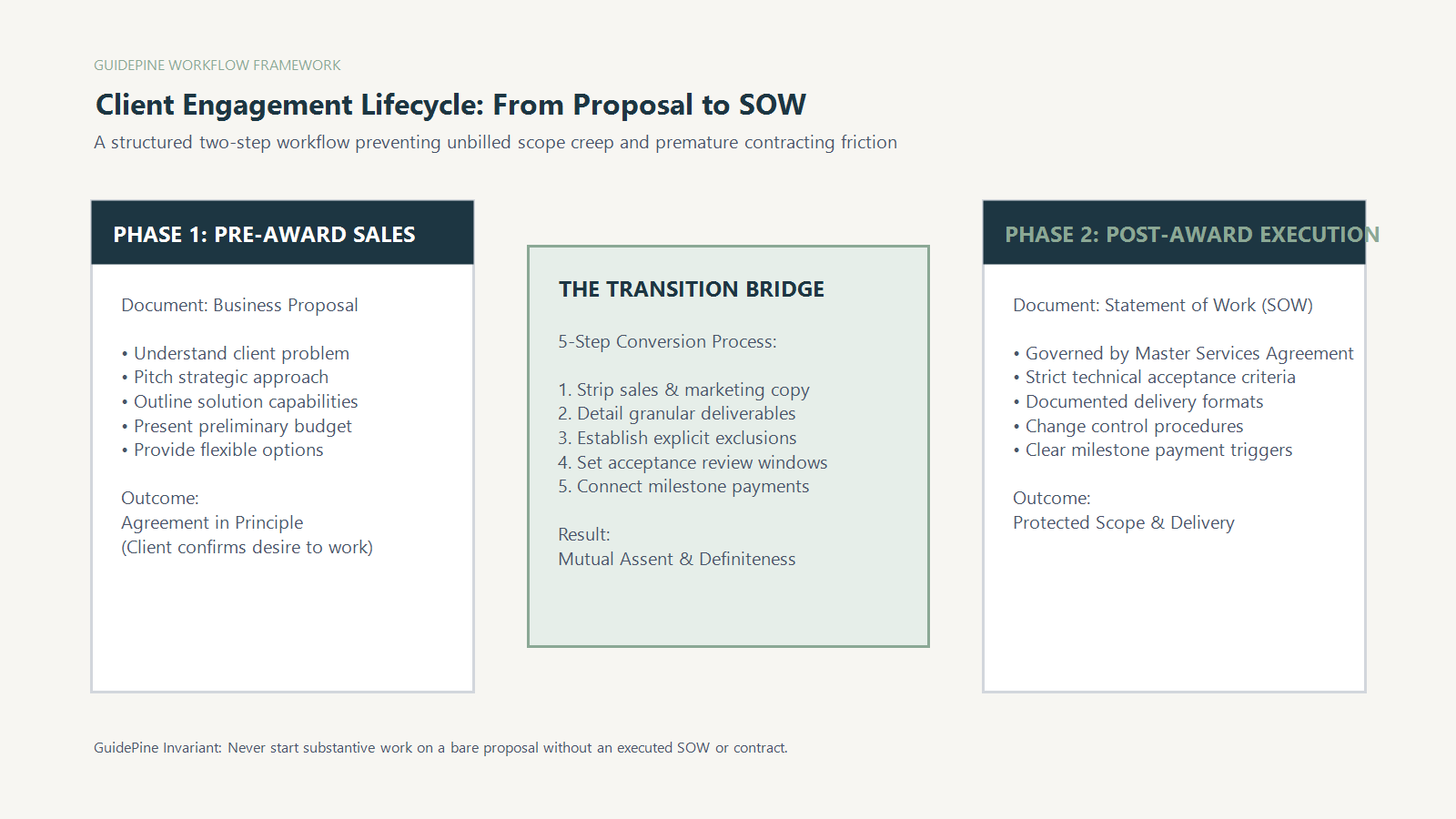
A proposal belongs to the sales phase of a client relationship. Its job is persuasion: establishing credibility, demonstrating understanding of the client’s problem, and making a compelling case for why the freelancer or agency is the right choice. At this stage, pricing is typically estimated, timelines are approximate, and language is intentionally flexible to allow room for negotiation.
A Statement of Work belongs to the execution phase. It is a working document that the team refers to throughout the engagement. Every term in an SOW exists to prevent ambiguity, not to persuade. The shift from proposal to SOW is a shift from “here is what we could do” to “here is exactly what we will do, by when, for how much, and under what conditions.” For consultants and contractors drafting formal client agreements, our structured scope of work template provides seven essential sections and practical clauses to define deliverables, acceptance criteria, and milestone schedules.
Sending an SOW too early in the client relationship introduces unnecessary friction. Presenting a client who is still evaluating providers with a formal contract document can feel presumptuous and may cause hesitation before they have fully committed. Conversely, starting substantive work on the basis of a signed proposal alone creates scope risk. Without granular deliverable definitions, review windows, and change-control provisions, there is no documented baseline against which to measure completion or handle client-requested modifications.
Scope granularity is where the two documents diverge most sharply. A proposal might describe a deliverable as “a refreshed website with improved navigation and updated brand visuals.” An SOW must replace that description with specific output items: a ten-page responsive website built in WordPress, delivered as a staging environment URL, with five rounds of revision per page within a seven business day review window, in accordance with the visual guidelines delivered at Milestone 1. The proposal opens the conversation; the SOW closes it.
Pricing follows the same pattern. A proposal may present a budget range or a ballpark total to gauge client appetite. The SOW converts those estimates into fixed milestone amounts tied directly to deliverable acceptance events, so both parties know precisely what triggers each payment.
On legal enforceability, the substance-over-label principle means that neither document is automatically binding or non-binding by virtue of its name. A signed proposal that specifies services, deliverables, pricing, and timelines with enough definiteness can satisfy the essential elements of a contract under general U.S. contract law. However, operating on a bare proposal signature without formal contract terms (limitation of liability, intellectual property ownership, governing law) exposes the freelancer to significant legal gaps. The SOW framework, particularly when paired with a master services agreement, is designed to close those gaps.
Legal and Contractual Standing: What Makes These Documents Binding?
Under general U.S. contract law, as summarized by Cornell Law School Legal Information Institute and the Restatement (Second) of Contracts, an enforceable agreement requires mutual assent (offer and acceptance), consideration, legal capacity of the parties, and definiteness of essential terms. No single document title confers enforceability. What matters is whether the content satisfies those elements and whether both parties have manifested their agreement, typically through signatures.
The Substance-Over-Label Principle
Labeling a document a “proposal” does not insulate it from forming a binding contract if a client signs it and it contains sufficiently definite terms. Equally, a document titled “Statement of Work” that lacks essential terms or is never manifested through mutual assent carries no enforceable weight. While an unexecuted SOW creates severe evidentiary vulnerabilities, contract law recognizes that mutual assent may occasionally be established through unambiguous written assent, performance of work, or payment acceptance depending on applicable state law. However, relying on conduct rather than a signed instrument exposes freelancers to costly legal disputes over scope and terms. Practitioners should understand that the legal analysis begins with the document’s substantive terms and the parties’ manifested assent, not its formal heading.
A freelancer who wants the proposal to function purely as a sales document, without creating binding obligations, should include explicit language clarifying that the proposal does not constitute an offer capable of acceptance and that a separately executed agreement will govern the engagement.
The MSA Framework
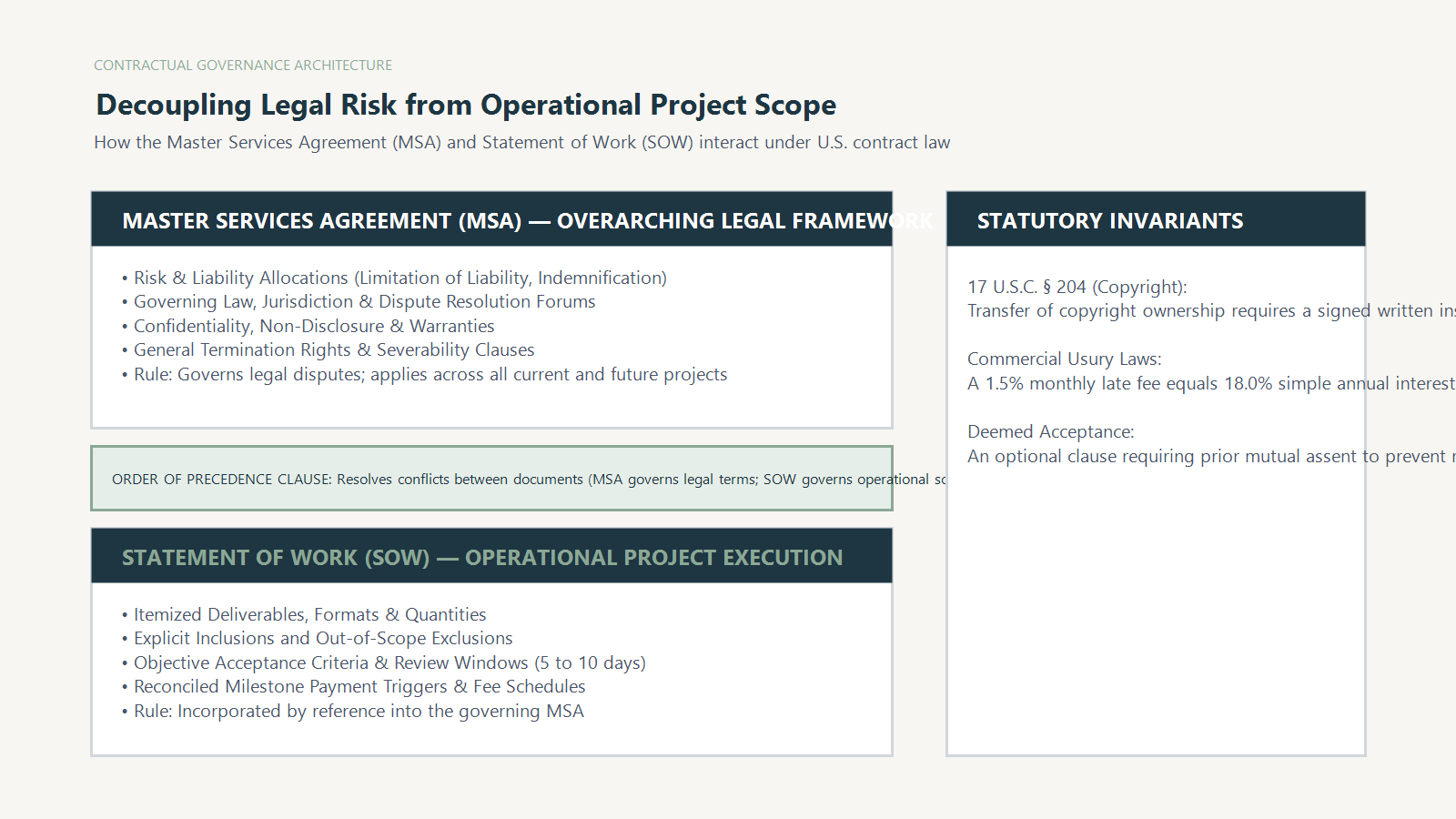
For engagements with enterprise clients, agencies, or repeat buyers, the most defensible structure separates legal risk from operational scope. A master services agreement (MSA) covers the provisions that rarely change between projects: indemnification, limitation of liability, governing law and dispute resolution, warranty disclaimers, confidentiality, and termination rights. The SOW then covers what changes with each project: scope, deliverables, timelines, milestones, and fees.
When an SOW incorporates the MSA by reference, an order of precedence clause specifies which document controls in the event of a conflict. Typically the MSA governs on legal and risk matters, while the SOW governs on operational and payment matters. Without that clause, a conflict between the two documents may require litigation to resolve.
Intellectual Property and Copyright Assignment
Freelance creative and technical deliverables are not automatically works made for hire. Under 17 U.S.C. § 101 and U.S. Copyright Office Circular 30, works made for hire must either be created by an employee within the scope of employment, or fall within one of nine narrow statutory categories for commissioned works (including contributions to collective works, parts of motion pictures, translations, supplementary works, compilations, instructional texts, tests, answer material for tests, and atlases). Most standalone freelance deliverables, including websites, logos, written content, and software, do not fall into these categories.
For copyright to transfer from a freelancer to a client, 17 U.S.C. § 204 requires a signed written instrument explicitly conveying ownership. The timing and scope of that transfer are negotiated contractual terms, not statutory requirements. Freelancers protect their leverage by conditioning copyright transfer on receipt of full payment: the client receives a broad license to use the work upon project completion, with full ownership assignment documented upon final payment clearance.
Late Payment Provisions
If the SOW or MSA includes a late payment interest clause, that rate must be agreed upon before performance begins. A commonly cited illustrative rate is 1.5% per month, which equals 18.0% simple annual interest (1.5 multiplied by 12 months equals 18.0%). This is an illustrative contractual term, not a universal default or statutory requirement. It is subject to applicable state usury laws, and best practice is to include a savings clause: “or the maximum rate permitted by applicable law, whichever is less.” A late fee provision added unilaterally after delivery has no contractual basis.
When to Use a Proposal, an SOW, or Both
The right document, or combination of documents, depends on the engagement’s complexity, the client relationship, and the risk profile of the work.
When a Proposal Alone May Be Sufficient
For short, low-complexity, fixed-price projects with a single clearly defined deliverable, a detailed signed proposal can function as the working agreement if it contains essential terms. A single-page brochure design, a one-hour consulting session, or a fixed retainer for a defined monthly service can often proceed on a signed proposal without a separate SOW. The risk is proportional to the project value and scope: the simpler and shorter the engagement, the lower the exposure from using a proposal as the governing document.
Freelancers taking this approach should still include clear deliverable descriptions, revision limits, payment terms, and a brief IP clause directly in the proposal to ensure the document contains enough definiteness to be enforceable if a dispute arises.
When a Formal SOW Is Appropriate
A dedicated SOW is appropriate whenever the engagement involves multiple phases, multiple deliverable types, enterprise or institutional clients, subcontractor involvement, or any work governed by an existing MSA. The SOW establishes the milestone-level specificity that protects both parties when the project extends over weeks or months.
Specific scenarios that call for a formal SOW include multi-phase website or software development projects, brand identity systems with multiple file format deliverables, long-term content retainers with monthly scope resets, any engagement where a client’s legal team will review the agreement before signing, and any project involving subcontractors to whom you will pass downstream scoped obligations. For recurring consulting arrangements, pair the SOW with clearly negotiated retainer terms; our consulting retainer agreement template illustrates the fee, capacity, overage, and renewal provisions to address.
The Two-Step Workflow
The most practical approach for mid-to-high-value freelance engagements is a sequential two-document workflow:
- Send the proposal. Use it to establish rapport, demonstrate strategic understanding, present a budget range, and confirm that the client wants to move forward. The proposal answers: “Should we work together, and roughly on what terms?”
- Issue the SOW before beginning work. Once the client accepts the proposal in principle, convert the agreed parameters into a formal SOW that specifies exact deliverables, acceptance criteria, milestone payment triggers, review windows, and a change-control procedure. Work does not begin until both parties sign the SOW.
This workflow prevents the two most common scope problems: starting work before terms are finalized (which often results in uncompensated scope expansion), and issuing a formal contract before the client has emotionally committed (which can interrupt the sales momentum).
How to Turn an Accepted Proposal into a Statement of Work
Converting an accepted proposal into a production-ready SOW requires five deliberate steps. The goal is to strip the persuasive layer from the document and replace it with operational precision.
Step 1: Strip Sales Language
Remove everything written to persuade rather than to specify. This includes agency background sections, rationale for the proposed approach, subjective language (“beautiful,” “seamless,” “innovative”), and any promises that cannot be measured against an objective standard. What remains should be a neutral, factual description of what will be delivered.
Step 2: Define Granular Deliverables and Explicit Exclusions
Convert each broad bullet in the proposal into a concrete deliverable with a format, quantity, revision limit, and delivery method. At the same time, enumerate explicit exclusions in a dedicated section. Commonly excluded items include copywriting and content creation, stock photography or font licensing fees, third-party software subscriptions, ongoing hosting or maintenance, and any task not specifically listed in the scope. Exclusions are not an afterthought; they are the first line of defense against scope creep.
Step 3: Establish Acceptance Criteria and Review Windows
For each deliverable, specify the format of a compliant submission, the review window (typically five to ten business days is appropriate for most creative and technical deliverables), and what constitutes a defect notice. A defect notice should be written, specific, and reference the relevant acceptance criteria, not a general expression of dissatisfaction.
A deemed acceptance clause is an optional provision, requiring prior mutual assent from both parties, that specifies the conditions under which a deliverable is considered accepted if the client does not respond within the review window. This clause prevents an engagement from stalling indefinitely. It should not be presented as a unilateral right; it must be negotiated and agreed upon in writing before the engagement begins.
Step 4: Implement Change-Control Procedure
All scope modifications after the SOW is signed must follow a formal process. Any client request to add deliverables, change specifications, or extend the timeline requires a written change order signed by both parties. The change order should specify the additional cost, the revised timeline impact, and any adjustments to milestone payment triggers. Work on the modification does not begin until the change order is fully executed.
This procedure protects both parties: the client gets a documented record of scope evolution, and the freelancer has an audit trail that justifies additional invoicing.
Step 5: Tie Milestone Payments to Deliverable Acceptance
Replace any calendar-based billing schedule from the proposal with milestone-based payment triggers tied directly to deliverable acceptance events. Instead of “invoice on the 1st of each month,” the payment schedule reads: “30% of project total due upon written client acceptance of wireframes and visual brand guidelines.” This structure ensures that payment velocity reflects actual project progress and that neither party is left financially exposed by delays outside their control.
Copy-Ready Statement of Work Template
This template is provided as a starting point. It is not legal advice. No single template is universally enforceable across all jurisdictions or engagement types. While this container illustrates standard commercial clauses, executing an SOW as a standalone document without an overarching Master Services Agreement leaves legal limitations on liability, indemnification, and dispute resolution unresolved unless specifically added. Consult a licensed attorney to review and adapt this language to your specific jurisdiction, risk tolerance, and project requirements.
STATEMENT OF WORK
SOW Number: [SOW NUMBER] Effective Date: [DATE] Project Name: [PROJECT NAME] Governing Agreement Reference: [Optional: Master Services Agreement dated [GOVERNING MSA DATE] between [YOUR BUSINESS NAME] and [CLIENT NAME] / Or designate: Standalone Project SOW]
Section 1: Project Overview and Objectives
This Statement of Work is entered into by and between [YOUR BUSINESS NAME] (“Service Provider”) and [CLIENT NAME] (“Client”) [if applicable: and is governed by the Master Services Agreement referenced above; where no MSA exists, this SOW serves as the governing project agreement]. This SOW defines the specific deliverables, milestones, compensation, and terms applicable to [PROJECT NAME].
Project Objectives:
- [Describe the primary business objective this project addresses]
- [Describe the secondary objective, if applicable]
- [Describe any measurable outcome the parties have agreed to target]
Section 2: Scope of Services and Deliverables
The following deliverables are included in this SOW. All work not listed below is excluded from scope.
| Deliverable | Description | Delivery Format | Quantity |
|---|---|---|---|
| [Deliverable 1 Name] | [Specific description of deliverable] | [File format, URL, or physical item] | [Number of units] |
| [Deliverable 2 Name] | [Specific description of deliverable] | [File format, URL, or physical item] | [Number of units] |
| [Deliverable 3 Name] | [Specific description of deliverable] | [File format, URL, or physical item] | [Number of units] |
Section 3: Explicit Exclusions
The following items are expressly outside the scope of work and are not included in the compensation defined in Section 7:
- Copywriting, editorial content, or content strategy not listed in Section 2
- Stock photography, font licenses, or third-party illustration licensing fees
- Third-party software, platform subscriptions, or API access fees
- Website hosting, domain registration, or ongoing server maintenance
- Training, documentation, or knowledge transfer sessions beyond those listed in Section 2
- Any task not specifically identified in Section 2
Changes to this exclusion list require a written change order per Section 6.
Section 4: Schedule and Milestones
| Milestone | Trigger Event | Target Due Date | Client Review Window |
|---|---|---|---|
| Milestone 0: Project Kickoff | Execution of this SOW and receipt of initial deposit | [DATE] | None |
| Milestone 1: [Name] | Delivery of [specific deliverable] to Client | [DATE] | [5 to 10] business days |
| Milestone 2: [Name] | Written acceptance of Milestone 1 deliverables | [DATE] | [5 to 10] business days |
| Milestone 3: Final Delivery | Completion of all deliverables listed in Section 2 | [DATE] | [5 to 10] business days |
All dates are estimates. Changes to timelines resulting from delayed client feedback, client-requested scope modifications, or force majeure events will be documented in a written change order per Section 6.
Section 5: Acceptance Testing and Review Protocol
Review Window: Client will review each deliverable within the number of business days specified in Section 4 of this SOW.
Defect Notice: To request revisions, Client must submit a written defect notice within the applicable review window. The notice must (a) identify the specific deliverable, (b) reference the relevant acceptance criteria described in Section 2, and (c) describe the specific nonconformance. A general expression of dissatisfaction does not constitute a valid defect notice.
Deemed Acceptance: If Client does not submit a written defect notice within the applicable review window, the deliverable shall be deemed accepted. This deemed acceptance provision is a negotiated term agreed upon by both parties as evidenced by their signatures below. It does not operate unilaterally and may be modified only by a written amendment signed by both parties.
Revision Limits: Each deliverable includes [insert number] rounds of revision. Additional revisions beyond this limit constitute a scope change and require a written change order per Section 6.
Section 6: Change Management Protocol
Any modification to the scope of work, timeline, or compensation requires a written change order executed by authorized representatives of both parties prior to implementation. A change order must specify:
- The nature of the requested change
- The additional cost or cost reduction, if any
- The revised timeline impact
- Any adjustments to milestone payment triggers
Work on a requested modification does not begin until the change order is fully executed. Verbal authorizations do not constitute approval for scope changes.
Section 7: Compensation and Milestone Payment Schedule
Total Project Fee: [Total Amount]
| Milestone | Payment Amount | Percentage of Total | Payment Trigger |
|---|---|---|---|
| Initial Deposit | [Amount] | [%] | Due upon execution of this SOW, before work begins |
| Milestone 1 Payment | [Amount] | [%] | Due upon written Client acceptance of Milestone 1 deliverables |
| Milestone 2 Payment | [Amount] | [%] | Due upon written Client acceptance of Milestone 2 deliverables |
| Final Payment | [Amount] | [%] | Due upon written Client acceptance of final deliverables |
| Total | [Total Amount] | 100% | None |
Payment Terms: Invoices are due within [insert number] days of the payment trigger event. Any late payment interest provisions, if applicable, are governed by the MSA. Where no MSA is in place, the parties agree that any late interest rate shall be [insert rate, e.g., 1.5% per month as an illustrative contractual term subject to applicable state law] or the maximum rate permitted by applicable law, whichever is less.
Section 8: Intellectual Property and Ownership
Upon receipt of full and final payment of all amounts due under this SOW, [YOUR BUSINESS NAME] hereby assigns to [CLIENT NAME] all right, title, and interest in and to the deliverables created specifically for this engagement, including copyright, pursuant to a signed written instrument as required by 17 U.S.C. § 204. Prior to full payment, [CLIENT NAME] receives a limited, non-exclusive license to review deliverables for acceptance purposes only.
Pre-existing materials, tools, frameworks, libraries, and methodologies developed or owned by [YOUR BUSINESS NAME] prior to this engagement remain the exclusive property of [YOUR BUSINESS NAME]. [CLIENT NAME] receives a non-exclusive, perpetual license to use such pre-existing materials as incorporated into the deliverables, solely in connection with [PROJECT NAME].
The parties acknowledge that the deliverables created under this SOW are not works made for hire under 17 U.S.C. § 101 unless they fall within one of the nine statutory categories defined therein, and that ownership transfer requires the express written assignment above.
Section 9: Signatures and Mutual Assent
The signatures below evidence the mutual assent of both parties to the terms of this Statement of Work. This SOW [if applicable: together with the Governing MSA referenced in the header / or: as a standalone project agreement] constitutes the entire agreement between the parties with respect to [PROJECT NAME] and supersedes any prior oral or written understandings regarding this engagement.
[YOUR BUSINESS NAME]
Authorized Signature: ____________________________________
Printed Name: ____________________________________
Title: ____________________________________
Date: ____________________________________
[CLIENT NAME]
Authorized Signature: ____________________________________
Printed Name: ____________________________________
Title: ____________________________________
Date: ____________________________________
Worked Example (Hypothetical): Web Redesign and Brand Positioning Engagement
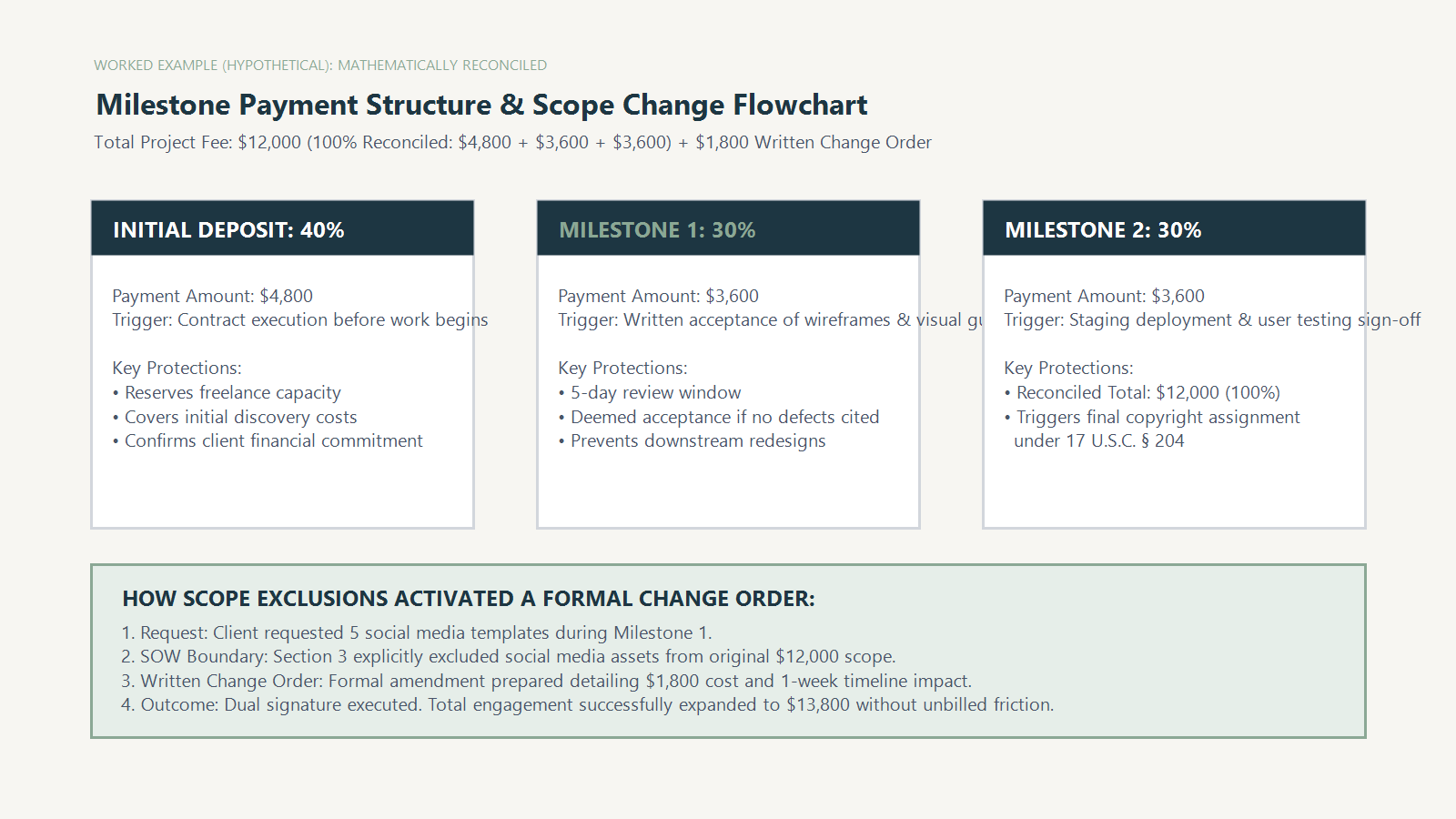
This section illustrates how the proposal-to-SOW workflow functions in practice. All details below are fictional and are presented solely as a hypothetical illustration, not as a real case study or verified client experience.
Engagement Overview: A freelance designer is awarded a web redesign and brand positioning engagement. The accepted proposal describes the engagement as “a full website redesign and updated brand identity.” The total agreed project value is $12,000.
Milestone Payment Structure (Mathematically Reconciled):
| Milestone | Description | Percentage | Amount |
|---|---|---|---|
| Initial Deposit | Due upon SOW execution, before work begins | 40% | $4,800 |
| Milestone 1: Design and Architecture Sign-Off | Due upon written acceptance of wireframes and visual brand guidelines | 30% | $3,600 |
| Milestone 2: Final Delivery and Launch Sign-Off | Due upon staging deployment and user testing acceptance | 30% | $3,600 |
| Reconciled Total | $4,800 + $3,600 + $3,600 | 100% | $12,000 |
How Scope Boundaries Protected Both Parties:
When the client’s marketing director asked the designer, midway through Milestone 1, to also create social media templates for five platforms, the SOW’s explicit exclusions section clearly listed “social media creative assets” as outside scope. Rather than absorbing the additional work or having a difficult conversation from a position of ambiguity, the designer prepared a written change order describing the social media deliverables, pricing the addition at $1,800, and extending the timeline by one week.
The client signed the change order. The designer invoiced the additional $1,800 at Milestone 2 completion, bringing the total engagement value to $13,800. The SOW did not prevent the scope expansion; it structured it. The client paid for additional value, and the designer was compensated for additional work.
This hypothetical illustration demonstrates why granular explicit exclusions and a formal written change order process are operational tools, not bureaucratic obstacles. They create a documented record of what was agreed, what was added, and what triggered each payment.
Frequently Asked Questions
Can a proposal serve as a legally binding contract?
Yes, if it contains all essential contract elements (mutual assent, offer, acceptance, consideration, legal capacity of the parties, and definiteness of essential terms) and both parties have signed it. However, proceeding without an MSA or formal terms on higher-value projects leaves the freelancer exposed to legal gaps on issues such as liability limits, warranty disclaimers, governing law, and IP ownership. For anything beyond a simple, low-value engagement, the proposal-plus-SOW structure provides stronger protection.
Should I charge clients for creating a Statement of Work?
For standard engagements, drafting the SOW is typically an administrative onboarding task absorbed into the project fee. For complex enterprise projects, multi-phase programs, or any engagement requiring extensive discovery and requirements gathering before scope can be defined, professionals reasonably treat the discovery phase as a paid deliverable, with the resulting SOW as the product. In those cases, the SOW preparation fee should be agreed upon and documented before the discovery work begins.
What happens if a client requests changes after the SOW is signed?
The change-control clause in Section 6 governs. Prepare a formal written change order that evaluates the cost impact, the timeline impact, and any adjustment to milestone payment triggers. Present it to the client for signature. Work on the requested modification does not begin until the change order is fully executed by both parties. Verbal authorizations are not substitutes for a signed change order.
Does a Statement of Work replace a Master Services Agreement?
No. The SOW specifies project-level deliverables, milestones, and payment obligations for a single engagement. The MSA establishes the overarching legal framework that applies across all projects with that client: limitation of liability, indemnification, warranty terms, IP assignment mechanics, confidentiality, and termination rights. An SOW without an MSA leaves those critical legal provisions unresolved. For repeat-client relationships or any engagement above a low complexity threshold, both documents together provide the most defensible structure.
Next Steps and Related Guides
If this article helped you understand the distinction between a proposal and an SOW, the following GuidePine guides cover the adjacent workflows in your client engagement process:
- Freelance Proposal Template: structure the initial client sales pitch before the SOW stage.
- Project Management Plan Example: manage execution controls and deliverable tracking after contract execution.
- Project Budget Overrun Guide: identify early warning signs, calculate cost variance, and protect profit margins when scope evolves.
- Payment Terms on an Invoice: establish invoicing terms and payment windows that align with your SOW milestone schedule.
- Sample Invoice for Hours Worked: itemize client billing for time-based engagements alongside your milestone billing workflow.