
Table of Contents
The Post-Signature Operational Gap: Why Client Projects Lose Momentum
Client onboarding is the structured operational process of transitioning a newly signed commercial client from sales agreement into active project execution. It encompasses legal verification, billing intake, workspace provisioning, strategic discovery, and formal stakeholder alignment. For independent consultants, freelance specialists, and boutique service agencies, the onboarding period establishes the professional standard for the entire engagement.
A common failure point in professional client work occurs during the post-signature gap. After celebrating a signed agreement, service providers often experience an uncoordinated pause. The client wonders what happens next, the consultant scrambles to request brand assets or technical credentials over scattered email threads, and project milestones drift before work officially begins. Without an explicit intake sequence, early enthusiasm deteriorates into operational confusion.
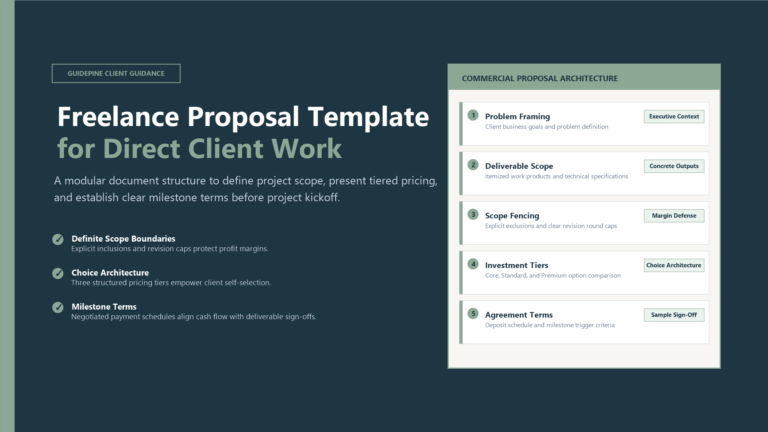
Managing this transition requires more than casual email check-ins. When converting new accounts originated through a structured freelance proposal template, deploying a comprehensive client onboarding checklist bridges the operational gap between commercial negotiation and technical execution. An authoritative checklist clarifies scope boundaries, protects payment timing, sets communication expectations, and eliminates administrative friction before billable delivery commences.
+---------------------------------------------------------------------------------------------------+
|                           THE FOUR PHASES OF PROFESSIONAL CLIENT ONBOARDING                       |
+-----------------------------+-----------------------------+---------------------------------------+
| PHASE 1: LEGAL & FINANCIAL  | PHASE 2: ADMINISTRATIVE     | PHASE 3: DISCOVERY & ASSET INTAKE     |
| - Countersigned Agreement   | - Shared Folder Hierarchy   | - Structured Intake Questionnaire     |
| - Form W-9 Collection       | - Communication Channels    | - Milestone Schedule Baseline         |
| - Upfront Deposit Cleared   | - Secure Credential Vault   | - Change Order Protocol Confirmation  |
+-----------------------------+-----------------------------+---------------------------------------+
                              | PHASE 4: KICKOFF & ALIGNMENT                                        |
                              | - 45-Minute Structured Kickoff Meeting Agenda                       |
                              | - Stakeholder RACI Matrix Alignment                                 |
                              | - Written Post-Kickoff Summary and 24-Hour Action Plan               |
+-----------------------------+---------------------------------------------------------------------+
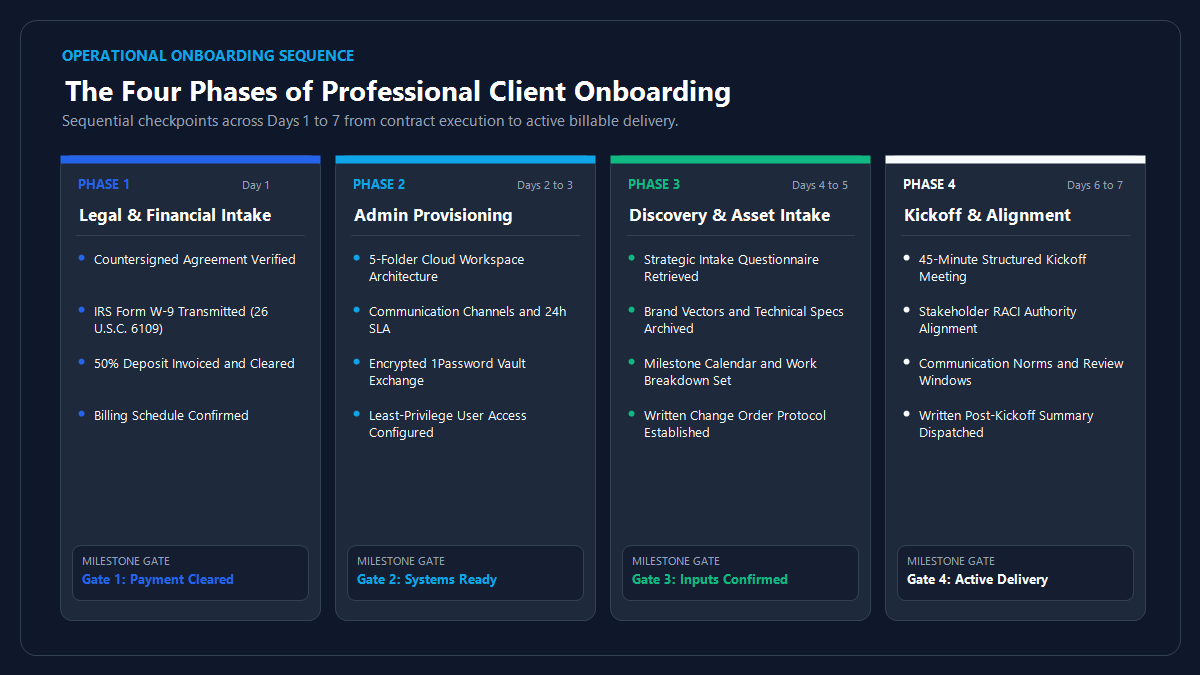
The Four Phases of Professional Client Onboarding
A dependable onboarding workflow divides administrative setup and strategic discovery into four distinct, sequential phases. Rather than overwhelming a new client with a twenty-question intake form and multiple access requests on Day 1, staging your requirements creates a professional, predictable experience.
The five-business-day onboarding sequence presented below represents a proposed adaptable workflow (typically structured across a five-day business week), designed to provide thorough administrative and strategic preparation before active milestone delivery begins. Practitioners can compress or extend this cadence to match project complexity: for a solo consultant delivering a discrete advisory sprint, the entire sequence can conclude within 48 to 72 hours, while enterprise consulting engagements involving multiple corporate stakeholders, legal departments, and IT security reviews may require allocating five to ten business days to prevent schedule compression and premature delivery stress.
The following overview outlines the objective, timeline benchmarks, primary deliverables, and key risks mitigated across each onboarding phase:
| Onboarding Phase | Target Timeframe | Primary Operational Owner | Core Deliverables | Critical Risk Mitigated |
|---|---|---|---|---|
| Phase 1: Legal & Financial Intake | Day 1 | Consultant and Client Finance | Countersigned contract, IRS Form W-9, initial deposit invoice, payment receipt confirmation. | Performing uncompensated labor or initiating deliverables without binding contractual terms. |
| Phase 2: Administrative Provisioning | Days 2 to 3 | Consultant and Client IT / Admin | Shared folder taxonomy, project portal access, communication rules, encrypted credential vault. | Scattered file storage, security vulnerabilities, and communication channel boundary erosion. |
| Phase 3: Strategic Discovery & Assets | Day 4 (Thursday) | Consultant and Project Lead | Completed intake questionnaire, brand assets, technical documentation, baseline milestone schedule. | Project delivery stalls resulting from missing assets or late-discovered technical dependencies. |
| Phase 4: Kickoff & Project Alignment | Day 5 (Friday) | Consultant and Key Stakeholders | 45-minute kickoff meeting, RACI stakeholder grid, post-kickoff written summary email. | Misaligned stakeholder expectations, unstated assumptions, and early scope expansion. |
Phase 1: Legal and Financial Intake
The first phase of onboarding establishes the commercial and regulatory foundation of the working relationship. Independent consultants must never treat legal documentation and deposit collection as casual afterthoughts. Executing these steps systematically on Day 1 establishes professional authority and protects both parties.
+---------------------------------------------------------------------------------------------------+
|                        PHASE 1: LEGAL & FINANCIAL INTAKE FLOWCHART                                |
+---------------------------------------------------------------------------------------------------+
  [Step 1.1: Verify Signed Contract]
                 |
                 v
  [Step 1.2: Exchange Tax Forms (IRS Form W-9 TIN Certification)]
                 |
                 v
  [Step 1.3: Issue Initial Deposit Invoice (Per Signed Agreement)]
                 |
                 +-----------------------+
                 |                       |
       [Deposit Unconfirmed]    [Deposit Cleared (ACH / Wire)]
                 |                       |
                 v                       v
     [HALT: Hold Production]   [ADVANCE: Provision Systems & Schedule Kickoff]
+---------------------------------------------------------------------------------------------------+
Step 1.1: Verification of the Countersigned Agreement
Never commence client work based solely on verbal assent, informal text messages, or an unsigned draft. Before creating workspace folders or scheduling discovery calls, verify that both parties have executed a binding agreement, whether formatted as a Master Services Agreement (MSA), a standalone consulting contract, or a detailed Statement of Work. For recurring advisory services, a consulting retainer agreement template can help document the recurring fee, scope, reserved capacity, and billing rules.
Your underlying agreement must define deliverables, milestone deadlines, client review turnaround windows, and payment obligations. When establishing project scope, refer to our comprehensive guide on drafting a scope of work template to ensure your deliverable descriptions, acceptance criteria, and explicit exclusions are legally enforceable before onboarding begins. Confirm that the countersigned PDF is permanently archived in your client legal records.
Step 1.2: Requesting and Archiving IRS Form W-9
Under Sections 6041 and 6041A of the Internal Revenue Code (IRC), businesses must report qualifying nonemployee compensation payments for services when statutory information-reporting requirements are met. Public Law 119-21, Section 70433, increased the general reporting threshold under Section 6041 from $600 to $2,000 for payments made after December 31, 2025, while the historical $600 threshold applies to payments made before 2026. However, several important statutory exceptions apply to this reporting requirement: payments made to corporate payees (including C corporations and S corporations) are generally exempt from Form 1099-NEC reporting under Treasury Regulation § 1.6041-3(p)(1), with specific exceptions for legal service fees paid to attorneys under IRC § 6045(f). Furthermore, payments settled via credit card or third-party payment networks are reported by payment settlement entities on Form 1099-K under IRC § 6050W, relieving payers from Form 1099-NEC filing obligations for those transactions.
To enable a client to obtain your correct taxpayer identification number (TIN) and determine applicable reporting or withholding requirements, furnish a completed Form W-9 upon request pursuant to IRC § 6109 and Treasury Regulation § 301.6109-1. Because Form W-9 contains sensitive taxpayer data (an individual Social Security Number or business Employer Identification Number), avoid transmitting completed W-9 forms over unencrypted standard email attachments. As a recommended security practice, use encrypted client portals, authenticated document-signing systems, or password-protected encrypted PDFs through the client’s approved secure collection procedure to safeguard taxpayer identifiers. Form W-9 collects the payee TIN and statutory certifications regarding U.S. person status and exemption codes. Under IRC § 3406, backup withholding at the statutory 24% rate can apply if a payee fails to furnish a certified TIN in the required manner or if the IRS notifies the payer of a TIN mismatch. Backup withholding is not an automatic deduction from compliant contractor payments, and using secure W-9 submission supports timely administrative compliance.
Optionally, if early vendor setup is mutually agreed or requested by the client during Day 1 intake, you can submit your completed Form W-9 using the client’s approved secure collection procedure (such as an encrypted accounts payable portal like Bill.com, Tipalti, or Coupa) rather than waiting until year-end reporting. Always follow the client’s designated secure intake channel rather than emailing sensitive tax forms alongside an invoice.
Disclaimer: Tax reporting obligations vary based on entity structure, state regulations, and international payee residency. Consult a licensed certified public accountant (CPA) or tax attorney for guidance regarding your specific business classification.
Step 1.3: Invoice Issuance and Initial Deposit Verification
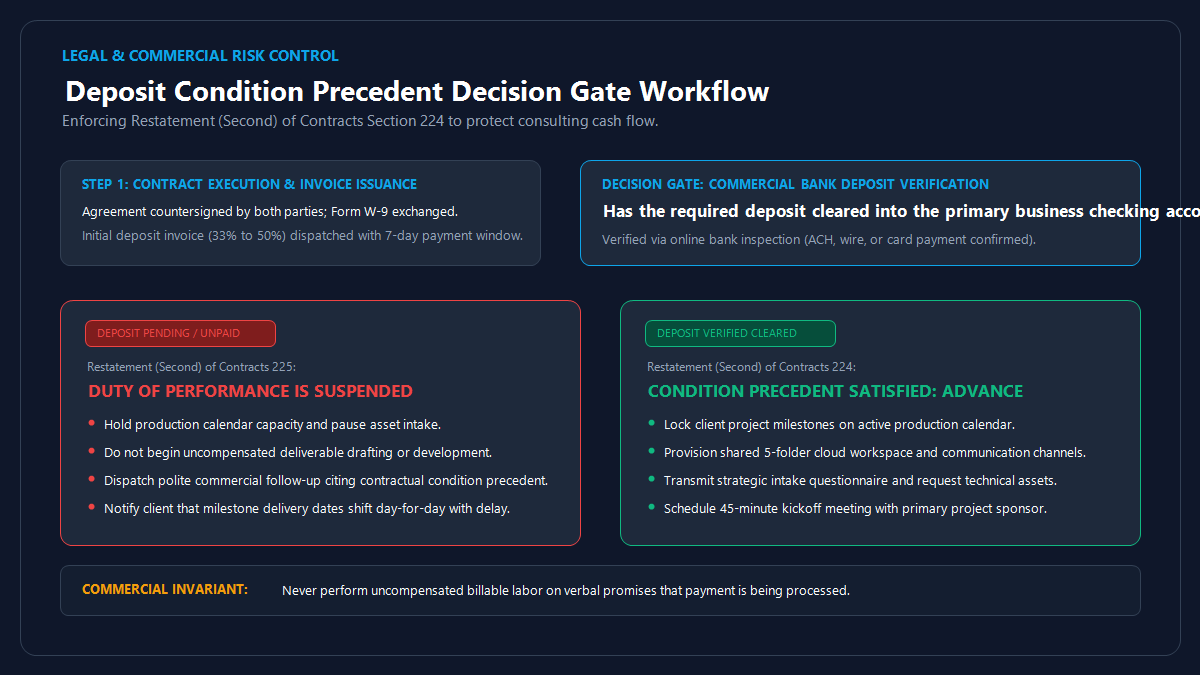
In contract law, a condition precedent (Cornell LII Wex) is generally defined as an event or state of affairs that must occur, unless excused, before performance under a contract becomes due. Whether a deposit requirement operates as a condition that must be satisfied before work begins depends on the contract’s wording and the governing state’s law. Consultants should state the requirement expressly in the agreement and obtain qualified legal advice where necessary.
Where your contract establishes an upfront deposit, issue the initial deposit invoice promptly once the agreement is signed. Whether deposit clearance acts as an enforceable condition precedent to starting work depends strictly on explicit contract language and governing law, so confirm that your agreement reflects the intended payment sequence. For fixed-fee consulting projects, practitioners frequently negotiate an upfront deposit, often in the range of 33% to 50% of the total project value as an illustrative commercial option. The specific deposit percentage is a negotiable business term rather than a statutory requirement or universal standard, and should reflect project duration, upfront resource commitments, and mutual risk tolerance. For detailed recommendations on configuring upfront deposits, late payment penalties, and milestone structures, examine our guide on payment terms on invoice.
Phase 2: Administrative and System Provisioning
Once commercial terms and deposit funds are confirmed, transition into technical and administrative setup. Phase 2 creates an organized digital environment where assets, communications, and deliverables reside without risk of data loss or boundary confusion.
Step 2.1: Shared Workspace and Directory Architecture
Disorganized digital storage causes version control errors, lost client feedback, and duplicate work. Avoid sending work-in-progress drafts as email attachments. Instead, establish a dedicated shared cloud directory (such as Google Drive, Microsoft SharePoint, or Dropbox) using a standardized five-folder structure:
[CLIENT-NAME] - Project Workspace/
|-- 01_Agreements_and_Billing/
|   |-- Countersigned_SOW_[Date].pdf
|   |-- Form_W9_[YourBusinessName].pdf
|   `-- Invoices/
|-- 02_Client_Intake_and_Assets/
|   |-- Completed_Intake_Questionnaire.pdf
|   |-- Brand_Guidelines_and_Logos/
|   `-- Technical_Documentation/
|-- 03_Drafts_in_Progress/
|   `-- [Deliverable_Name]_v0.1_Working.docx
|-- 04_Client_Review_and_Feedback/
|   `-- Consolidated_Feedback_Round1.pdf
`-- 05_Final_Deliverables/
    `-- [Deliverable_Name]_Final_Approved.pdf
Configure folder permissions intentionally. Set client team members as View Only or Commenter on working drafts to prevent unintended overwrites, while granting Editor access to the intake and feedback folders.
Step 2.2: Structured Communication Channels and Boundary Alignment
One of the fastest ways to burn out during a consulting project is allowing client communication to fragment across unmonitored text messages, WhatsApp groups, personal social media DMs, and late-night phone calls. During Phase 2, establish explicit communication rules in writing.
Adhere to the communications management principles outlined in the Project Management Institute (PMI) Guide to the Project Management Body of Knowledge (PMBOK Guide). Formulate an agreed communications framework defining: 1. Primary Project Channel: Designate a single project management workspace (such as Asana, ClickUp, or Basecamp) or centralized email thread for all official scope decisions and task updates. 2. Asynchronous Messaging: If using dedicated client Slack or Microsoft Teams channels, explicitly define them for quick, informal logistical questions rather than formal scope change requests. 3. Response-Time Norms: Establish a clear business-hours service expectation (for example, standard email inquiries answered within 24 business hours; urgent technical blockers answered within 4 business hours). 4. Meeting Cadence: Agree upon a regular weekly 30-minute status check-in, eliminating the need for unscheduled, disruptive daily calls.
Step 2.3: Secure Credential Exchange and Password Security
Consultants frequently require administrative access to client software, website hosting environments, analytics suites, or internal databases. Exchanging system passwords in plain text over unencrypted email or Slack violates basic cybersecurity standards and creates substantial commercial exposure.
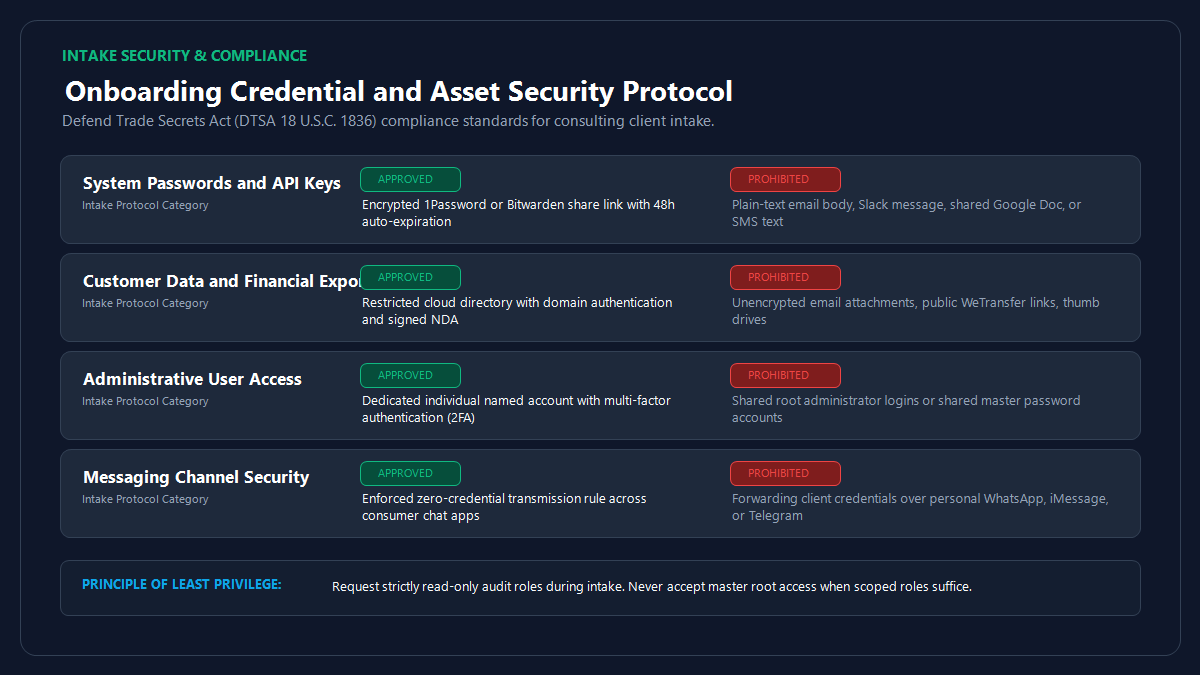
Protecting client proprietary data requires distinguishing between statutory trade-secret legal protections and practical technical information-security controls. Under the Defend Trade Secrets Act (DTSA), 18 U.S.C. § 1839(3), and state adoptions of the Uniform Trade Secrets Act (UTSA), business information qualifies for legal trade-secret protection only if the owner has taken reasonable measures under the circumstances to maintain its secrecy. However, the DTSA is a federal statutory misappropriation law, not an operational technical standard for password management. Operational security relies on practical technical controls: using encrypted password vaults, enforcing multi-factor authentication (MFA), practicing the principle of least privilege, and provisioning dedicated user credentials rather than sharing root administrative passwords. Transmitting logins over unencrypted email or consumer chat compromises practical account security and can undermine the legal argument that reasonable protective measures were in place.
Require clients to share administrative logins through an encrypted password management tool (such as 1Password, Bitwarden, or Keeper) using expiring, single-recipient secure sharing links. Where supported, instruct client IT administrators to issue you a dedicated individual user account tied to your business email with two-factor authentication (2FA) enabled, adhering strictly to the principle of least privilege as defined in NIST Special Publication 800-53 Rev. 5, Control AC-6 (Least Privilege). Never accept or use shared root administrator credentials.
| Asset or Access Category | Approved Secure Transfer Method | Prohibited Insecure Method | Operational Security Rule |
|---|---|---|---|
| System Passwords & API Keys | Encrypted password vault share link (1Password, Bitwarden) with auto-expiration. | Plain-text email body, Slack message, Google Doc, SMS text message. | Expire share links within 48 hours; require unique named logins rather than shared master credentials. |
| Customer Data & Financial Exports | Encrypted cloud drive folder with restricted, authenticated domain permissions. | Unencrypted email attachments, public wetransfer links, thumb drives. | Ensure non-disclosure agreement (NDA) execution precedes data upload; delete local working copies at handover. |
| Brand Assets & Vector Logos | Shared cloud drive directory (02_Client_Intake_and_Assets). |
Pasted images inside Word documents or compressed email zip archives. | Request original vector formats (.SVG, .EPS) and official brand style guidelines upfront. |
| Technical Architecture Docs | Dedicated project management portal or restricted corporate intranet access. | Forwarded internal email threads containing unvetted employee comments. | Catalog all external dependencies and confirm version compatibility before project kickoff. |
Phase 3: Strategic Discovery and Asset Collection
With administrative systems provisioned, Phase 3 focuses on gathering the contextual intelligence and raw assets required to deliver the project. Beginning delivery without complete discovery data forces mid-project halts and causes defensive rework.
+---------------------------------------------------------------------------------------------------+
|                        PHASE 3: DISCOVERY & ASSET INTAKE CHECKLIST                                |
+---------------------------------------------------------------------------------------------------+
  [Item 3.1: Issue Intake Questionnaire] --> Captures goals, audience, tech stack, and pain points
                 |
                 v
  [Item 3.2: Confirm Milestone Schedule]  --> Reconciles deliverable due dates with client review SLAs
                 |
                 v
  [Item 3.3: Reiterate Change Order Rule] --> Establishes that out-of-scope requests require written cost approval
+---------------------------------------------------------------------------------------------------+
Step 3.1: The Structured Client Intake Questionnaire
Do not conduct discovery through unstructured, rambling telephone conversations. Provide the client with a concise, targeted intake questionnaire designed to capture high-value strategic inputs.
A rigorous intake questionnaire must uncover four categories of operational data: – Strategic Goals & Success Metrics: What concrete business outcome must this engagement accomplish for the client to consider it a complete success? What specific metrics (e.g., conversion rates, processing time, operational cost) define that success? – Audience & Stakeholder Context: Who is the primary end-user or beneficiary of this work? Which internal client departments have a direct stake in the output? – Technical & Brand Constraints: What internal systems, brand standards, compliance rules, or legacy workflows restrict the solution? – Past Failures & Lessons Learned: Has the client attempted this project previously? If so, what internal roadblocks or vendor shortcomings prevented success?
Send the intake questionnaire as an editable document or clean digital form with an explicit return deadline (typically 48 to 72 business hours after receipt).
Step 3.2: Milestone Schedule Confirmation and Dependency Mapping
Projects rarely derail because a consultant works too slowly; they derail because client feedback takes twice as long as anticipated, or critical assets arrive three weeks late. During Phase 3, transform the initial project timeline into a mutual milestone schedule.
Map each deliverable alongside its required client dependencies. For example, if Deliverable B (System Architecture Specification) requires client approval of Deliverable A (Discovery Findings), explicitly state that the delivery date for Milestone B shifts day-for-day if Milestone A review exceeds the agreed turnaround window. For structured methodologies on documenting project milestones, tracking critical paths, and modeling dependencies, review our detailed guide on structuring a project management plan example. For a practical register to track project dependencies, assumptions, risks, and issues as onboarding moves into delivery, see our project management RAID log guide and free Excel template.
Establish clear client review SLAs upfront. A standard commercial SLA provides the client with three to five business days to review and return consolidated feedback on a submitted deliverable. Establishing this expectation during onboarding prevents clients from assuming they have unlimited time to review drafts while expecting delivery dates to remain fixed.
Step 3.3: Establishing the Written Change Order Process Upfront
Scope creep occurs when new requirements, revisions, or feature requests expand a project’s boundaries without a corresponding increase in compensation or delivery time. The most effective time to introduce the change order process is not when a dispute occurs mid-project, but during onboarding when mutual goodwill is highest.
Include an explicit statement in your onboarding materials explaining how scope changes are handled:
Positioning change orders as an organized, professional mechanism for accommodating client growth eliminates defensive friction when out-of-scope requests inevitably arise.
Phase 4: The Kickoff Meeting and Project Alignment
The final phase of client onboarding brings stakeholders together in a formal kickoff meeting. The kickoff meeting is not a working session to begin task production; it is an executive alignment session designed to confirm objectives, validate workflows, and establish mutual accountability.
+---------------------------------------------------------------------------------------------------+
|                        PHASE 4: THE 45-MINUTE KICKOFF MEETING ARCHITECTURE                        |
+---------------------------------------------------------------------------------------------------+
  [00-05 min: Welcome & Rapport]      --> Brief introductions, meeting goals, and agenda confirmation
                 |
                 v
  [05-15 min: Strategic Objectives]   --> Review core business problems, success metrics, and deliverables
                 |
                 v
  [15-25 min: Operating Protocols]    --> Walk through shared drives, communication tools, and review SLAs
                 |
                 v
  [25-35 min: Timeline & Dependencies]--> Inspect milestone schedule, client review windows, and next steps
                 |
                 v
  [35-45 min: Open Q&A & Confirmation]--> Address client questions, confirm immediate 24-hour action items
+---------------------------------------------------------------------------------------------------+
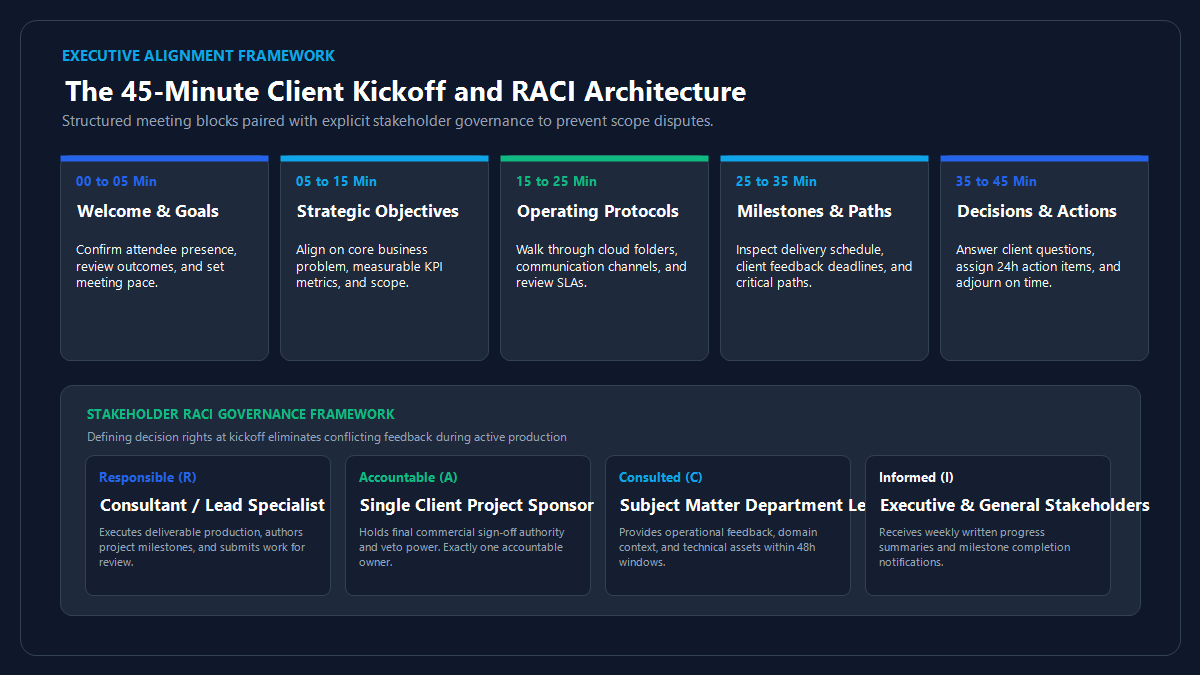
Step 4.1: The 45-Minute Kickoff Meeting Agenda
Keep the kickoff meeting tightly structured. Avoid open-ended, meandering conversations by circulating a written agenda at least 24 hours in advance. A 45-minute allocation provides sufficient time for alignment while respecting executive schedules.
Follow this structured five-part meeting agenda: – Part 1: Welcome and Objective Alignment (00 to 05 minutes): Welcome attendees, confirm the session’s purpose, and state the exact meeting deliverables. – Part 2: Strategic Goal Review (05 to 15 minutes): Summarize the core business problem from the intake questionnaire. Validate that all stakeholders agree on the primary metric of success. – Part 3: Operational Protocols and Tools (15 to 25 minutes): Demonstrate the shared folder architecture, review communication rules, and explain how draft feedback must be submitted. – Part 4: Milestone Schedule and Dependencies (25 to 35 minutes): Walk through the project calendar. Explicitly highlight upcoming dates where client feedback or asset deliveries are required to maintain schedule integrity. – Part 5: Questions and Immediate Next Steps (35 to 45 minutes): Address stakeholder questions, confirm action items assigned to specific individuals, and formally conclude the session on time.
Step 4.2: Clarifying Roles with the RACI Framework
In multi-stakeholder client organizations, projects stall when decision-making authority is ambiguous. Who has the authority to approve a final deliverable? Who provides technical feedback? Who is merely receiving status updates?
Applying the RACI Framework during onboarding clarifies authority and prevents circular review rounds: – Responsible (R): The practitioner or team member who executes the work and creates the deliverable (typically the consultant). – Accountable (A): The single individual with ultimate decision-making authority and final approval veto (typically the client executive sponsor). Exactly one person must be Accountable for each major milestone. – Consulted (C): Subject matter experts, department leads, or technical staff whose input is gathered prior to finalizing a deliverable. – Informed (I): Peripheral stakeholders who are notified of progress and milestone completions but do not possess editorial or review veto power.
| Project Deliverable / Milestone | Consultant | Client Sponsor | Department Lead | General Team |
|---|---|---|---|---|
| Intake Questionnaire & Assets | Accountable (A) / Responsible (R) | Informed (I) | Responsible (R) | Informed (I) |
| Draft Strategy Deliverable | Responsible (R) | Consulted (C) | Consulted (C) | Informed (I) |
| Consolidated Feedback Submission | Informed (I) | Accountable (A) | Responsible (R) | Informed (I) |
| Scope Change Order Approval | Responsible (R) | Accountable (A) | Consulted (C) | Informed (I) |
| Final Deliverable Sign-Off | Responsible (R) | Accountable (A) | Consulted (C) | Informed (I) |
Step 4.3: The Post-Kickoff Summary Email and Next Steps Protocol
Within 24 hours following the conclusion of the kickoff meeting, send a formal written summary email to all attendees. Verbal agreements made on a video conference fade quickly; a written summary permanently records the decisions and schedules agreed upon during the meeting.
Your post-kickoff summary email must document: 1. A concise bulleted recap of the key decisions confirmed during the meeting. 2. The final, agreed-upon milestone delivery calendar. 3. An explicit action-item checklist listing each task, the assigned owner by name, and the exact completion deadline. 4. Formal confirmation that substantive deliverable production has commenced.
Worked Example (Hypothetical): Onboarding a $12,000 Consulting Client
To illustrate how these four phases function in practice, consider the following detailed illustrative scenario. This hypothetical worked example demonstrates the exact onboarding workflow executed by an independent operational consultant over five consecutive business days.
Engagement Context and Commercial Terms
- Service Provider: Elena Vance, Strategic Operations Consultant (Solo Practitioner).
- Client Organization: Apex Freight Systems (Mid-sized regional freight carrier, 65 corporate employees).
- Executive Sponsor: Marcus Ward, Vice President of Operations.
- Project Scope: 6-week operational workflow overhaul and dispatch system integration analysis.
- Contract Type: Fixed-fee consulting agreement.
- Total Contract Value: $12,000.00.
- Payment Structure:
- Upfront Deposit (50%): $6,000.00 invoiced upon signing; in this hypothetical example, the signed agreement expressly states that deposit clearance is a condition precedent to project kickoff.
- Interim Milestone Payment (25%): $3,000.00 due upon delivery of Phase 1 Workflow Map (Week 3).
- Final Payment (25%): $3,000.00 due upon delivery and executive presentation of Final Overhaul Plan (Week 6).
+---------------------------------------------------------------------------------------------------+
|                        APEX FREIGHT SYSTEMS: FINANCIAL RECONCILIATION                             |
+-------------------------------------+------------------+------------------+-----------------------+
| MILESTONE / PAYMENT EVENT           | BILLING RATIO    | AMOUNT DUE (USD) | VERIFIED STATUS       |
+-------------------------------------+------------------+------------------+-----------------------+
| Milestone 1: Initial Deposit        | 50.00%           | $6,000.00        | Cleared (Day 3 ACH)   |
| Milestone 2: Interim Workflow Map   | 25.00%           | $3,000.00        | Scheduled (Week 3)    |
| Milestone 3: Final Delivery Handover| 25.00%           | $3,000.00        | Scheduled (Week 6)    |
+-------------------------------------+------------------+------------------+-----------------------+
| TOTAL CONTRACT VALUE                | 100.00%          | $12,000.00       | 100% RECONCILED       |
+---------------------------------------------------------------------------------------------------+
The 14-Item Five-Day Onboarding Execution Log
The following table documents the complete 14-item onboarding checklist executed by Elena across five business days, illustrating owners, prerequisites, deliverables, and completion verification:
| No. | Schedule | Onboarding Item Description | Owner | Prerequisite Dependency | Deliverable / Output Evidence | Status |
|---|---|---|---|---|---|---|
| 01 | Day 1 (Mon 09:00) | Execute Countersigned Consulting Agreement | Elena & Marcus | Final scope review completed | Countersigned PDF archived in 01_Agreements |
Completed |
| 02 | Day 1 (Mon 10:30) | Submit Consultant IRS Form W-9 | Elena Vance | Contract signature confirmed | Form W-9 delivered to Apex Accounts Payable | Completed |
| 03 | Day 1 (Mon 11:00) | Issue 50% Deposit Invoice ($6,000.00) | Elena Vance | Form W-9 submitted | Invoice #1042 issued via QuickBooks Online | Completed |
| 04 | Day 2 (Tue 09:30) | Provision Shared Cloud Workspace | Elena Vance | Contract executed | Five-folder Google Drive architecture established | Completed |
| 05 | Day 2 (Tue 11:00) | Establish Dedicated Asana Project Portal | Elena Vance | Folder setup completed | Apex project board configured with milestone tasks | Completed |
| 06 | Day 2 (Tue 14:00) | Deploy Encrypted 1Password Credential Vault | Elena Vance | Client IT lead identified | Expiring vault share link sent to Apex IT lead | Completed |
| 07 | Day 3 (Wed 10:15) | Verify 50% Deposit Clearance ($6,000.00) | Elena Vance | Invoice #1042 issued | Commercial bank ACH confirmation received ($6,000.00) | Completed |
| 08 | Day 3 (Wed 11:00) | Distribute Strategic Client Intake Questionnaire | Elena Vance | Deposit payment cleared | Digital intake form transmitted to Marcus Ward | Completed |
| 09 | Day 3 (Wed 14:30) | Retrieve Dispatch System Read-Only Credentials | Apex IT Lead | 1Password link sent | Named read-only access verified in dispatch software | Completed |
| 10 | Day 4 (Thu 12:00) | Receive Completed Intake Questionnaire & Assets | Marcus Ward | Intake questionnaire sent | Completed intake memo and process flows uploaded | Completed |
| 11 | Day 4 (Thu 15:30) | Circulate 45-Minute Kickoff Meeting Agenda | Elena Vance | Intake data reviewed | Five-part agenda and RACI matrix emailed to attendees | Completed |
| 12 | Day 5 (Fri 10:00) | Conduct 45-Minute Executive Kickoff Call | Elena & Team | Agenda distributed | Completed alignment session via Zoom; recording saved | Completed |
| 13 | Day 5 (Fri 14:00) | Transmit Post-Kickoff Summary & Action Register | Elena Vance | Kickoff call concluded | Written recap email distributed with confirmed calendar | Completed |
| 14 | Day 5 (Fri 15:30) | Officially Commence Phase 1 Deliverable Production | Elena Vance | Kickoff summary sent | First dispatch audit sprint initiated on schedule | Completed |
Interactive Worked Example Inspection Card
Review the full, plain-text operational record of Elena’s onboarding sequence below. You can copy the raw text directly into your project management system or client folder.
Apex Freight Systems: 5-Day Onboarding Execution Record
================================================================================
CLIENT ONBOARDING EXECUTION RECORD (HYPOTHETICAL WORKED EXAMPLE)
================================================================================
CLIENT NAME:        Apex Freight Systems, Inc.
PROJECT TITLE:      Operational Workflow Overhaul and Dispatch Integration
CONSULTANT:         Elena Vance, Management Consultant
CONTRACT VALUE:     $12,000.00 Fixed Fee
PAYMENT TERMS:      50% Initial Deposit ($6,000.00) / 25% Interim / 25% Final
ONBOARDING WINDOW:  Monday, October 12, 2026 to Friday, October 16, 2026
EXECUTIVE SPONSOR:  Marcus Ward, VP of Operations
PRIMARY CHANNEL:    Asana Portal + Weekly Status Call (Thursdays 10:00 AM CST)
================================================================================

PHASE 1: LEGAL & FINANCIAL INTAKE
--------------------------------------------------------------------------------
[x] 1.1 Countersigned Consulting Agreement
    - Timestamp: Monday, Oct 12, 2026 at 09:15 AM CST
    - Verified: Executed by Marcus Ward (Client) and Elena Vance (Consultant)
    - File Location: /01_Agreements/SOW_Apex_Freight_2026_Final.pdf

[x] 1.2 Form W-9 Submission
    - Timestamp: Monday, Oct 12, 2026 at 10:30 AM CST
    - Delivered To: Apex Accounts Payable (ap@apexfreight.example.com)
    - TIN Classification: Single-Member LLC / Disregarded Entity verified

[x] 1.3 50% Deposit Invoice Issuance ($6,000.00)
    - Timestamp: Monday, Oct 12, 2026 at 11:00 AM CST
    - Invoice Reference: INV-1042 via QuickBooks Online
    - Due Date: Payable upon receipt prior to project commencement

[x] 1.4 Deposit Payment Clearance Verification
    - Timestamp: Wednesday, Oct 14, 2026 at 10:15 AM CST
    - Payment Method: Corporate ACH direct deposit
    - Amount Cleared: $6,000.00 net in commercial account
    - Milestone Status: Express agreement deposit condition satisfied 100%

PHASE 2: ADMINISTRATIVE & SYSTEM PROVISIONING
--------------------------------------------------------------------------------
[x] 2.1 Workspace Directory Architecture Established
    - Timestamp: Tuesday, Oct 13, 2026 at 09:30 AM CST
    - Platform: Secure Google Workspace Cloud Directory
    - Structure:
        /Apex_Freight_Systems/
          01_Agreements_and_Billing/
          02_Client_Intake_and_Assets/
          03_Drafts_in_Progress/
          04_Client_Review_and_Feedback/
          05_Final_Deliverables/

[x] 2.2 Client Portal Configuration
    - Timestamp: Tuesday, Oct 13, 2026 at 11:00 AM CST
    - Platform: Asana Project Board
    - Setup: Milestone columns, weekly backlog, and review queue configured
    - Access: Marcus Ward (VP), Sarah Chen (Dispatch Lead) invited

[x] 2.3 Secure Credential Exchange
    - Timestamp: Tuesday, Oct 13, 2026 at 02:00 PM CST
    - Method: Encrypted 1Password share link (48-hour expiration)
    - Received: Dedicated read-only dispatch system credentials (ID: evance_ext)
    - Verified: Multi-factor authentication successfully tested

PHASE 3: STRATEGIC DISCOVERY & ASSET INTAKE
--------------------------------------------------------------------------------
[x] 3.1 Strategic Intake Questionnaire Distributed
    - Timestamp: Wednesday, Oct 14, 2026 at 11:00 AM CST
    - Target: Marcus Ward and Sarah Chen
    - Scope: Core operational bottlenecks, dispatch latency, driver feedback

[x] 3.2 Completed Questionnaire & Assets Retrieved
    - Timestamp: Thursday, Oct 15, 2026 at 12:00 PM CST
    - Assets Received: Current SOP handbook (PDF), Q3 dispatch logs (CSV)
    - Storage: Archived in /02_Client_Intake_and_Assets/

[x] 3.3 Milestone Calendar and Review SLAs Confirmed
    - Deliverable 1 (Workflow Map): Due Friday, Oct 30 (Week 3)
    - Review Window: Apex feedback due within 4 business days (Wed, Nov 4)
    - Deliverable 2 (Final Overhaul): Due Friday, Nov 20 (Week 6)
    - Scope Policy: Any requests outside SOW require written Change Order

PHASE 4: KICKOFF MEETING & ALIGNMENT
--------------------------------------------------------------------------------
[x] 4.1 Kickoff Agenda Distributed
    - Timestamp: Thursday, Oct 15, 2026 at 03:30 PM CST
    - Delivered: 45-minute agenda, RACI grid, and Zoom link distributed

[x] 4.2 45-Minute Executive Kickoff Call Conducted
    - Timestamp: Friday, Oct 16, 2026 from 10:00 AM to 10:45 AM CST
    - Attendees: Elena Vance (Consultant), Marcus Ward (VP), Sarah Chen (Lead)
    - Outcomes: Success metrics confirmed (target 20% reduction in dispatch lag)
    - Recording: Transcribed and archived in /02_Client_Intake_and_Assets/

[x] 4.3 Post-Kickoff Written Summary Transmitted
    - Timestamp: Friday, Oct 16, 2026 at 02:00 PM CST
    - Content: Recap of confirmed objectives, RACI roles, and 14-day schedule
    - Client Confirmation: Marcus Ward acknowledged and affirmed at 02:45 PM CST

[x] 4.4 Substantive Project Production Initiated
    - Timestamp: Friday, Oct 16, 2026 at 03:30 PM CST
    - Status: 100% on schedule; Week 1 dispatch data analysis underway
================================================================================
Interactive Reusable Template: Complete Client Onboarding Checklist
Use the copy-ready plain-text template below to build a customized, reusable client onboarding operating procedure for your consulting practice or freelance service business. This template includes generic placeholder tags (such as [YOUR BUSINESS NAME] and [CLIENT COMPANY NAME]) so you can adapt it directly into your project management system or client operations manual.
Master Client Onboarding Checklist & Intake Procedure
Standardized 4-phase procedural template with intake forms and meeting scripts.
================================================================================
MASTER CLIENT ONBOARDING CHECKLIST AND INTAKE PROTOCOL
================================================================================
SERVICE PROVIDER:  [YOUR BUSINESS NAME]
PRIMARY CONTACT:   [YOUR NAME / ROLE]
SUPPORT EMAIL:     [YOUR PROFESSIONAL EMAIL]
CLIENT NAME:       [CLIENT COMPANY NAME]
PROJECT TITLE:     [PROJECT OR ENGAGEMENT TITLE]
TOTAL CONTRACT:    $[TOTAL CONTRACT VALUE]
INITIAL DEPOSIT:   $[DEPOSIT AMOUNT] ([DEPOSIT PERCENTAGE]%)
ONBOARDING PERIOD: [START DATE] to [KICKOFF DATE]
================================================================================

SECTION 1: PHASE 1 LEGAL AND FINANCIAL INTAKE (DAY 1)
--------------------------------------------------------------------------------
[ ] 1.1 Verify Countersigned Contract
    - Task: Confirm mutual execution of Agreement / Statement of Work (SOW).
    - Storage: Archive executed PDF into /01_Agreements_and_Billing/.
    - Sign-Off: Both parties signed; zero unresolved redlines remaining.

[ ] 1.2 Issue Provider Tax Documentation (Form W-9)
    - Task: Transmit signed IRS Form W-9 to client accounts payable contact.
    - Statutory Note: Furnishes certified taxpayer identification under 26 U.S.C. Section 6109 and Treas. Reg. 301.6109-1 to satisfy annual 26 U.S.C. Section 6041/6041A reporting requirements ($2,000 threshold for payments made in 2026 under P.L. 119-21 Section 70433; historically $600 for pre-2026 payments; corporate payees and third-party network transactions generally exempt under Treas. Reg. 1.6041-3(p)(1) and IRC Section 6050W). Transmit via encrypted upload or secure client portal.
    - AP Contact Name:  [CLIENT ACCOUNTS PAYABLE CONTACT]
    - AP Contact Email: [CLIENT AP EMAIL ADDRESS]

[ ] 1.3 Issue Initial Deposit Invoice
    - Task: Issue Invoice #[INVOICE NUMBER] for $[DEPOSIT AMOUNT].
    - Contractual Terms: If intended, expressly state in the signed agreement that
      the required deposit must clear before work begins. Confirm the wording
      under the governing state's law.
    - Payment Methods: [ACH / WIRE TRANSFER / CREDIT CARD / BILL.COM]

[ ] 1.4 Confirm Deposit Bank Clearance
    - Task: Verify full fund clearance in provider commercial bank account.
    - Rule: Zero billable deliverable production begins prior to deposit clearance.
    - Clearance Date: [CLEARED DATE] | Transaction Reference: [REF NUMBER]

SECTION 2: PHASE 2 ADMINISTRATIVE AND SYSTEM PROVISIONING (DAYS 2-3)
--------------------------------------------------------------------------------
[ ] 2.1 Set Up Shared Workspace Directory Structure
    - Platform: [GOOGLE DRIVE / MICROSOFT SHAREPOINT / DROPBOX]
    - Create standard folder taxonomy:
        /[CLIENT NAME] - Workspace/
          01_Agreements_and_Billing/
          02_Client_Intake_and_Assets/
          03_Drafts_in_Progress/
          04_Client_Review_and_Feedback/
          05_Final_Deliverables/
    - Access Level: Grant client stakeholders "Viewer" or "Commenter" permissions.

[ ] 2.2 Configure Client Communication Protocols
    - Primary Project Workspace: [ASANA / CLICKUP / TRELLO / EMAIL]
    - Dedicated Chat (Optional): [SLACK CHANNEL / MS TEAMS / NOT APPLICABLE]
    - Standard Response SLA: Within 24 business hours (Monday-Friday, 9am-5pm [TIMEZONE]).
    - Scheduled Touchpoint: [WEEKLY STATUS CALL DAY AND TIME]

[ ] 2.3 Secure Technical Credential Exchange
    - Tool: [1PASSWORD / BITWARDEN / KEEPER] secure share link.
    - Security Standard: Encrypted credential vault with role-based least privilege and MFA.
    - Access Credentials Requested:
        * [SOFTWARE OR PLATFORM 1]: [ROLE REQUIRED, E.G., READ-ONLY AUDIT]
        * [SOFTWARE OR PLATFORM 2]: [ROLE REQUIRED]
    - Rule: Prohibit sharing plain-text passwords over unencrypted email or chat.

SECTION 3: PHASE 3 STRATEGIC DISCOVERY AND ASSET INTAKE (DAYS 4-5)
--------------------------------------------------------------------------------
[ ] 3.1 Transmit Strategic Client Intake Questionnaire
    - Core Questions to Answer:
        1. Primary Business Goal: What is the single most critical business outcome
           this project must achieve?
        2. Key Success Metrics: How will success be measured quantitatively?
        3. Audience Demographics: Who is the target user, customer, or reader?
        4. Technical Limitations: What system, legal, or brand constraints apply?
        5. Historical Context: What prior initiatives have been attempted?
    - Questionnaire Return Deadline: [DEADLINE DATE AND TIME]

[ ] 3.2 Collect Required Brand and Technical Assets
    - [ ] Vector Brand Logos (.SVG, .EPS, .AI)
    - [ ] Official Typography and Brand Style Guide (.PDF)
    - [ ] Technical Architecture Diagrams or Data Dictionaries
    - [ ] Relevant Historical Reports, Analytics, or Process Flows
    - Storage: Archive all received files in /02_Client_Intake_and_Assets/.

[ ] 3.3 Confirm Milestone Schedule and Change Order Protocol
    - Deliverable 1: [DELIVERABLE NAME] -> Due: [DATE] (Client Review: [X] Days)
    - Deliverable 2: [DELIVERABLE NAME] -> Due: [DATE] (Client Review: [X] Days)
    - Final Handover: [FINAL DELIVERABLE] -> Due: [DATE]
    - Written Change Order Rule: Any expansion beyond agreed SOW requires a
      formal written Change Order adjusting scope, budget, and timeline.

SECTION 4: PHASE 4 KICKOFF MEETING AND ALIGNMENT (DAY 5 / FRIDAY)
--------------------------------------------------------------------------------
[ ] 4.1 Distribute 45-Minute Kickoff Meeting Agenda (24h in advance)
    - Meeting Date & Time: [DATE, TIME, TIMEZONE]
    - Video Conference Link: [ZOOM / GOOGLE MEET / TEAMS URL]
    - Agenda Structure:
        * 00-05m: Welcome, introductions, and session objectives.
        * 05-15m: Core business goal and success metric confirmation.
        * 15-25m: Workspace walkthrough, communication rules, and review SLAs.
        * 25-35m: Milestone calendar, review turnaround windows, and dependencies.
        * 35-45m: Open Q&A and immediate 24-hour next steps.

[ ] 4.2 Establish Stakeholder RACI Matrix
    - Executive Sponsor ([CLIENT SPONSOR NAME]): Accountable (A) for final sign-off.
    - Service Provider ([YOUR NAME]): Responsible (R) for deliverable production.
    - Department Lead ([CLIENT LEAD NAME]): Consulted (C) for operational feedback.
    - General Stakeholders: Informed (I) via weekly summary emails.

[ ] 4.3 Transmit Written Post-Kickoff Summary Email (Within 24 Hours)
    - Email Subject: Project Kickoff Summary & Immediate Next Steps - [CLIENT NAME]
    - Document verified decisions, finalized calendar, and assigned action items.
    - Formally confirm the start of billable Phase 1 deliverable production.
================================================================================
Downloadable Client Onboarding Resources
To help you implement this onboarding workflow directly in your practice, we have prepared three comprehensive, production-ready resource files. Each file contains un-fragmented templates, checklists, and tracking systems designed specifically for independent consultants and small service firms.
Free Client Onboarding Workflow Downloads
Production-ready spreadsheet trackers, customizable Word manuals, and printable PDF checklists.
Dynamic Client Onboarding Tracker (Excel)
Three-tab automated workbook featuring an interactive 14-item onboarding schedule, automated progress percentage formulas, dependency tracking, and a client RACI matrix (5.5 KB).
Client Onboarding Procedure Manual (Word)
Complete, unbranded documentation manual containing email templates, kickoff meeting agendas, and intake questionnaires formatted for instant client deployment (3.1 KB).
14-Point Intake & Kickoff Checklist (PDF)
Print-ready one-page operational summary designed for active desk reference during client intake and onboarding review calls (5.2 KB).
Frequently Asked Questions About Client Onboarding
What should you do if a client fails to pay the onboarding deposit on time?
If an initial deposit is delayed, pause all billable deliverable production immediately and send a polite, factual email reminder referencing the contractual terms. State clearly that project kickoff and milestone schedules are anchored to the date of deposit clearance.
For example: “We are eager to begin your workflow overhaul. As noted in Section 4 of our Statement of Work, our delivery schedule commences once the initial deposit clears. Once your accounts payable team confirms the transaction, we will immediately schedule our kickoff call and lock in our deliverable milestones.” Never begin deliverable production in the hope that payment will arrive later; performing work prior to deposit clearance surrenders your financial leverage and exposes your business to uncompensated labor.
How do you handle clients who delay returning the intake questionnaire or brand assets?
When intake questionnaires or critical technical assets are delayed, notify the client executive sponsor in writing that delivery milestone dates must shift accordingly. Project schedules depend on mutual obligations; when client inputs are delayed, delivery dates cannot remain static.
Send a scheduled reminder after 48 hours: “To maintain our planned delivery date for Milestone 1 on the 15th, we require your completed questionnaire and vector brand files by tomorrow at 5:00 PM. If your team needs additional time to gather these materials, we will simply adjust our subsequent deliverable deadlines day-for-day to preserve thorough analysis.” This framing protects your delivery standards while making the commercial consequences of client delays transparent.
What should you do if a client requests immediate deliverables before the kickoff call?
Clients occasionally experience internal urgency and pressure consultants to bypass onboarding and start building deliverables immediately. Resist this pressure professionally. Explain that the onboarding sequence is specifically designed to prevent expensive rework, security vulnerabilities, and strategic misalignment.
Communicate the value of the process: “We recognize the urgency of this initiative and want to ensure our execution directly hits your target. Our intake and kickoff process takes only a few days and helps ensure that we build upon verified data, approved credentials, and executive consensus. Bypassing discovery risks delivering work that fails internal review, ultimately delaying your timeline.” Reassure them of the rapid onboarding timeframe while preserving your operational boundaries.
How do you manage onboarding when working with multiple client stakeholders with conflicting goals?
When working with large client teams, department heads often express divergent priorities during onboarding. To prevent becoming caught between internal factions, enforce the RACI framework established in Phase 4 and rely on the single Accountable executive sponsor.
If stakeholder priorities clash during the kickoff meeting or intake review, document the conflicting viewpoints neutrally and present them to the designated executive sponsor for a definitive decision: “During discovery, Marketing prioritized lead generation velocity while Compliance prioritized data retention controls. Because Marcus is designated as Accountable for project sign-off, we will structure our baseline schedule around the compliance standards he approved, while noting marketing opportunities as potential Phase 2 enhancements.” This approach maintains consultant neutrality and keeps project governance clean.