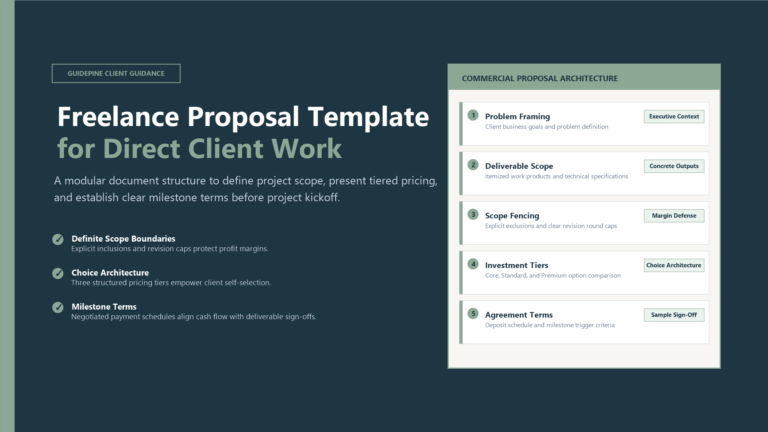

A freelance marketing proposal is an authoritative commercial agreement that outlines marketing strategy, defines channel deliverables, establishes project milestones, and sets clear investment terms before campaign execution begins. In independent marketing practices, casual email exchanges or verbal agreements often leave deliverables and performance expectations ambiguous. Without a structured proposal, freelance marketers frequently face scope creep across unbudgeted social channels, uncompensated revisions, and client disputes regarding third-party advertising spend.
A disciplined marketing proposal creates mutual assent on campaign scope while protecting professional advisory capacity. It ensures that both the independent marketer and the client share an identical understanding of what strategic assets are being produced, how revisions are managed, and how pass-through advertising expenses are funded.
This comprehensive guide provides an operational framework for writing freelance marketing proposals. It covers the seven essential sections every marketing proposal must include, provides actionable guidelines for separating professional advisory fees from paid advertising budgets, outlines statutory intellectual property and truth-in-advertising standards, and presents a complete, mathematically reconciled $9,600.00 B2B growth marketing worked example alongside an ungated, copy-ready template.
The 7 Essential Sections of a Freelance Marketing Proposal
Every commercial marketing engagement requires clear contractual boundaries. While tactical activities vary across search engine optimization, content marketing, paid acquisition, and email marketing, an effective proposal relies on seven structural pillars:
- 1. Executive Summary and Strategic Objectives: Outlines business context, customer acquisition friction, and core campaign objectives without exaggerated outcome claims.
- 2. Core Marketing Scope and Channel Deliverables: Itemizes specific campaign deliverables (such as editorial content calendars, ad copy variations, landing page wireframes, and analytics dashboards) with explicit volume boundaries.
- 3. Phased Implementation Roadmap and Milestone Timeline: Structures work into disciplined stages: Phase 1 (Audit, Strategy & Tracking Setup), Phase 2 (Channel Build & Campaign Execution), and Phase 3 (Conversion Optimization & Executive Handover).
- 4. Performance Metrics and Conversion Disclaimers: Establishes key performance indicators (organic search impressions, click-through rates, qualified lead volume) while qualifying under federal standards that commercial revenue outcomes cannot be guaranteed.
- 5. Client Dependencies, Asset Handoffs, and Review Turnarounds: Establishes explicit client responsibilities, including timely brand asset provision, platform access, and a mandatory 5-business-day feedback turnaround.
- 6. Commercial Terms, Fixed Milestone Fees, and Media Budget Separation: Structures project investment across phased milestone payments while mandating that third-party advertising spend be funded directly via the client’s corporate billing profile.
- 7. Intellectual Property Transfer, Terms, and Acceptance: Sourced to 17 U.S.C. Section 204(a), requiring a signed written instrument for copyright transfer, with transfer upon cleared full payment structured as an agreed contractual condition while reserving ownership of proprietary marketing audit frameworks.
1. Executive Summary and Strategic Growth Objectives
The executive summary opens the proposal by demonstrating an objective understanding of the client’s growth bottlenecks. Rather than focusing immediately on tactical channels, this section articulates the business challenge and target audience profile.
- Commercial Context: Summarizes the client’s market position, competitive pressures, and current acquisition challenges (such as rising customer acquisition costs, low organic search visibility, or weak lead nurturing).
- Target Audience Alignment: Identifies primary customer segments, buyer personas, and key purchasing triggers based on preliminary discovery discussions.
- Strategic Growth Statement: Formulates the overarching marketing initiative without promising unverified commercial results or guaranteed sales increases.
2. Core Marketing Scope and Channel Deliverables
The scope of work must itemize every tangible asset the client will receive. Ambiguity in deliverable descriptions is the primary driver of scope creep in creative and digital marketing engagements. Freelancers must specify deliverable volumes, formats, and channels.
Before detailing channel execution, independent professionals often use a freelance proposal template to structure preliminary client discovery findings into a formal commercial document.
| Marketing Channel | Deliverable Asset | Technical Volume & Format |
|---|---|---|
| Content Marketing | Long-form Pillar Guides | 2 monthly guides (2,000+ words) |
| Paid Search (SEM) | Google Search Campaign Build | 3 ad groups, responsive search ads with up to 15 headlines each |
| Email Marketing | Onboarding Nurture Sequence | 5 automated lifecycle emails |
| Web Analytics | GA4 Custom Funnel Dashboard | 1 Looker Studio executive board |
3. Phased Implementation Roadmap and Milestone Timeline
A structured timeline organizes complex multi-channel marketing initiatives into logical phases. Rather than presenting a chaotic task list, the roadmap establishes clear operational gates:
- Phase 1: Discovery, Technical Audit, and Analytics Setup (Weeks 1 to 4): Review historical campaign data, audit tracking infrastructure, conduct competitive keyword research, and establish conversion baselines.
- Phase 2: Asset Build, Creative Production, and Campaign Launch (Weeks 5 to 8): Produce creative assets, write ad copy, configure email automation workflows, and launch initial marketing campaigns.
- Phase 3: Conversion Optimization, Performance Audit, and Handover (Weeks 9 to 12): Monitor early engagement data, optimize low-performing ad creative, conduct A/B headline tests, and deliver executive performance reports.
When moving from high-level strategic proposals into tactical day-to-day execution, marketers must distinguish between an advisory agreement and a technical statement of work. Consulting a proposal vs statement of work guide helps clarify when to transition from strategic recommendations to granular milestone task lists.
4. Performance Metrics and Regulatory Conversion Disclaimers
Professional marketing proposals establish measurable key performance indicators (KPIs) while protecting the consultant from unreasonable commercial expectations. Under Section 5 of the Federal Trade Commission Act (15 U.S.C. Section 45), commercial advertising claims and marketing representations require adequate substantiation. While performance guarantees are not automatically unlawful if supported by competent and reliable empirical evidence, independent consultants generally avoid promising specific sales volumes or revenue numbers because final business results depend on variables outside the marketer’s operational control: product-market fit, sales closing velocity, pricing competitiveness, and third-party platform algorithm volatility. Proposals should focus on delivered strategic assets, audience reach, qualified traffic growth, and disciplined testing routines rather than unsubstantiated revenue promises.
5. Client Dependencies and Review Governance
Marketing campaigns require active client collaboration. A proposal must delineate client responsibilities to prevent project delays from stalling payment milestones: timely account access within 5 business days, provision of approved brand assets, and consolidated stakeholder feedback within 5 business days.
6. Commercial Terms, Fixed Fees, and Media Budget Separation
Commercial terms establish total project investment, payment schedules, invoice payment windows, and out-of-scope hourly rates. The proposal must mandate that all third-party media expenses (paid search and social ad spend) are funded directly by the client, completely separate from professional consulting fees.
7. Intellectual Property Transfer, Terms, and Acceptance
Under 17 U.S.C. Section 204(a) of the U.S. Copyright Act, a valid transfer of copyright ownership generally requires an instrument of conveyance in writing and signed by the owner of the rights conveyed. Within that statutory framework, specifying that copyright transfers to the client only upon receipt of cleared final payment is a standard, negotiated contractual condition that protects the consultant from unauthorized exploitation before invoices are satisfied, while proprietary audit frameworks remain the consultant’s licensed property.
While signing a proposal manifests mutual commercial assent, it forms a legally binding contract only when the document embodies definitive material terms (offer, acceptance, and consideration) and both parties demonstrate clear intent to be bound under applicable state contract law.
Separating Marketing Advisory Fees from Paid Advertising Budgets
A recommended financial practice for independent digital marketers is establishing direct, client-owned billing profiles for third-party media spend. While some agencies manage ad spend lines of credit, direct client card billing is the standard operational default for independent consultants to separate media pass-through costs from professional advisory fees and avoid personal credit exposure.
| Evaluation Criteria | Direct Client Card Billing | Marketer Credit Card Billing |
|---|---|---|
| Financial Exposure | Recommended default; minimizes consultant exposure to client non-payment | Consultant may bear contractual responsibility to ad networks if client defaults |
| Accounting Administration | Direct pass-through; ad spend appears on client books | Requires pass-through billing and careful reconciliation to avoid gross revenue distortion |
| Platform Account History | Client establishes direct credit history with ad platforms | Intermingling ad spend can risk account suspension across multiple clients |
| Payment Processing Costs | Client pays ad networks directly; no intermediary merchant fees | Consultant absorbs merchant processing fees unless contractually offset |
Worked Example (Hypothetical): $9,600 B2B Growth Strategy Engagement
The following hypothetical worked example illustrates an objective, mathematically reconciled 3-month digital marketing proposal for a business-to-business software startup.
- Client (Hypothetical): Kestrel Cloud Solutions (B2B SaaS data security provider).
- Consultant (Hypothetical): NorthStar Growth Advisory (Independent digital marketing practice).
- Project Scope: 3-Month Multi-Channel Growth Strategy, Content Marketing, and Search Engine Acquisition Campaign.
- Total Fixed Engagement Investment: $9,600.00.
- Out-of-Scope Hourly Rate: $150.00 per hour (applied to additional creative iterations or unbudgeted platform setups via written change order).
| Milestone Stage | Scope of Deliverables | Due Date | Investment |
|---|---|---|---|
| Milestone 1 (Month 1) | Full marketing audit, competitor keyword blueprint, GA4 tracking setup, and channel strategy map | Upon Contract Execution | $3,200.00 (33.33%) |
| Milestone 2 (Month 2) | 2 pillar articles (2,000 words), Google Search ad campaign build (3 ad groups, responsive search ads with up to 15 headlines and 4 descriptions each), 5-part email nurture | 30 Days Post-Execution | $3,200.00 (33.33%) |
| Milestone 3 (Month 3) | Conversion rate optimization, A/B headline tests, channel audit, executive reporting and handover | 60 Days Post-Execution | $3,200.00 (33.34%) |
| TOTAL FIXED INVESTMENT (100% RECONCILED) | $9,600.00 | ||
To evaluate project profitability and ensure that campaign production stays within budgeted allocations, consultants should track project hours against fixed fees. Reviewing consultant time tracking methodologies helps consultants audit their effective hourly realization rate across fixed milestone engagements.
Managing Scope Creep Across Multi-Channel Campaigns
Scope creep in marketing engagements typically manifests as requests for extra social media graphics, additional revisions on published copy, or demands to manage new platforms without additional budget.
| Work Category | Included in Agreed Scope | Requires Written Change Order |
|---|---|---|
| Content Revisions | 2 rounds of consolidated written feedback within 5 business days | Third or subsequent revision rounds; structural rewrites |
| Channel Expansion | Google Search and organic pillar content marketing channels | Managing Meta, TikTok, or LinkedIn paid ad campaigns |
| Creative Assets | Agreed ad copy and text scripts; 4 social promotion banner rasters | Video production, custom 3D animation, or photo shoots |
| Ad Budget Changes | Managing monthly client ad spend between $2,000 and $5,000/month | Re-architecting funnels for ad spend exceeding $10,000/month |
Following Up on Submitted Marketing Proposals
Once a marketing proposal is submitted, professional communication maintains momentum without appearing desperate. Under Restatement (Second) of Contracts Section 41, an offer expires upon the lapse of the time specified in the offer, or if no time is specified, at the end of a reasonable time. Specify a firm 14-day validity window to protect your calendar capacity.
For detailed email templates and guidance on handling prospective clients who stop responding, review the comprehensive guide on how to follow up on a proposal. If your scope focuses primarily on copywriting, long-form articles, or content marketing assets, compare our dedicated freelance writing proposal template.
Frequently Asked Questions About Freelance Marketing Proposals
Should freelance marketers guarantee sales or revenue results?
As a best operational practice, independent marketers generally avoid offering blanket sales or revenue guarantees in standard proposals. Under Section 5 of the FTC Act, any commercial performance claim requires prior substantiation through competent empirical evidence. Because final sales depend on client sales teams, product pricing, and market conditions outside the marketer’s direct control, proposals should establish commitments around executed deliverables, audience reach, and structured optimization sprints rather than unsubstantiated revenue guarantees.
Who pays for third-party advertising spend on Google and Meta?
Direct client card billing is the strongly recommended operational default for independent consultants. Having the client link their corporate card directly to their ad accounts avoids personal financial liability for media invoices, eliminates tax complications from gross revenue pass-throughs, and maintains transparent billing history directly owned by the client.
How many revisions should be included in a marketing proposal?
A standard marketing proposal should include two rounds of consolidated written feedback per deliverable, provided the feedback is submitted within a defined 5-business-day turnaround window. Structural pivots or additional rounds of revisions beyond the agreed allocation should be handled through written change orders billed at the marketer’s established out-of-scope hourly rate ($150.00 per hour).
When does copyright transfer for marketing copy and campaign graphics?
Under 17 U.S.C. Section 204(a), copyright transfer requires a written instrument signed by the creator. In commercial marketing engagements, intellectual property rights in final custom deliverables should formally transfer to the client only after the client has paid all project milestone invoices in full with cleared funds. Pre-existing consultant assets, such as strategy frameworks, calculation spreadsheets, and audit templates, remain the exclusive property of the consultant.
Free Downloadable Marketing Proposal Resources
Free Marketing Proposal Downloads
Download ready-to-use marketing proposal templates in Word (.docx) and PDF formats. Each file includes customizable deliverable tables, milestone payment terms, and statutory intellectual property clauses.
Blank Proposal Template
Standard 7-section proposal ready for client customization.
Filled Worked Example ($9,600)
Complete B2B growth marketing scope for Kestrel Cloud Solutions.
Copy-Ready Plain-Text Freelance Marketing Proposal Template
The following plain-text template provides a clean starting point for independent marketers. Replace all bracketed placeholders with your project details before presenting to prospective clients.
Freelance Marketing Proposal Template
FREELANCE MARKETING PROPOSAL & SCOPE OF WORK

Date: [DATE]
Proposal Reference: [PROPOSAL-REF-NUMBER]
Validity: This proposal is valid for 14 calendar days from the date above.

PREPARED FOR:
Client Name: [CLIENT CONTACT NAME]
Company: [CLIENT COMPANY NAME]
Email: [CLIENT EMAIL]

PREPARED BY:
Marketer / Agency: [YOUR NAME OR MARKETING PRACTICE]
Email: [YOUR BUSINESS EMAIL]
Website: [YOUR WEBSITE]

================================================================================
1. EXECUTIVE SUMMARY & OBJECTIVES
================================================================================
[YOUR MARKETING PRACTICE] has prepared this proposal to support [CLIENT COMPANY NAME]
in achieving strategic customer acquisition and growth objectives. Based on our
discovery discussion on [DISCOVERY DATE], the primary focus of this engagement is to
address acquisition bottlenecks, improve qualified organic traffic, and deploy
multi-channel conversion funnels.

Primary Growth Objectives:
* Objective 1: [E.G., BUILD AND LAUNCH A HIGH-INTENT GOOGLE SEARCH AD CAMPAIGN]
* Objective 2: [E.G., PRODUCE 2 MONTHLY IN-DEPTH PILLAR CONTENT GUIDES FOR ORGANIC SEARCH]
* Objective 3: [E.G., CONFIGURE A 5-PART AUTOMATED LIFECYCLE EMAIL NURTURE SEQUENCE]

================================================================================
2. SCOPE OF DELIVERABLES
================================================================================
Phase 1: Discovery, Technical Audit & Setup (Month 1)
* Comprehensive digital marketing audit and competitor positioning blueprint.
* Setup and verification of Google Analytics 4 event tracking and conversion tags.
* Target keyword research matrix and 90-day content calendar.

Phase 2: Asset Build & Campaign Execution (Month 2)
* 2 long-form pillar articles (minimum 2,000 words each, optimized for search).
* 1 complete Google Search ad campaign build (3 ad groups, responsive search ads utilizing up to 15 headlines and 4 descriptions each).
* 5 automated email onboarding nurture templates with responsive formatting.

Phase 3: Conversion Optimization & Reporting (Month 3)
* Bi-weekly A/B copy and headline testing across search ad groups.
* Landing page conversion rate optimization audit and recommendations.
* Final executive performance audit and client handover documentation.

Out-of-Scope Services:
Services not explicitly itemized above (including video production, custom 3D design,
unbudgeted social channels, or PR outreach) are excluded and require a separate
written change order at [YOUR HOURLY RATE, E.G., $150.00]/hour.

================================================================================
3. ADVERTISING BUDGET & BILLING POLICY
================================================================================
All third-party advertising expenditure (including media spend on Google Ads, Meta Ads,
or LinkedIn Ads) is funded directly by [CLIENT COMPANY NAME] via corporate credit card
linked to client ad accounts. Media spend is completely separate from the professional
consulting fees itemized below.

================================================================================
4. INVESTMENT & PAYMENT MILESTONES
================================================================================
Total Fixed Investment: $[TOTAL ENGAGEMENT VALUE, E.G., $9,600.00]

Payment Schedule:
* Milestone 1 (Month 1 Deposit): $[AMOUNT, E.G., $3,200.00] due upon contract execution.
* Milestone 2 (Month 2 Milestone): $[AMOUNT, E.G., $3,200.00] due 30 days post-commencement.
* Milestone 3 (Month 3 Completion): $[AMOUNT, E.G., $3,200.00] due 60 days post-commencement.

Payment Terms: Net 14 days from invoice date. Late payments incur interest at 1.5%
per month, or the maximum rate permitted by applicable state law, as established in the signed contract.

================================================================================
5. REVISIONS & CLIENT DEPENDENCIES
================================================================================
* Included Revisions: Up to 2 rounds of consolidated written feedback per deliverable
  submitted within 5 business days of delivery.
* Client Dependencies: [CLIENT COMPANY NAME] agrees to provide account access, creative
  assets, and timely feedback within 5 business days of receipt. Delays in client feedback
  shift campaign timelines proportionately.

================================================================================
6. INTELLECTUAL PROPERTY & ACCEPTANCE
================================================================================
Pursuant to 17 U.S.C. Section 204(a), all copyright in final custom deliverables
produced under this agreement transfers to [CLIENT COMPANY NAME] upon receipt of cleared
final payment. Pre-existing proprietary frameworks, audit spreadsheets, and calculation
templates remain the intellectual property of [YOUR MARKETING PRACTICE].

ACCEPTANCE & SIGNATURES:
By signing below, both parties manifest mutual assent to the scope, timeline,
investment, and terms outlined in this proposal.

For [CLIENT COMPANY NAME]:              For [YOUR MARKETING PRACTICE]:
Signature: ___________________________  Signature: ___________________________
Name: _______________________________   Name: _______________________________
Title: ________________________________  Title: ________________________________
Date: ________________________________  Date: ________________________________