

Transitioning from one-off, transactional projects to recurring advisory revenue is a pivotal milestone for an independent consulting practice. Relying solely on informal emails or verbal handshakes to govern recurring client work, however, routinely invites scope creep, uncompensated availability, and disputed invoices. A legally disciplined consulting retainer agreement establishes the commercial foundation needed to secure predictable cash flow while protecting your calendar capacity.
A consulting retainer agreement is a formal, written contract in which a client pays a recurring fee in advance to secure ongoing advisory counsel, priority access, specialized deliverables, or a dedicated allocation of consulting hours. Beyond securing steady revenue, an effective retainer contract defines explicit scope boundaries, establishes strict non-rollover rules, specifies overage rates, and clarifies intellectual property ownership before active advisory begins. When paired with a structured statement of work or a polished proposal developed from a consulting proposal framework, a signed retainer agreement turns prospective client interest into an auditable, long-term commercial engagement.
Educational and Legal Scope Disclaimer: GuidePine provides practical educational and operational guidance for independent consultants and small service firms. Nothing in this guide, our worked examples, or our downloadable templates constitutes formal legal, tax, or accounting advice. Contract enforceability depends on exact wording, factual circumstances, and governing state law. Retainer provisions such as non-refundable availability fees, non-rollover clauses, automatic renewal terms, and late-payment interest vary in enforceability across jurisdictions. Practitioners should have customized contracts reviewed by qualified legal counsel in their applicable state before execution.
Download the Consulting Retainer Agreement Template and Tracker
To help you establish structured retainer engagements quickly, we have prepared three practical companion resources: an editable Word agreement template, a print-ready PDF version of the full agreement, and a formula-driven Excel drawdown tracker. Each file is ungated and ready for immediate customization.
Free Consulting Retainer Agreement Downloads
Editable contract template, print-ready PDF agreement, and formula-driven Excel drawdown tracker.
Consulting Retainer Agreement Template (DOCX, 43.3 KB)
Customizable consulting retainer agreement featuring 10 substantive clauses, Section 11 governing law, bracketed placeholder fields, Schedule A scope parameters, non-rollover terms, and signature blocks.
Consulting Retainer Agreement Template (PDF, 11.8 KB)
Print-ready document containing the complete master agreement (10 substantive clauses plus Section 11 governing law), Schedule A, and the reconciled 24-hour worked example statement.
Retainer Drawdown and Overage Tracker (XLSX, 16.9 KB)
Dynamic spreadsheet with live mathematical formulas for weekly hour drawdowns, automatic 80% threshold alerts, pre-authorized overage billing with a recorded authorization reference, and cent-reconciled invoicing.
What Is a Retainer Fee and How Do Consulting Retainer Models Work?
A retainer fee is an advance payment made by a client to secure a consultant’s professional services, ongoing availability, or specific project deliverables over an agreed period, typically on a monthly recurring basis. Unlike standard hourly invoicing in arrears, where a practitioner works first and bills weeks later, a retainer is billed and collected in advance of the service month.
Retainers are not one-size-fits-all agreements. Independent consultants structure retainers around three distinct operational models, depending on whether the engagement prioritizes executive access, recurring deliverables, or an hourly block of time.
1. Pay-For-Access (Strategic Advisory Retainer)
In a pay-for-access retainer, the client pays a fixed monthly fee (such as $3,500 to $10,000 per month) to secure guaranteed priority access to the consultant’s strategic judgment, executive counsel, and problem-solving expertise. The client is not purchasing a timesheet or specific manual labor; they are securing the consultant’s availability, response-time commitment, and attendance at recurring executive briefings.
This model can suit fractional executives, senior management advisors, and specialized industry strategists. The parties may structure the fee as compensation for reserving capacity on the consultant’s calendar, subject to the agreement’s wording and applicable law. Because the consultant holds capacity open regardless of whether the client calls, hours do not accumulate or roll over when the agreement validly provides for that treatment.
2. Pay-For-Work (Deliverable-Based Retainer)
A pay-for-work retainer guarantees the recurring delivery of specific, defined work products each billing cycle for a set monthly fee. For instance, an operations consultant might agree to deliver two monthly workflow audits, conduct four leadership coaching sessions, and publish a monthly performance dashboard for a fixed fee of $5,000 per month.
Scope boundaries in this model are defined by clear deliverable acceptance criteria rather than hourly timesheets. If the client requests additional work outside the agreed schedule, the extra tasks are handled through an independent project change order or billed separately at an agreed advisory rate.
3. Hourly Drawdown Retainer (Pre-Paid Block of Time)
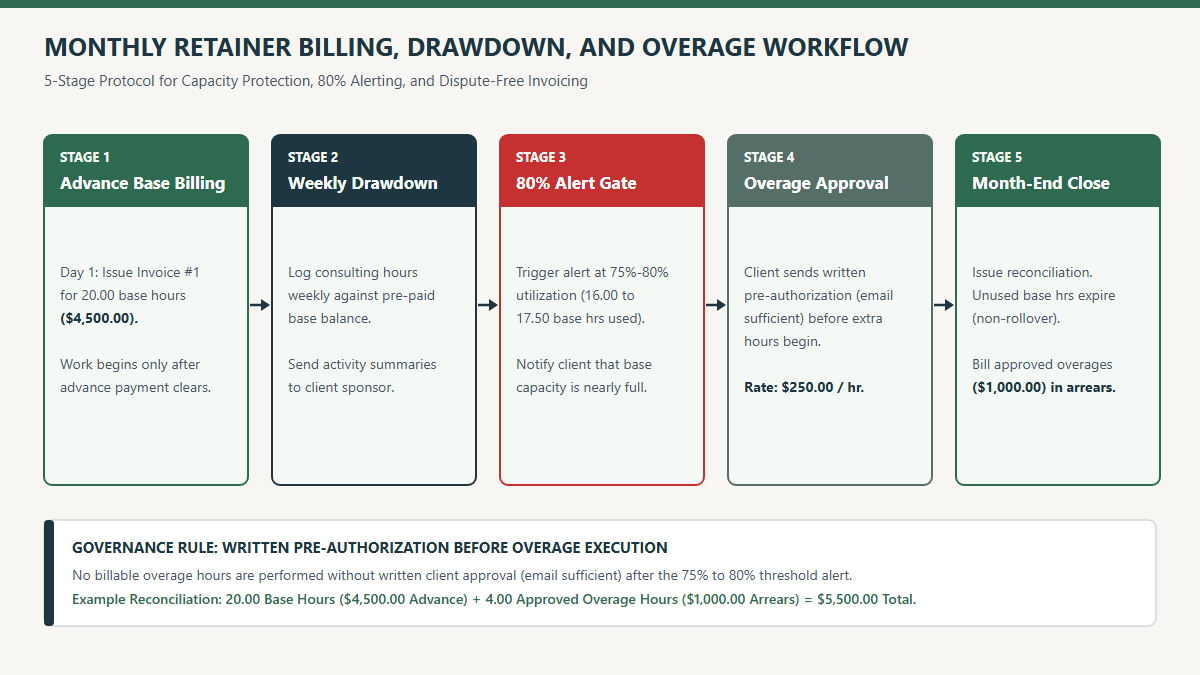
The hourly drawdown retainer is one option for technical, implementation, and general consulting engagements. The client purchases a monthly block of hours in advance (for example, 20.00 hours at $225.00 per hour, totaling $4,500.00 per month). As the consultant performs work throughout the month, hours are logged and deducted from the pre-paid balance.
This structure provides the client with flexible support while ensuring the consultant is paid upfront. However, it requires rigorous administrative controls: an automated alert when hours reach 75% to 80% of capacity, an agreed written pre-authorization process for overage hours, and an explicit non-rollover clause to prevent the client from banking unused hours indefinitely.
| Retainer Model | Billing Basis | Ideal Consulting Scenario | Rollover Handling | Primary Operational Risk |
|---|---|---|---|---|
| Pay-for-Access | Fixed monthly fee for priority availability | Fractional executive roles, senior strategic advisory, board guidance | Non-applicable (fee compensates calendar reservation) | Client treating advisory access as unlimited operational labor |
| Pay-for-Work | Fixed monthly fee for recurring deliverables | Monthly audit memos, regular performance dashboards, ongoing reviews | Non-applicable (governed by milestone delivery) | Uncontrolled revisions expanding deliverable complexity |
| Hourly Drawdown | Pre-paid monthly hour block at agreed base rate | Technical advisory, ongoing workflow optimization, ad hoc analysis | Strict non-rollover (unused hours expire at month-end) | Client banking unused hours or exceeding cap without written approval |

10 Essential Substantive Clauses in a Consulting Retainer Agreement
A well-constructed consulting retainer agreement protects both the consultant and the client by removing ambiguity. Below are the 10 essential substantive clauses that every consulting retainer agreement should address, along with their operational implications (paired with a standard governing-law provision, Section 11, in the full template below).
1. Parties, Effective Date, and Retainer Model Designation
The preamble identifies the full legal names of the consultant and the client entity, their formal business addresses, and the effective date of the agreement. It must explicitly designate which retainer model governs the engagement (Pay-for-Access, Pay-for-Work, or Hourly Drawdown). In U.S. contract law, written signature blocks serve to evidence mutual assent to the stated terms and effective date. Stating the model clearly upfront prevents downstream disputes over whether the fee purchases dedicated availability or an hourly timesheet.
2. Scope of Services and Availability Parameters
Define precisely what advisory activities are included under the monthly fee, and equally important, what activities are excluded. For example, specify that the agreement covers strategic planning sessions, executive phone check-ins, and process review memos, while excluding hands-on software development, heavy copywriting, or on-site operational staffing. Establish availability parameters such as core business hours (e.g., Monday through Friday, 9:00 AM to 5:00 PM Eastern Time) and standard email response windows (such as within 24 business hours).
3. Retainer Fee, Advance Billing, and Payment Terms
State the exact dollar amount of the monthly retainer fee and specify that invoices are issued and payable in advance on the first calendar day of each service month. Conditioning the start of advisory work upon the clearance of the advance fee ensures predictable cash flow and aligns with sound commercial practices. If your agreement includes late-payment interest, state the agreed rate and whether it compounds, and ensure the term complies with applicable state law. Do not assume a particular monthly rate is lawful in every jurisdiction. For detailed guidance on structuring invoice payment terms, see our reference on payment terms on invoice.
4. Hours Allocation and Non-Rollover Policy
If utilizing an hourly drawdown model, specify the exact number of base hours included in the monthly fee (such as 20.00 hours per month). Include an unambiguous non-rollover clause stating that unused hours expire at the conclusion of each monthly billing cycle and do not carry forward into subsequent months.
Allowing hours to roll over indefinitely creates an unmanageable capacity liability. For example, if a client uses only 5 of their 20 monthly hours for three consecutive months, they accumulate 45 banked hours. If they attempt to redeem all 45 hours during a single week in month four, they will monopolize your schedule and disrupt commitments to other clients. Non-rollover policies protect your capacity economics by treating each month as a discrete reservation of professional time.
5. Overage Work and Written Pre-Authorization
Even with careful planning, client demand may exceed the allotted base hours. Your agreement should establish a clear protocol for handling overages. Set a separate hourly overage rate, which is frequently equal to or slightly higher than the implied base hourly rate (for example, a $250.00 per hour overage rate on an agreement with a $225.00 per hour base rate).
A practical agreement can require the consultant to notify the client when monthly utilization reaches an agreed threshold, such as 75% to 80% of the base allocation, and prohibit billable overage work without the client’s prior written authorization (such as email approval). This mechanism protects the client from unexpected invoices while ensuring the consultant is compensated for additional work. Overages incurred during a service month are billed in arrears at month-end.
6. Reimbursable Out-Of-Pocket Expenses
The retainer fee covers professional consulting labor, not pass-through project expenses. Include a clause stating that pre-approved out-of-pocket expenses (such as specialized software licenses, third-party data subscriptions, or client-requested travel) will be reimbursed by the client at actual cost. Require written client pre-approval for any single expense exceeding an agreed threshold (such as $100.00) and attach detailed receipts to month-end expense invoices.
7. Term, Renewal, and Termination Notice
Specify the initial duration of the retainer engagement (such as three months or six months) and the mechanism for continuation. If incorporating automatic renewal, check the applicable state law before using the clause. Notice and cancellation requirements vary by jurisdiction and by the type of contract. Define an explicit termination clause allowing either party to terminate the agreement for convenience with 30 days written notice. Clarify how prepaid fees for the active service month are handled upon termination based on your retainer model, actual services rendered or capacity reserved, and governing state law (distinguishing earned-upon-receipt Pay-for-Access availability fees from Pay-for-Work or Hourly Drawdown prepayments that may require pro-rata reconciliation for unperformed deliverables or unworked hours), while confirming that unearned future months following the effective termination date will not be billed.
8. Independent Contractor Status and Tax Compliance
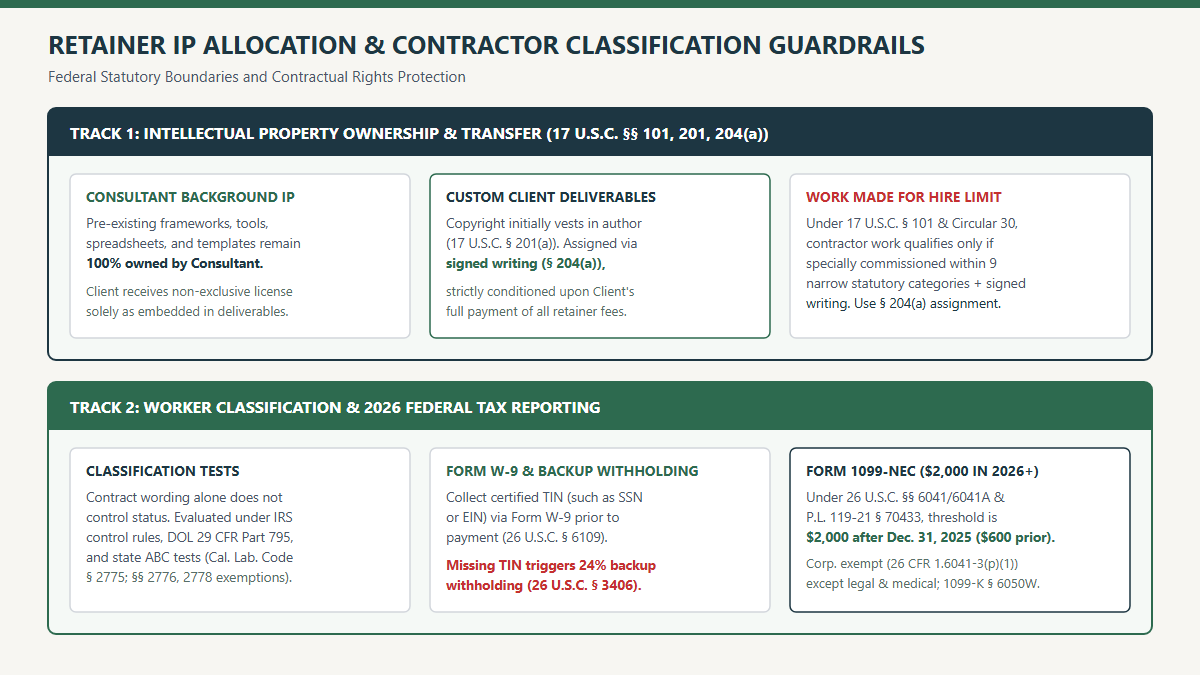
The agreement should accurately describe the intended independent-contractor relationship, including the consultant’s responsibilities, control over the manner and means of performing the work, and the parties’ actual working arrangements. A contract label or clause does not by itself determine worker status. Under U.S. law, classification depends on the applicable legal test and the facts of the relationship, including federal common-law control factors (IRS behavioral, financial, and relational controls), Department of Labor regulations (29 CFR Part 795), and state or local worker-classification standards (such as California Labor Code Section 2775 / AB 5, which applies an ABC test subject to statutory exemptions such as the business-to-business exception under Section 2776 and limited professional-services exception under Section 2778). Note that the DOL stopped applying its 2024 rule’s analysis in enforcement actions on May 1, 2025 (Field Assistance Bulletin 2025-1). The Department’s Fact Sheet 13 explains that the 2024 rule remained relevant in private litigation until its rescission takes effect, so its enforcement position should not be confused with the rule’s status in private lawsuits. Its replacement final rule (Federal Register Doc. 2026-23777, RIN 1235-AA46, amending 29 CFR Parts 500, 795, and 825), published November 23, 2026, takes effect January 22, 2027 (60 days after Federal Register publication). The final rule emphasizes two core economic-reality factors (the nature and degree of control over the work, and the worker’s opportunity for profit or loss based on initiative or investment), addresses worker classification under the FLSA, FMLA, and MSPA, and does not replace IRS tax classification or stricter state or local worker-classification laws.
From a tax perspective, clients generally collect the consultant’s Taxpayer Identification Number (TIN, such as an SSN or EIN) on IRS Form W-9 before making reportable payments, pursuant to 26 U.S.C. Section 6109. Under 26 U.S.C. Section 3406 and IRS backup-withholding guidance, 24% federal backup withholding can apply in specified circumstances, including when a payee fails to furnish a required TIN or the IRS notifies the payer that a TIN is incorrect. For payments made in 2026, the general Form 1099-NEC reporting threshold for reportable nonemployee compensation is $2,000, increased from $600 for payments made before January 1, 2026; the threshold for payments made after 2026 is subject to the applicable inflation adjustment. Payments to corporations are generally exempt from information reporting, but important exceptions apply and the form depends on the payment type: reportable attorneys’ fees for legal services are generally reported on Form 1099-NEC, while payments of $2,000 or more for medical or health-care services are generally reported on Form 1099-MISC, including payments to corporations and professional corporations. Certain attorney gross-proceeds payments are also reported on Form 1099-MISC rather than Form 1099-NEC. Under the IRS’s 2026 reporting guidance, reportable gross proceeds paid to attorneys generally use a separate $600 threshold, so do not apply the $2,000 nonemployee-compensation threshold to that category. See the current IRS Publication 1099 reporting instructions. Payments processed through payment cards or qualifying third-party payment networks are generally reported by the payment settlement entity on Form 1099-K under 26 U.S.C. Section 6050W and its separate rules, rather than being reported again by the customer as nonemployee compensation. The applicable reporting rules contain exceptions, so payers should consult current IRS instructions for the payment category and tax year. For a full operational workflow on intake tax collection, see our client onboarding checklist.
9. Confidentiality and Proprietary Information
Because ongoing advisory work exposes consultants to internal operational metrics, product roadmaps, and business strategies, a mutual confidentiality provision is essential. The clause should obligate both parties to maintain the secrecy of proprietary information, restrict disclosure to personnel with a need to know, and establish standard exceptions for information that is publicly known, already in the receiving party’s possession, or required to be disclosed by law.
10. Intellectual Property Rights (Background IP vs. Deliverables)
Intellectual property allocation must clearly distinguish between the consultant’s pre-existing tools and the custom deliverables created specifically for the client. Except where a work qualifies as a valid work made for hire, U.S. copyright law generally vests initial ownership in the author or authors of an original work. For a consulting deliverable created by an independent contractor that is not a work made for hire, the creator is generally the initial copyright owner. Under 17 U.S.C. Section 201(a) and Section 201(d), copyright ownership may be transferred in whole or in part by written conveyance. Under 17 U.S.C. Section 204(a), a transfer of copyright ownership is not valid unless it is executed in writing and signed by the rights holder or their authorized agent. Furthermore, under 17 U.S.C. Section 101 and U.S. Copyright Office Circular 30, work created by an independent contractor qualifies as a “work made for hire” only if it is specially commissioned, falls within one of nine narrow statutory categories, and is expressly designated as such in a signed writing.
Because many consulting deliverables (such as strategic memos or proprietary frameworks) fall outside these statutory categories, sound agreements either use a direct written copyright assignment under Section 204(a) (as shown in Template Clause 10.2 below) or pair a work-made-for-hire clause with a fallback written assignment. This assignment of custom deliverables should be expressly conditioned on the client’s full payment of all applicable retainer fees. Simultaneously, the consultant must retain complete ownership of their pre-existing background IP, spreadsheets, templates, and methodologies, granting the client a non-exclusive license to use those materials solely as incorporated into the final deliverable.
Complete Consulting Retainer Agreement Template (Copy-Ready)
Below is the complete, unabridged Master Consulting Retainer Agreement Template containing 10 substantive clauses (Sections 1 to 10), Section 11 (Governing Law and Dispute Resolution), execution blocks, and Schedule A. You can copy the raw plain text directly using the copy button and adapt the bracketed placeholder fields to reflect your specific engagement terms.
Master Consulting Retainer Agreement
Master agreement featuring 10 substantive clauses, Section 11 governing law, Schedule A scope parameters, non-rollover rules, and signature blocks.
================================================================================
MASTER CONSULTING RETAINER AGREEMENT
================================================================================

This Master Consulting Retainer Agreement ("Agreement") is entered into as of
[EFFECTIVE DATE] ("Effective Date"), by and between:

CONSULTANT:
[YOUR BUSINESS NAME], a [STATE OF INCORPORATION / ENTITY TYPE, E.G., DELAWARE LLC]
Having its principal place of business at:
[YOUR BUSINESS MAILING ADDRESS]
Email: [YOUR PROFESSIONAL EMAIL]
("Consultant")

AND

CLIENT:
[CLIENT LEGAL ENTITY NAME], a [STATE OF INCORPORATION / ENTITY TYPE]
Having its principal place of business at:
[CLIENT MAILING ADDRESS]
Email: [CLIENT DESIGNATED CONTACT EMAIL]
("Client")

(Consultant and Client may collectively be referred to as the "Parties," or
individually as a "Party.")

RECITALS
WHEREAS, Client desires to retain Consultant to provide ongoing professional
advisory and consulting services, and Consultant agrees to provide such services
under the terms and conditions set forth herein;

NOW, THEREFORE, in consideration of the mutual covenants contained herein and
other good and valuable consideration, the Parties agree as follows:

1. RETAINER MODEL AND ENGAGEMENT STRUCTURE
The engagement governed by this Agreement shall follow the model specified in
Schedule A:
[ ] Model 1: Pay-for-Access (Strategic Advisory Availability)
[ ] Model 2: Pay-for-Work (Defined Monthly Deliverables)
[ ] Model 3: Hourly Drawdown Retainer (Pre-Paid Monthly Hour Allocation)

2. SCOPE OF SERVICES AND AVAILABILITY
2.1 Services: Consultant shall render professional consulting services as
described in Schedule A attached hereto.
2.2 Availability: Consultant shall maintain general professional availability
during regular business hours ([CORE BUSINESS HOURS, E.G., 9:00 AM TO 5:00 PM EST],
Monday through Friday, excluding federal holidays). Consultant shall use commercially
reasonable efforts to respond to Client inquiries within [RESPONSE TIME, E.G., 24
BUSINESS HOURS].
2.3 Exclusions: Any services not explicitly identified in Schedule A, including
direct operational implementation or large-scale development, shall be deemed
out-of-scope and subject to a separate written Statement of Work.

3. RETAINER FEE AND PAYMENT TERMS
3.1 Monthly Base Retainer Fee: Client shall pay Consultant a recurring monthly base
retainer fee of $[MONTHLY RETAINER FEE AMOUNT] ("Retainer Fee"), due and payable
in advance on or before the first (1st) day of each calendar month.
3.2 First Month Proration: If the Effective Date occurs on a day other than the
first of the month, the Retainer Fee for the initial month shall be prorated on a
per diem basis and payable upon execution of this Agreement.
3.3 Advance Payment Condition: Consultant's obligation to reserve calendar capacity
and perform services for any billing cycle is expressly conditioned upon Consultant's
receipt of the applicable Retainer Fee in cleared funds.
3.4 Late Payments: Undisputed amounts past due by more than [GRACE PERIOD, E.G.,
10 CALENDAR DAYS] may accrue interest at [AGREED LATE-PAYMENT RATE, IF ANY], not
exceeding the maximum rate permitted by applicable law, from the due date until
paid in full. If no rate is agreed or the applicable limit is uncertain, omit this
provision pending review by qualified local counsel.

4. HOURS ALLOCATION AND STRICT NON-ROLLOVER POLICY
(Applicable to Model 3: Hourly Drawdown Retainers)
4.1 Base Hours Block: The Retainer Fee covers up to [INCLUDED BASE HOURS, E.G., 20.00]
hours of professional consulting services per calendar month.
4.2 Non-Rollover Policy: The Parties agree that unused base hours in any calendar
month expire at the conclusion of that monthly billing cycle and do not roll over,
accumulate, or carry forward. The Parties intend the Model 3 Retainer Fee to
compensate Consultant for reserving the monthly capacity described in Schedule A,
not merely to prepay for hours actually worked. No automatic month-end credit is
provided for unused hours. Any refund or reconciliation following termination
remains subject to Section 7.3 and applicable law.

5. OVERAGE WORK AND WRITTEN PRE-AUTHORIZATION
5.1 Threshold Notification: Consultant shall notify Client in writing (email
sufficient) when cumulative monthly service time reaches approximately [ALERT
THRESHOLD, E.G., 80%] of the monthly base allocation.
5.2 Overage Authorization: Any work performed in excess of the monthly base hours
shall be billed at the overage rate of $[OVERAGE HOURLY RATE] per hour. Consultant
shall not perform work exceeding the base allocation without prior written
authorization from Client's designated representative.
5.3 Overage Invoicing: Approved overage hours shall be invoiced in arrears at the
conclusion of the service month and payable within [OVERAGE PAYMENT TERMS, E.G.,
NET 14 DAYS] of invoice date.

6. REIMBURSABLE EXPENSES
Client shall reimburse Consultant for reasonable, actual, out-of-pocket project
expenses (e.g., travel, specialized software licenses) incurred in connection
with the services, provided that Consultant obtains Client's prior written
approval for any individual expense exceeding $[EXPENSE PRE-APPROVAL THRESHOLD,
E.G., $100.00]. Consultant shall provide itemized receipts with month-end invoices.

7. TERM AND TERMINATION
7.1 Initial Term: This Agreement commences on the Effective Date and shall continue
for an initial term of [INITIAL TERM DURATION, E.G., 3 MONTHS], unless terminated
earlier in accordance with Section 7.2.
7.2 Termination for Convenience: Either Party may terminate this Agreement without
cause by providing at least [TERMINATION NOTICE PERIOD, E.G., 30 DAYS] prior written
notice to the other Party.
7.3 Financial Effect of Termination: Upon termination, Client shall remain obligated
to pay for all approved services and overages rendered through the effective date
of termination. Treatment of prepaid Retainer Fees for the active monthly cycle
depends on the selected retainer model, actual services rendered or capacity
reserved, and applicable state law: (a) for Model 1 (Pay-for-Access), the Parties may agree that the fee is earned in
exchange for reserving dedicated availability, but whether it is non-refundable
depends on the agreement, the facts, and applicable state law; (b) for Model 2
(Pay-for-Work) and Model 3 (Hourly Drawdown), prepaid amounts attributable to
unperformed deliverables or unworked hours may require pro-rata reconciliation or
refund unless the agreement validly allocates the payment to reserved capacity
under applicable law. Fees for future months following the effective termination
date will not be billed.

8. INDEPENDENT CONTRACTOR STATUS AND TAX COMPLIANCE
8.1 Independent Contractor: Consultant is an independent contractor. Neither
Consultant nor Consultant's personnel shall be deemed employees, agents, or
partners of Client. Consultant retains full control over the manner, means, and
methods of performing the services.
8.2 Taxes: Consultant is solely responsible for all federal, state, and local taxes,
self-employment taxes, and social security withholdings arising from compensation
paid under this Agreement.
8.3 Tax Documentation: Prior to receiving payment, Consultant shall deliver to
Client a completed and signed IRS Form W-9 pursuant to 26 U.S.C. Section 6109.
Information reporting shall be administered by Client under the applicable federal
rules and forms for the payment type and tax year, including the $2,000 general
Form 1099-NEC threshold for reportable nonemployee compensation paid in 2026,
subject to applicable exceptions. Certain attorneys' fees may be reportable on
Form 1099-NEC, medical and health-care payments may be reportable on Form 1099-MISC,
and payment-card or qualifying third-party network transactions may be reportable
on Form 1099-K. Client shall consult current IRS instructions when determining
whether a payment is reportable and which information return applies.

9. CONFIDENTIALITY
9.1 Confidential Information: Each Party agrees to protect the proprietary and
confidential information of the other Party with the same degree of care it uses
for its own confidential data, but in no event less than a reasonable standard of
care. Confidential information shall not include information that is publicly known,
already known to the recipient, or independently developed without reference to
the disclosing Party's materials.

10. INTELLECTUAL PROPERTY RIGHTS
10.1 Background IP: Consultant retains sole and exclusive ownership of all pre-
existing intellectual property, methodologies, frameworks, templates, and tools
developed prior to or independently of this Agreement ("Consultant Background IP").
Consultant grants Client a non-exclusive, perpetual, worldwide license to use
such Background IP solely as incorporated into final deliverables.
10.2 Custom Deliverables: Upon Consultant's receipt of full payment of all applicable
fees, Consultant assigns to Client all right, title, and interest in and to the
custom deliverables created specifically for Client under this Agreement pursuant
to 17 U.S.C. Section 204(a).

11. GOVERNING LAW AND DISPUTE RESOLUTION
11.1 Governing Law: This Agreement shall be governed by and construed in accordance
with the laws of the State of [GOVERNING STATE], without regard to its conflict of
law principles.
11.2 Optional Venue and Jurisdiction: Subject to applicable state law, any suit,
action, or proceeding arising out of this Agreement may be brought in the state or
federal courts located in [COUNTY AND STATE, SUBJECT TO LOCAL COUNSEL REVIEW], and
each Party consents to the [EXCLUSIVE / NON-EXCLUSIVE] jurisdiction of such courts.
11.3 Optional Dispute Resolution Step (Customize with Legal Counsel): Before
initiating formal litigation or [OPTIONAL: MEDIATION / BINDING OR NON-BINDING
ARBITRATION UNDER AGREED RULES], the Parties [SHALL / MAY] attempt in good faith
to resolve any dispute through written notice and direct executive negotiation
within [NEGOTIATION PERIOD, E.G., 15 BUSINESS DAYS]. Enforceability of venue,
fee-shifting, and arbitration clauses varies by state; consult licensed counsel
before selecting or executing these optional terms.

IN WITNESS WHEREOF, the Parties have executed this Master Consulting Retainer
Agreement as of the Effective Date, evidencing their mutual assent.

CONSULTANT:
[YOUR BUSINESS NAME]
By: ____________________________________
Name:  [YOUR LEGAL NAME]
Title: [YOUR PROFESSIONAL TITLE]
Date:  [DATE SIGNED]

CLIENT:
[CLIENT LEGAL ENTITY NAME]
By: ____________________________________
Name:  [CLIENT AUTHORIZED REPRESENTATIVE NAME]
Title: [CLIENT REPRESENTATIVE TITLE]
Date:  [DATE SIGNED]

================================================================================
SCHEDULE A: RETAINER PARAMETERS AND SCOPE OF SERVICES
================================================================================
1. Retainer Model (Select One):
   [ ] Model 1: Pay-for-Access (Strategic Advisory Availability)
   [ ] Model 2: Pay-for-Work (Defined Monthly Deliverables)
   [ ] Model 3: Hourly Drawdown Retainer (Pre-Paid Monthly Hour Allocation)
2. Monthly Base Retainer Fee: $[MONTHLY RETAINER FEE, E.G., 4,500.00]
3. Monthly Included Hours: [COMPLETE FOR MODEL 3; OTHERWISE ENTER N/A]
4. Hourly Overage Rate: [RATE, IF APPLICABLE; OTHERWISE ENTER N/A]
5. Core Advisory Scope:
   - Weekly executive strategic review and performance analysis
   - Operations workflow evaluation and vendor selection guidance
   - Ad hoc strategic email and telephone consultation
6. Scope Exclusions: Software coding, manual data entry, on-site staffing
7. Client Authorized Representative for Overages: [CLIENT DESIGNEE NAME & EMAIL]
================================================================================
Worked Example: Monthly Retainer Drawdown and Overage Reconciliation
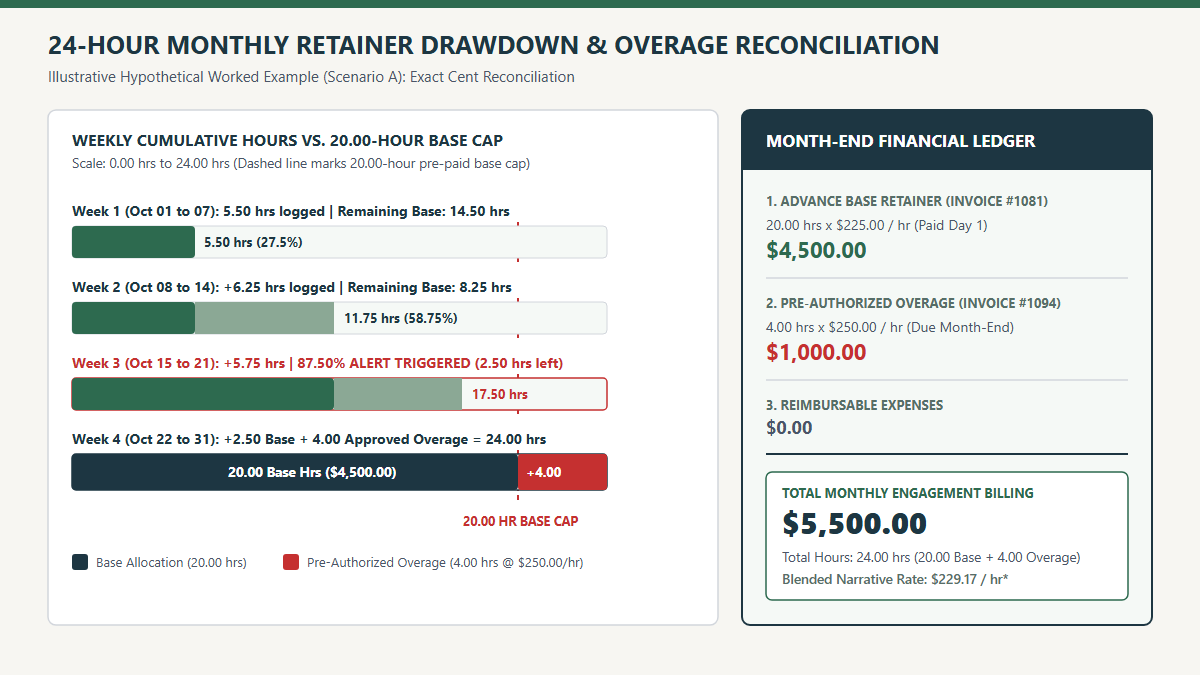
To understand how an hourly drawdown retainer functions in actual commercial practice, examine the following illustrative hypothetical worked example. All figures in this scenario reconcile to the exact cent across advance billing, weekly drawdowns, utilization alerts, and month-end overage invoicing.
In this hypothetical scenario, an independent operations consultant maintains a monthly consulting retainer agreement with a growing manufacturing client under the following contract parameters:
- Retainer Model: Hourly Drawdown Retainer, billed in advance on the 1st of the month.
- Monthly Base Allocation: 20.00 hours per calendar month.
- Base Retainer Rate: $225.00 per hour.
- Monthly Base Retainer Fee (Advance Invoice #1): 20.00 hours * $225.00 = $4,500.00.
- Pre-Authorized Overage Rate: $250.00 per hour (requires written client approval).
- Rollover Terms: Strict non-rollover (unused base hours expire at month-end).
- Reimbursable Expenses: $0.00 incurred during this billing cycle.
Scenario a: 24.00 Total Hours Used (20.00 Base + 4.00 Pre-Authorized Overage)
During a high-intensity operational audit month, the client requires support across four consecutive weeks. Here is how the hours and financial drawdowns unfold:
- Week 1 (Executive Alignment & Audit): The consultant logs 5.50 hours. These are fully covered by the pre-paid base block. Cumulative base hours used: 5.50. Remaining base hours: 14.50.
- Week 2 (Operating Model Workshop): The consultant logs 6.25 hours. Cumulative base hours used: 11.75. Remaining base hours: 8.25.
- Week 3 (Vendor & Budget Review): The consultant logs 5.75 hours. Cumulative base hours used reach 17.50 out of 20.00, representing 87.50% utilization. Because utilization has crossed the 80% threshold (16.00 hours), the consultant sends a written utilization update to the client sponsor noting that 2.50 base hours remain. The client promptly replies with written pre-authorization for up to 5.00 overage hours at the agreed $250.00 per hour overage rate to finalize the month-end sprint.
- Week 4 (Final Base Hours + Pre-Authorized Overage): The consultant logs 6.50 hours of work. The first 2.50 hours exhaust the remaining base allocation (bringing cumulative base hours to exactly 20.00). The remaining 4.00 hours are billed under the pre-authorized overage rate (4.00 hours * $250.00 = $1,000.00).
| Billing Period / Line Item | Hours Logged | Allocation Type | Applicable Rate | Line Amount | Cumulative Base Hours | Remaining Base Hours |
|---|---|---|---|---|---|---|
| Advance Base Retainer (Invoice #1, Due Day 1) | 20.00 hrs (Allotted) | Pre-Paid Base Block | $225.00 / hr | $4,500.00 | 0.00 hrs | 20.00 hrs |
| Week 1: Executive Alignment & Audit | 5.50 hrs | Base Drawdown | Included in Base | $0.00 (Drawn) | 5.50 hrs | 14.50 hrs |
| Week 2: Operating Model Workshop | 6.25 hrs | Base Drawdown | Included in Base | $0.00 (Drawn) | 11.75 hrs | 8.25 hrs |
| Week 3: Vendor & Budget Review (87.5% Alert) | 5.75 hrs | Base Drawdown | Included in Base | $0.00 (Drawn) | 17.50 hrs | 2.50 hrs |
| Week 4 (Part A): Final Base Allocation | 2.50 hrs | Base Drawdown | Included in Base | $0.00 (Drawn) | 20.00 hrs (Cap) | 0.00 hrs |
| Week 4 (Part B): Pre-Authorized Overage | 4.00 hrs | Pre-Authorized Overage | $250.00 / hr | $1,000.00 | 20.00 hrs (Cap) | 0.00 hrs |
| Reimbursable Project Expenses | N/A | Pass-Through | Actual Cost | $0.00 | N/A | N/A |
| Month-End Total Billing Reconciliation | 24.00 hrs | 20.00 Base + 4.00 Overage | Blended: $229.17 / hr* | $5,500.00 | 20.00 hrs | 0.00 hrs |
*Note on Blended Rate Precision: Total monthly fees divided by total hours equals $5,500.00 / 24.00 hours = $229.166666… per hour, presented here as $229.17 per hour strictly for narrative reporting. Never use a rounded blended rate to calculate invoice line totals; calculate base and overage blocks independently from their contractually specified hourly rates to preserve exact cent reconciliation. To maintain internal tracking discipline across weekly drawdowns, review our guide to consultant time tracking.
Scenario B: 18.50 Hours Used (Illustrating Non-Rollover Expiration)
Now consider an alternative month where the client’s internal initiatives slow down. Across the same four-week period, the consultant logs a total of 18.50 base hours and zero overage hours.
Under the hypothetical agreement’s strict non-rollover clause, the 1.50 unused base hours expire at month-end and do not carry forward. This example assumes the $4,500.00 advance compensates the consultant for reserving 20.00 hours of monthly capacity, with no automatic month-end credit under the stated terms. That treatment is not a universal legal rule: refund or reconciliation obligations on termination, or where required by applicable law, must be addressed separately in the agreement. At month-end, the consultant issues a monthly activity summary detailing the 18.50 hours logged, notes that zero overage charges were incurred (Month-End Invoice #2 = $0.00), and confirms the renewal invoice of $4,500.00 for the upcoming month.
Below is the completed, copyable month-end statement corresponding to Scenario A ($5,500.00 total billable value), formatted for easy inspection or import into your invoicing system.
Monthly Retainer Reconciliation Statement (Scenario A)
Fully reconciled monthly accounting statement showing 20.00 base hours, 4.00 overage hours, and exact $5,500.00 billing.
================================================================================
MONTHLY RETAINER DRAWDOWN & OVERAGE RECONCILIATION STATEMENT
================================================================================
BILLING PERIOD:    October 1, 2026 through October 31, 2026
CONSULTANT:        Vance Operations Advisory LLC
CLIENT:            Meridian Industrial Systems Inc.
CONTRACT MODEL:    Model 3 (Hourly Drawdown Retainer)
BASE ALLOCATION:   20.00 Hours @ $225.00 / Hour = $4,500.00 (Billed in Advance)
OVERAGE TERMS:     $250.00 / Hour (Pre-Authorized via Email on Oct 21, 2026)
================================================================================

1. ADVANCE BASE RETAINER SUMMARY (INVOICE #INV-1081)
--------------------------------------------------------------------------------
Invoice Date:      October 1, 2026
Payment Received:  October 1, 2026 (ACH Cleared)
Amount Pre-Paid:   $4,500.00 (Covers initial 20.00 base hours)
Status:            PAID IN FULL

2. WEEKLY ACTIVITY AND DRAWDOWN LOG
--------------------------------------------------------------------------------
Week 1 (Oct 01 - Oct 07):  5.50 Hours  [Drawdown from Base]
- Executive operational alignment interviews (3.00 hrs)
- Baseline workflow diagnostic and data review (2.50 hrs)
Cumulative Base Used: 5.50 Hours | Remaining Base: 14.50 Hours

Week 2 (Oct 08 - Oct 14):  6.25 Hours  [Drawdown from Base]
- Manufacturing floor scheduling workshop (3.75 hrs)
- Inventory management bottlenecks analysis memo (2.50 hrs)
Cumulative Base Used: 11.75 Hours | Remaining Base: 8.25 Hours

Week 3 (Oct 15 - Oct 21):  5.75 Hours  [Drawdown from Base]
- Supply chain vendor contract analysis (3.50 hrs)
- Preliminary mitigation roadmap drafting (2.25 hrs)
Cumulative Base Used: 17.50 Hours | Remaining Base: 2.50 Hours
*80% alert threshold was crossed during Week 3; the October 21 weekly reconciliation
showed 17.50 base hours used (87.5%). Written overage authorization was recorded
before the four overage hours were performed.

Week 4 (Oct 22 - Oct 31):  6.50 Hours Total
- Part A (Base Exhaustion): 2.50 Hours @ Included Rate
  Final leadership review presentation prep (2.50 hrs)
  Cumulative Base Used: 20.00 Hours | Remaining Base: 0.00 Hours (CAP REACHED)

- Part B (Pre-Authorized Overage): 4.00 Hours @ $250.00 / Hour
  Executive committee Q&A session and implementation scheduling (4.00 hrs)
  Overage Subtotal: $1,000.00

3. RECONCILIATION TOTALS
--------------------------------------------------------------------------------
Total Professional Hours Rendered:          24.00 Hours
- Base Hours Applied (Pre-Paid):            20.00 Hours
- Pre-Authorized Overage Hours Applied:      4.00 Hours

Pre-Paid Advance Retainer (Invoice #1081):   $4,500.00
Month-End Overage Due (Invoice #1094):       $1,000.00
Reimbursable Expenses (Receipts Attached):   $    0.00
--------------------------------------------------------------------------------
TOTAL MONTHLY ENGAGEMENT BILLING:           $5,500.00
Effective Blended Rate (24.00 hrs):         $  229.17 / Hour
================================================================================
Consulting Retainer Best Practices Before You Send the Contract
Executing a successful retainer relationship requires operational discipline both before and after the contract is signed. Incorporate these four practical habits into your retainer onboarding process:
- Collect Advance Payment Before Reserving Calendar Time: Never block out recurring weekly advisory sessions or begin deliverable preparation until the first month’s advance retainer fee has cleared into your commercial bank account. Reserving capacity without cleared funds surrenders your schedule leverage.
- Set Automated Utilization Alerts at 75% to 80%: If managing an hourly drawdown retainer, establish a rigid operational checkpoint when the client consumes 75% to 80% of their monthly base hours. Transmit a brief status update summarizing hours used, remaining capacity, and an explicit estimate of overage requirements so the client has ample time to pre-authorize additional work.
- Keep Strategy Retainers Distinct from Heavy Implementation Projects: If a client on an advisory retainer suddenly requires a massive, multi-week implementation (such as migrating to an enterprise ERP system or overhauling corporate branding), do not attempt to absorb it into the monthly retainer hours. Draft a dedicated, fixed-scope statement of work for the implementation project while maintaining the advisory retainer for ongoing executive counsel.
- Obtain State-Specific Legal Review for Specialized Clauses: Have your customized agreement reviewed by licensed legal counsel in the governing state. Local courts scrutinize contractual provisions differently, particularly regarding availability fee retention, non-rollover enforcement, restrictive covenants, automatic renewal notifications, and statutory usury caps on late payment fees.
Frequently Asked Questions About Consulting Retainers
What is the difference between a consulting retainer and a deposit?
A deposit is a one-time partial advance payment applied against the total cost of a specific, defined project milestone. In contrast, a consulting retainer is a recurring, periodic advance fee that secures ongoing advisory availability, priority scheduling, recurring deliverables, or a monthly block of professional time across an extended engagement.
Should unused consulting retainer hours roll over to the next month?
Rollover is a negotiated contract term, not a universal rule. A non-rollover arrangement can make each month’s allocation expire at the end of that billing cycle, while a rollover arrangement may set a cap and expiration date. State clearly whether unused hours are forfeited, credited, refunded, or treated as reserved capacity, and have the provision reviewed under applicable law.
Are non-refundable consulting retainer fees legally enforceable?
Whether a retainer payment is refundable depends on the agreement’s structure, what the fee purchases, the work or capacity actually provided, the termination facts, and applicable law. Do not assume that labeling a fee “non-refundable” makes it enforceable. Distinguish fees for reserved availability from advance payments for future deliverables or unworked hours, state how each is reconciled on termination, and have local counsel review the clause.
Does signing a consulting retainer agreement make someone an independent contractor automatically?
No. An independent-contractor clause records the parties’ stated intention, but it does not decide the worker’s legal status. Federal and state authorities examine the actual relationship under the test that applies to the claim or tax issue. Relevant frameworks can include the IRS common-law behavioral, financial, and relationship factors; Department of Labor rules under the FLSA (the Department stopped applying the 2024 rule in enforcement actions on May 1, 2025, but stated in Fact Sheet 13 that the 2024 rule remained relevant in private litigation until its rescission on January 22, 2027; the replacement final rule, published November 23, 2026, takes effect on January 22, 2027, and applies its analysis to the FLSA, FMLA, and MSPA, not IRS tax classification or stricter state or local laws; see the Federal Register final rule); and state statutes such as California’s ABC test (Cal. Lab. Code Section 2775, subject to statutory exemptions such as the business-to-business rule in Section 2776 and professional services exemptions in Section 2778). Working for multiple clients, using one’s own equipment, and controlling work methods may be relevant under some tests, but no single factor guarantees independent-contractor status and state ABC requirements may be stricter.
How do Form W-9 and the $2,000 Form 1099-NEC threshold apply to retainer payments in 2026?
Commercial clients generally collect Form W-9 during intake to obtain the payee’s Taxpayer Identification Number (TIN, such as an SSN or EIN). Under 26 U.S.C. Section 3406, 24% backup withholding can apply in specified circumstances, including failure to furnish a required TIN or IRS notice that the TIN is incorrect. For payments made in 2026, the general Form 1099-NEC threshold for reportable nonemployee compensation is $2,000; payments made before 2026 generally used the $600 threshold, and payments made after 2026 are subject to the applicable inflation-adjusted threshold. The form depends on the payment: reportable attorneys’ fees are generally reported on Form 1099-NEC, while reportable medical and health-care payments, including qualifying payments to corporations, are generally reported on Form 1099-MISC. Certain attorney gross-proceeds payments are also reported on Form 1099-MISC, generally using the separate $600 reporting threshold in the 2026 IRS instructions. Payment-card and qualifying third-party network transactions are generally reported by the settlement entity on Form 1099-K under separate rules. Consult the current IRS instructions for the relevant tax year and payment type.
Who owns the intellectual property created under a consulting retainer?
Under U.S. copyright law (17 U.S.C. Sections 201(a) and 204(a)), copyright initially vests in the independent consultant as author and does not transfer automatically without a signed written instrument. In an effective retainer contract, custom deliverables created specifically for the client are assigned to the client upon full payment of all applicable retainer fees. Simultaneously, the consultant retains ownership of their pre-existing background IP, proprietary frameworks, and general tools, granting the client a non-exclusive license to use them as part of the final deliverable.