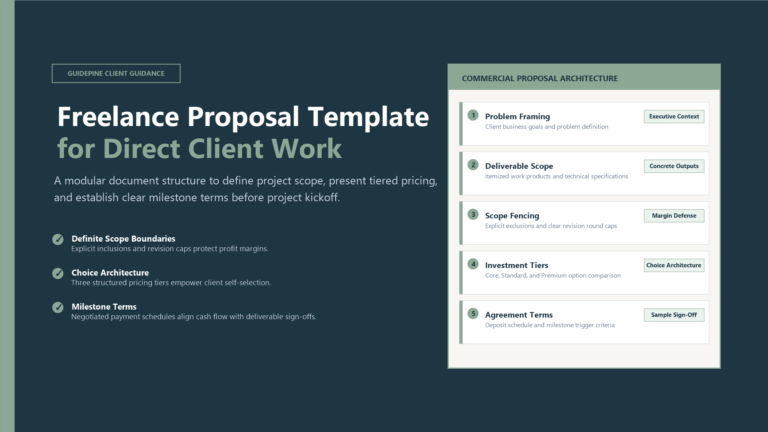

A professional graphic design proposal is a written commercial document that outlines project objectives, itemizes visual deliverables, defines concrete revision boundaries, and establishes clear payment milestones before creative production begins. In independent design practices, an informal email estimate or casual message exchange often leaves critical expectations unstated. Without an explicit document, freelance designers frequently absorb unpaid revision cycles, experience disputes over raw vector source files, or encounter misunderstandings regarding commercial font licenses.
A structured proposal establishes mutual assent on project scope while setting enforceable operational boundaries. It ensures that both the creative professional and the client share an identical understanding of what is being built, how many concept directions will be explored, and when intellectual property rights formally transfer.
This guide provides a comprehensive framework for structuring graphic design proposals. It examines the essential sections every creative proposal must include, provides concrete language for defining revision rounds, explains statutory copyright transfer rules under federal law, and presents a complete, mathematically reconciled $5,400 brand identity worked example alongside an ungated, copy-ready template.
Core Sections Every Graphic Design Proposal Must Include
Every commercial design engagement requires clear contractual boundaries. While visual aesthetics vary across branding, digital illustration, and print production, an effective proposal relies on six structural pillars:
- 1. Executive Summary and Creative Objectives: Identifies business context, target audience, and visual communication goals without exaggerated outcome promises.
- 2. Scope of Work and Deliverable Formats: Specifies resolution-independent vector masters (.AI, .EPS, .SVG), digital screen rasters, and print-ready prepress files.
- 3. Phased Creative Milestones and Review Schedule: Establishes discovery, concept exploration, refinement iterations, and final asset packaging.
- 4. Scope Control and Revision Boundaries: Defines included minor revisions versus out-of-scope structural redesigns requiring written change orders.
- 5. Intellectual Property and Commercial Font Licensing: Governs written copyright assignment under 17 U.S.C. Section 204 upon full payment and separates design labor from software EULAs.
- 6. Phased Investment and Milestone Payment Schedule: Reconciles project fees across a 50% deposit, 25% concept approval, and 25% final delivery milestone.
1. Executive Summary and Creative Objectives
The executive summary opens the document by demonstrating an objective understanding of the client’s commercial challenge. Rather than focusing immediately on visual aesthetics, this section establishes the business purpose of the creative work. Just as an effective freelance proposal template opens with client objectives rather than administrative boilerplate, a graphic design proposal must ground creative execution in commercial goals.
- Business Context: Summarizes the client’s current market position, target demographic, or operational evolution (such as a company rebrand, product launch, or packaging refresh).
- Creative Objectives: Identifies specific visual outcomes, such as establishing visual consistency across retail packaging, improving brand recognition among corporate buyers, or preparing scalable assets for digital advertising.
- Core Value Statement: Formulates the overarching creative solution without promising exaggerated commercial outcomes or guaranteed revenue increases.
2. Scope of Work and Technical Deliverable Formats
The scope of work must itemize every tangible asset the client will receive. Ambiguity in asset descriptions is a frequent cause of end-of-project friction. Graphic designers must explicitly distinguish between resolution-independent vector artwork, raster screen images, and print-ready prepress files.
Understanding the technical distinction between pixel dimensions and resolution density (DPI / PPI) is essential for client clarity:
- Pixel Dimensions Govern Digital Rendering: On digital screens, monitors, and web platforms, images render strictly pixel-by-pixel. An asset created at 2400 × 1600 pixels displays identically on a web page regardless of whether its file header tags it at 72, 150, or 300 DPI. For digital deliverables, proposals must specify exact pixel dimensions (width × height) and aspect ratios.
- DPI Governs Physical Print Output: Dots per inch (DPI), or pixels per inch (PPI), is metadata used exclusively by physical printing engines to calculate printed dimensions:
$$\text{Physical Output Size (Inches)} = \frac{\text{Pixel Dimensions}}{\text{Print DPI}}$$
An illustration measuring 3,000 × 2,400 pixels printed at 300 DPI produces an exact 10 × 8 inch physical print. If sent to print at 150 DPI, the same pixel grid expands to 20 × 16 inches at half the print density. Proposals for print assets must specify 300 DPI at 100% target physical dimensions with appropriate bleeds.
| Asset Category | Deliverable Formats | Technical Specification |
|---|---|---|
| Vector Masters | .AI, .EPS, .SVG | Scalable mathematical paths, CMYK/RGB profiles, converted outlines |
| Digital Rasters | .PNG, .JPG, .WebP | Transparent alpha channel, sRGB color space, 72 to 150 DPI screen resolution |
| Print Documents | PDF/X-1a, PDF/X-4 | 300 DPI high resolution, converted vector fonts, 0.125-inch bleeds, crop marks |
- Vector Master Files (.AI, .EPS, .SVG): Vector files are resolution-independent graphics built using mathematical paths, points, and curves. They allow clients to scale marks infinitely from small business card icons to large vehicle wraps without loss of sharpness.
- Web and Digital Rasters (.PNG, .JPG, .WebP): Raster exports are pixel-bounded assets intended for screen displays, email headers, and digital presentations. Exporting transparent PNGs ensures seamless placement over coloured backgrounds.
- Print-Ready Documents (PDF/X): Print files require strict prepress specifications, including the CMYK color space, converted text outlines (which eliminates missing font errors at commercial print shops), and standard 0.125-inch (3mm) bleeds with trim marks.
3. Phased Creative Process and Project Milestones
Organizing the engagement into distinct sequential phases prevents disorganized client feedback and preserves logical design momentum.
- Phase 1: Discovery, Research, and Mood Boards: Analysis of competitor visual identities, target audience preferences, and establishment of creative direction via curated mood boards.
- Phase 2: Concept Exploration and Presentation: Creation of two distinct visual directions presented in clean presentation mockups showing real-world application.
- Phase 3: Refinement and Iteration: Focused adjustments to the single selected direction across typography, color balance, and layout composition.
- Phase 4: Final Packaging and Asset Delivery: Technical production of vector master files, export of digital raster variations, compilation of brand guideline documentation, and transfer of final assets.
Managing Scope: Revision Limits and Out-Of-Scope Work
Uncontrolled revision cycles represent the single most common source of unbilled labor in creative service engagements. When a proposal promises unlimited revisions, clients are subtly encouraged to treat the creative process as an open-ended trial-and-error experiment. A professional proposal establishes firm boundaries around revision rounds.
| Category | Included Revision Bounds | Out-of-Scope Redesign (Change Order Required) |
|---|---|---|
| Typography | Adjusting weights, sizes, or line spacing within approved family | Introducing entirely new font families or redesigning logotype styling |
| Color Palette | Fine-tuning tint values, contrast, or hierarchy within agreed palette | Replacing the approved color palette with completely new chromatic schemes |
| Layout & Composition | Nudging alignment, margins, or relative mark proportions | Requesting an entirely new composition or concept after direction sign-off |
| Scope & Deliverables | Minor copy updates or file format adjustments | Adding unbudgeted packaging SKUs, stationery items, or marketing collateral |
Defining an Included Revision Round
A proposal must clearly distinguish an included revision round from a project redesign. As outlined in our guide on time tracking for designers, monitoring creative iteration hours in your internal logs prevents unbilled revision creep from eroding your effective hourly rate.
- What an Included Revision Covers: A revision round consists of a consolidated batch of feedback requesting specific adjustments to an existing, approved visual direction. This includes nudging layout elements, adjusting color values within a defined palette, testing alternative font pairings from an agreed shortlist, or tweaking icon weights.
- Consolidated Feedback Requirement: The client must collect and deliver all stakeholder feedback into a single, organized written summary per round. Fragmented feedback delivered via scattered chat messages or phone calls disrupts version control and prolongs delivery timelines.
- Standard Allowance: Professional graphic design proposals typically include two complete rounds of revisions during the refinement phase.
Out-Of-Scope Redesigns and Written Change Orders
If a client reviews an agreed creative direction, approves it, and subsequently requests a completely new visual concept during Phase 3, that request constitutes a scope modification rather than a revision:
- Hourly Reference Billing: Out-of-scope revisions, additional design iterations beyond the included allowance, or supplemental collateral assets are billed at the designer’s agreed reference rate (for example, $125.00 per hour).
- Written Authorization: Work on out-of-scope items does not begin until the client reviews and approves a brief written change order detailing the estimated hours and additional cost. This practice eliminates surprise charges on final invoices.
When formalizing larger corporate creative engagements, consider whether your proposal should transition into a binding execution agreement. Understanding the legal and structural distinctions between a proposal vs statement of work ensures you use the right contractual instrument once scope boundaries and milestone budgets are approved.
Intellectual Property, Preliminary Concepts, and Font Licensing
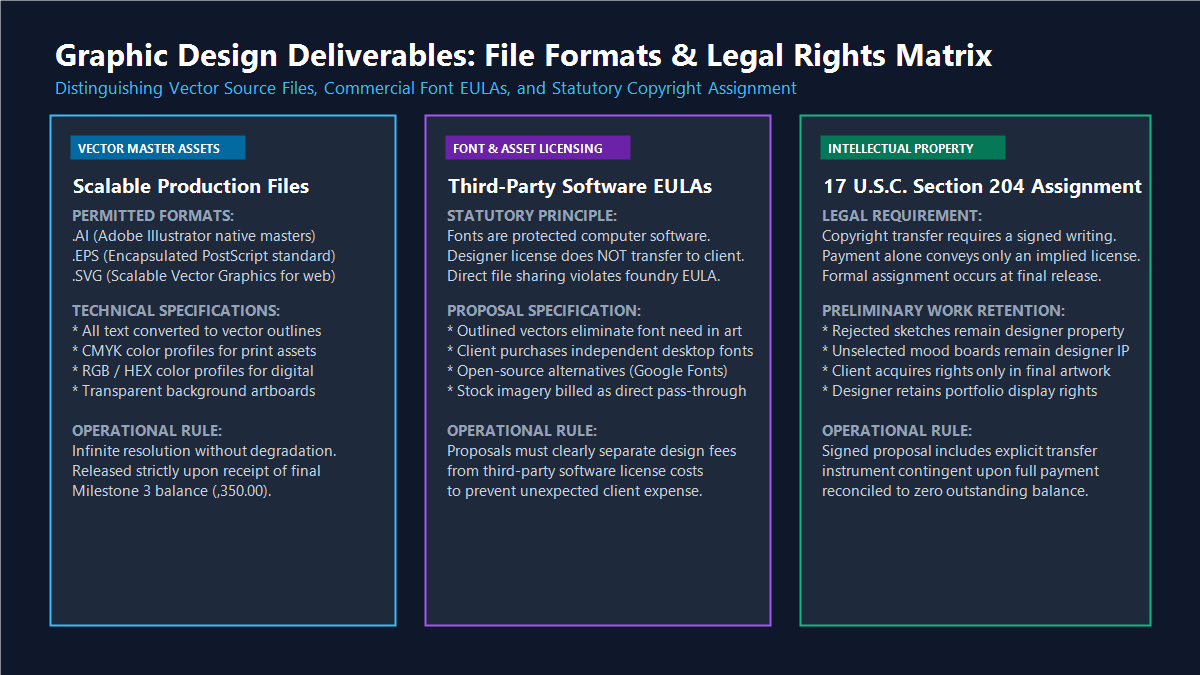
Intellectual property ownership in visual design involves statutory boundaries established under United States copyright law. A professional proposal explicitly outlines ownership rights, licensing scopes, and third-party software liabilities.
Written Copyright Transfer Under 17 U.S.C. Section 204(A)
Under federal copyright law, independent contractors own the intellectual property rights in their creative creations from the moment of fixation in a tangible medium:
17 U.S.C. Section 204(a): “A transfer of copyright ownership, other than by operation of law, is not valid unless an instrument of conveyance, or a note or memorandum of the transfer, is in writing and signed by the owner of the rights conveyed or such owner’s duly authorized agent.” (Source: Cornell Legal Information Institute 17 U.S. Code Section 204).
In creative contracting, copyright does not transfer automatically upon paying an initial deposit, nor through casual verbal assent. Furthermore, independent graphic designers are not statutory employees under the work-made-for-hire doctrine unless specific statutory categories and express written agreements are executed (see U.S. Copyright Office Circular 9: Works Made for Hire). In the absence of an executed written conveyance, the client receives only an implied, non-exclusive license to use the final work (*Effects Associates, Inc. v. Cohen*, 908 F.2d 555 (9th Cir. 1990)).
A properly drafted proposal protects both parties by establishing:
- Timing of Transfer: Exclusive ownership rights in the final approved artwork transfer to the client strictly upon receipt of 100% full payment of all project fees.
- Written Instrument: The designer executes a formal written copyright assignment instrument alongside the final invoice reconciliation.
- Reservation of Portfolio Rights: The designer retains a perpetual, non-exclusive, royalty-free license to reproduce the final artwork in personal portfolios, case studies, award submissions, and marketing materials.
Ownership of Preliminary Concepts and Exploratory Sketches
During Phase 2, a designer typically presents multiple conceptual directions, thumbnail sketches, and layout explorations. The proposal must explicitly specify that:
- Preliminary Concepts Remain Designer Property: All rejected design directions, preliminary sketches, unused mood boards, and exploratory mockups remain the exclusive intellectual property of the designer.
- Prohibition on Client Use: The client may not use, adapt, or share rejected concepts with third-party vendors without purchasing an independent license from the designer.
Commercial Font and Stock Asset Licensing Rules
Digital font files (.OTF, .TTF, .WOFF) are legally recognized as computer software programs protected under United States copyright law (*Adobe Systems Inc. v. Southern Software, Inc.*, 45 U.S.P.Q.2d 1278 (N.D. Cal. 1998)). Understanding the boundaries of font software End-User License Agreements (EULAs) is critical to avoiding third-party software liability (see Monotype Commercial Font Software Licensing Basics):
- Converting Text to Vector Outlines: In standard branding deliverables, designers convert typographic elements into static vector paths (
Type > Create Outlinesin Adobe Illustrator). Converting text outlines permanently transforms letterforms into mathematical vector paths, allowing clients to reproduce marks, signage, and packaging infinitely without requiring font software installation or violating foundry EULAs. - Raw Font Software Files Excluded: If the client requires live, editable typography for internal staff workstations (such as typing proposals in Word, InDesign, or styling website body copy), the client must license the font software independently. Standard commercial desktop and web font licenses are non-transferable agreements granted to a specific licensee; designers are contractually prohibited from transmitting raw font binary files to clients.
- Permissive Open-Source Alternatives: When clients prefer to avoid commercial font licensing fees, proposals can specify open-source typefaces licensed under permissive models like the SIL Open Font License (available via Google Fonts), which permit free commercial use, self-hosting, and workstation installation.
- Stock Media Pass-Through: Commercial stock photography, vector textures, or video clips must be purchased directly by the client or billed as itemized pass-through expenses with zero unauthorized markup.
Worked Example: $5,400 Brand Identity Proposal
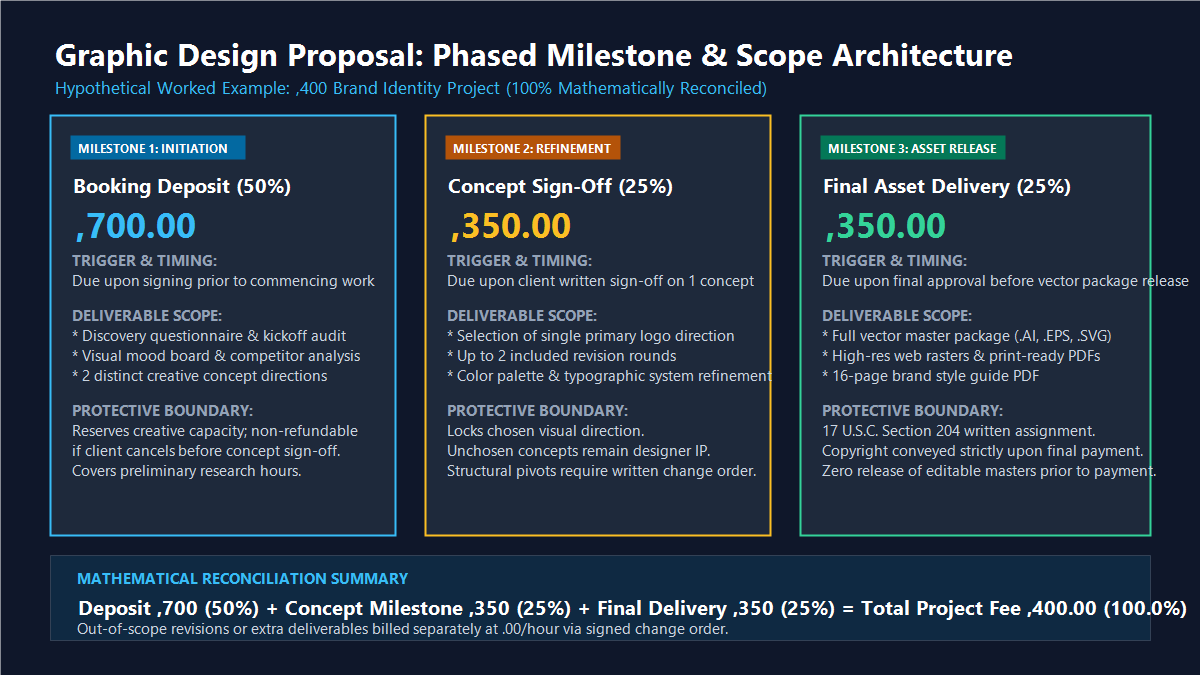
To illustrate these principles in practice, the following worked example models a complete commercial branding engagement between an independent designer and a specialty coffee business.
Scenario Definition (Hypothetical)
- Client: Cascade Peak Coffee Roasters (Hypothetical growing specialty coffee roasting enterprise).
- Designer: Apex Creative Studio LLC (Hypothetical solo brand identity designer).
- Project Scope: Comprehensive visual identity refresh, packaging label architecture, and brand standards manual.
- Agreed Reference Rate: $125.00 per hour for out-of-scope revisions.
| Deliverable Phase / Component | Scope Specifications | Fee Allocation |
|---|---|---|
| Phase 1: Core Visual Identity | Primary mark, secondary badge, submark, full color palette, typography hierarchy rules | $3,600.00 |
| Phase 2: Product Packaging Suite | 12 oz whole-bean coffee bag label system, carton sealing tape graphics, print-ready PDF/X-4 files | $1,200.00 |
| Phase 3: Brand Guidelines Manual | 16-page digital PDF manual detailing clear-space, minimum sizing, contrast rules, improper treatments | $600.00 |
| TOTAL RECONCILED INVESTMENT | Complete brand identity and packaging launch package (100.0% reconciled) | $5,400.00 |
Mathematical Reconciliation of Scope Deliverables
- Phase 1: Core Visual Identity ($3,600.00):
- Primary brand mark, horizontal lockup, secondary circular badge, and submark/favicon.
- Comprehensive color palette specifications across digital (HEX, RGB) and print (CMYK, Pantone solid coated matches).
- Typographic hierarchy rules and font pairing documentation.
- Phase 2: Product Packaging Suite ($1,200.00):
- Modular 12 oz retail whole-bean coffee bag label system accommodating variable origin, roast date, and tasting note modules.
- Exterior shipping carton sealing tape graphics.
- Full prepress packaging files delivered as print-ready PDF/X-4 files with 0.125-inch bleeds.
- Phase 3: Brand Guidelines Manual ($600.00):
- 16-page digital PDF manual detailing clear-space boundaries, minimum physical sizing, background contrast rules, and improper logo treatments.
- Total Project Fee Reconciliation:
$$\$3,600.00 + \$1,200.00 + \$600.00 = \$5,400.00$$
Mathematical Reconciliation of Phased Milestone Payments
To maintain balanced project cash flow, the engagement uses a structured 3-part milestone schedule:
| Milestone Stage | Trigger & Deliverable Condition | Reconciled Amount |
|---|---|---|
| Milestone 1 (50% Deposit) | Due upon proposal signature prior to commencing discovery research and mood boarding | $2,700.00 |
| Milestone 2 (25% Concept) | Due upon formal client selection and written approval of 1 of 2 presented concept directions | $1,350.00 |
| Milestone 3 (25% Final) | Due upon final project approval prior to releasing vector master archives and copyright assignment | $1,350.00 |
| TOTAL RECONCILED CASH FLOW | Exact 100.0% equality parity: $2,700.00 + $1,350.00 + $1,350.00 | $5,400.00 |
- Milestone 1 (50% Project Booking Deposit):
$$\$5,400.00 \times 0.50 = \$2,700.00$$
*Payment Timing:* Required upon proposal signing prior to reserving calendar dates and commencing discovery research.
- Milestone 2 (25% Concept Direction Approval):
$$\$5,400.00 \times 0.25 = \$1,350.00$$
*Payment Timing:* Due upon formal client selection and written approval of one of two presented creative directions, prior to commencing detailed packaging design.
- Milestone 3 (25% Final Packaging and Asset Release):
$$\$5,400.00 \times 0.25 = \$1,350.00$$
*Payment Timing:* Due upon project approval prior to transmitting final vector master archives (.AI, .EPS) and executing the written copyright assignment.
- Total Reconciled Cash Flow:
$$\$2,700.00 + \$1,350.00 + \$1,350.00 = \$5,400.00$$
All project figures reconcile to exact 100.00% equality, eliminating rounding disputes and cash flow ambiguity.
Copy-Ready Graphic Design Proposal Template
Free Graphic Design Proposal Downloads
Choose a blank graphic design proposal template or the completed $5,400 brand identity worked example. Available in editable Word (DOCX) and print-ready PDF formats. No registration or email required.
Blank Graphic Design Proposal
Clean, customizable graphic design proposal template with deliverable matrices, revision bounds, and statutory 17 U.S.C. Section 204 copyright transfer provisions.
Worked Example Proposal
Completed $5,400 brand identity proposal for Cascade Peak Coffee Roasters with 3-phase milestone schedule, file deliverable matrix, and font licensing terms.
The following copy-ready template container provides an ungated, customizable structure for creative client engagements. Replace the bracketed placeholders with your specific studio details, scope items, and fee schedule.
Ungated Plain-Text Graphic Design Proposal Template
Standardized plain-text proposal container formatted with itemized deliverables, revision limits, 3-phase milestone billing, and 17 U.S.C. Section 204 copyright transfer assignment.
========================================================================
                      GRAPHIC DESIGN PROJECT PROPOSAL
========================================================================

PREPARED BY:
Studio / Designer: [YOUR BUSINESS OR STUDIO NAME]
Designer Name: [YOUR FULL NAME]
Email: [YOUR EMAIL ADDRESS]
Phone: [YOUR PHONE NUMBER]
Website: [YOUR WEBSITE URL]

PREPARED FOR:
Client Business: [CLIENT COMPANY NAME]
Contact Person: [CLIENT PRIMARY CONTACT NAME]
Title: [CLIENT CONTACT TITLE]
Email: [CLIENT EMAIL ADDRESS]

Proposal Date: [MONTH, DAY, YEAR]
Proposal Validity: Valid for 30 calendar days from date of issuance.
Target Project Kickoff: [ESTIMATED START DATE]
Target Project Completion: [ESTIMATED COMPLETION DATE]

------------------------------------------------------------------------
1. EXECUTIVE SUMMARY & CREATIVE OBJECTIVES
------------------------------------------------------------------------
[CLIENT COMPANY NAME] is seeking a comprehensive graphic design solution
to [DESCRIBE CLIENT BUSINESS CHALLENGE, E.G., REFRESH BRAND IDENTITY,
LAUNCH A NEW PRODUCT LINE, OR MODERNIZE PACKAGING COLLATERAL].

[YOUR STUDIO NAME] will develop a distinctive visual system that elevates
brand recognition and establishes clear aesthetic consistency across all
customer touchpoints.

Primary Project Goals:
- Establish a versatile, scalable visual mark suitable for digital and print.
- Create an itemized packaging system supporting future product expansions.
- Provide clear brand style documentation to guide internal team usage.

------------------------------------------------------------------------
2. DETAILED SCOPE OF WORK & DELIVERABLES
------------------------------------------------------------------------
The project includes the following itemized creative deliverables:

Phase 1: Visual Identity Development
- Primary brand logo, secondary horizontal lockup, and standalone icon/mark.
- Complete color palette specifications (HEX, RGB, CMYK, Pantone solid).
- Primary and secondary typographic pairing recommendations.

Phase 2: Collateral & Packaging Assets
- [LIST ITEM 1, E.G., 12 OZ RETAIL PACKAGING LABEL SYSTEM]
- [LIST ITEM 2, E.G., DOUBLE-SIDED BUSINESS CARD PREPRESS LAYOUT]
- [LIST ITEM 3, E.G., DIGITAL HEADER AND SOCIAL PROFILE ASSET SUITE]

Phase 3: Brand Guidelines Manual
- Digital PDF brand guide detailing logo clear space, minimum sizing rules,
  color formulas, typographic rules, and unacceptable usage examples.

Deliverable Asset Formats:
- Vector Masters: Scalable Adobe Illustrator (.AI), .EPS, and .SVG files.
- Digital Rasters: High-resolution transparent .PNG and .JPG files.
- Print-Ready Files: Prepress PDF/X files with 0.125-inch bleeds and crops.

------------------------------------------------------------------------
3. REVISION POLICY & SCOPE BOUNDARIES
------------------------------------------------------------------------
- Included Revisions: This proposal includes up to two (2) consolidated
  rounds of revisions per phase. A revision round consists of refinements
  to typography, layout balance, spacing, or color adjustments within
  the mutually approved design direction.
- Feedback Delivery: Client agrees to deliver all revision requests in a
  single, consolidated written document per round.
- Out-of-Scope Redesigns: Requests for new conceptual directions after
  direction sign-off, or work outside the itemized deliverables, will be
  quoted separately at our reference rate of $[125.00] per hour via
  written change order prior to commencing work.

------------------------------------------------------------------------
4. INTELLECTUAL PROPERTY & FONT LICENSING
------------------------------------------------------------------------
- Copyright Assignment: Exclusive copyright in the final approved design
  deliverables transfers to the Client strictly upon receipt of full payment
  of all project fees under a written conveyance instrument pursuant to
  17 U.S.C. Section 204.
- Preliminary Concepts: All preliminary sketches, exploratory concepts, and
  unselected design directions remain the exclusive property of Designer.
- Font & Stock Licensing: Client is responsible for purchasing required
  commercial font software licenses and stock media rights for internal
  workstations and hosting environments. Design fees cover labor only.
- Portfolio Rights: Designer retains the non-exclusive right to display
  final designs in professional portfolios, case studies, and marketing.

------------------------------------------------------------------------
5. PROJECT INVESTMENT & PAYMENT MILESTONES
------------------------------------------------------------------------
Deliverable Phase                                                   Fee
------------------------------------------------------------------------
Phase 1: Visual Identity Development                         $[3,600.00]
Phase 2: Collateral & Packaging Design                       $[1,200.00]
Phase 3: Brand Style Guidelines Manual                         $[600.00]
------------------------------------------------------------------------
TOTAL PROJECT INVESTMENT:                                    $[5,400.00]
========================================================================

Milestone Payment Schedule:
- Milestone 1 (50% Deposit): $[2,700.00] due upon signing prior to kickoff.
- Milestone 2 (25% Progress): $[1,350.00] due upon creative concept sign-off.
- Milestone 3 (25% Final): $[1,350.00] due prior to release of master files.

Payment Terms: Invoices are payable within 14 calendar days via ACH, bank
wire transfer, or approved credit card payment.

------------------------------------------------------------------------
6. ACCEPTANCE & PROJECT AUTHORIZATION
------------------------------------------------------------------------
By signing below, the parties agree to the scope, fee schedule, revision
terms, and intellectual property provisions set forth in this proposal.

ACCEPTED AND AGREED:

For Client ([CLIENT COMPANY NAME]):
Signature: ___________________________________
Printed Name: ________________________________
Title: _______________________________________
Date: ________________________________________

For Designer ([YOUR BUSINESS OR STUDIO NAME]):
Signature: ___________________________________
Printed Name: ________________________________
Title: _______________________________________
Date: ________________________________________
========================================================================
Frequently Asked Questions About Graphic Design Proposals
How many design concepts should you present to a client?
Most professional graphic designers present two distinct creative directions. Presenting only a single concept risks client resistance if the initial direction misses personal taste expectations. Conversely, presenting four or five concepts overwhelms stakeholders, dilutes creative strategy, and encourages unhelpful hybrid combinations. Two well-developed directions provide meaningful choice while maintaining focused discussion.
When does the client legally own the design copyright?
Under 17 U.S.C. Section 204, copyright transfers only through a signed written instrument. A standard design proposal specifies that ownership transfers strictly upon receipt of final milestone payment. Transferring copyright before final payment forfeits the designer’s primary leverage if a client delays or withholds payment.
What should you do if a client rejects all presented concepts?
If a client dislikes both presented directions during Phase 2, review the original discovery brief together to identify where expectations diverged. If the presented concepts adhered to the signed brief, offer an additional concept direction under a written change order at an agreed reference rate. If the designer misapplied the discovery brief, prepare one revised direction within scope to realign the project.
Should you include raw, layered source files in standard project deliverables?
Standard proposals typically deliver vector master files (.AI, .EPS, .SVG) with text converted to outlines and clean layers, alongside print-ready PDFs and digital rasters. Providing proprietary working files (such as raw layered Photoshop composites with linked unlicensable assets) is generally excluded unless specifically negotiated and priced in the proposal.