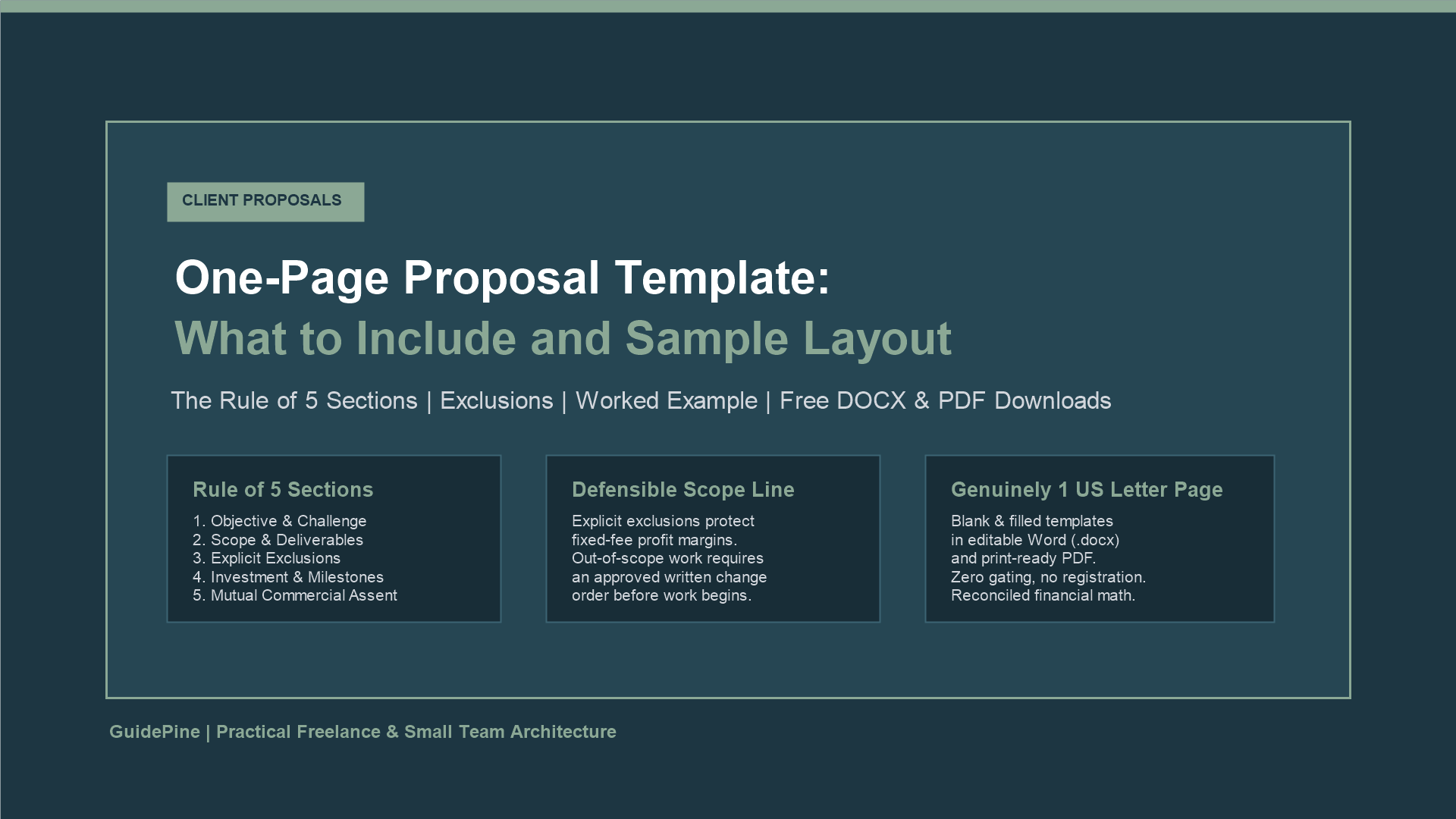
A one-page proposal template gives freelancers and consultants a single US Letter page that states what you will do, what you will not do, what it costs, and how the client says yes. It fits best on straightforward, fixed-scope projects, usually between $1,000 and $5,000, where one person makes the buying decision.
This guide gives you the five sections every one-page proposal needs, a copy-ready template with generic placeholders, and a fully worked example with numbers that add up. It also explains what a signed single page can and cannot do legally, so you know when to move to a longer document.
Why a One-Page Proposal Works for Freelancers and Solo Consultants
Small projects often stall in the gap between a good conversation and a signed agreement. A client who is ready to hire you for a $3,000 audit rarely wants to read eight pages first. A short proposal respects their time and shows you can scope work cleanly.
The goal of the format is fast client alignment on a defined engagement. Everything on the page has to earn its space: the objective, the deliverables, the boundaries, the fee, and the signature. Anything else belongs in a longer document or a separate agreement.
When One Page Is Enough
A one-page proposal fits when the project is simple enough that both sides can describe it in a few bullet points. The typical conditions look like this:
- The scope is fixed, with named deliverables and a clear finish line.
- The fee is a flat amount, usually between $1,000 and $5,000.
- One decision-maker can approve the work without a procurement process.
- The timeline is short, often a few weeks or less.
If the engagement needs multiple phases, option tiers, or a detailed methodology, use the longer format described in our freelance proposal template guide. If the client needs a formal contractual document that spells out acceptance criteria and change control in depth, read our comparison of a proposal versus a statement of work. For specialized content, copywriting, or editorial deliverables where revision limits and cancellation fees require specific handling, review our freelance writing proposal template.
One-Page Proposal vs. Multi-Page Proposal vs. Statement of Work
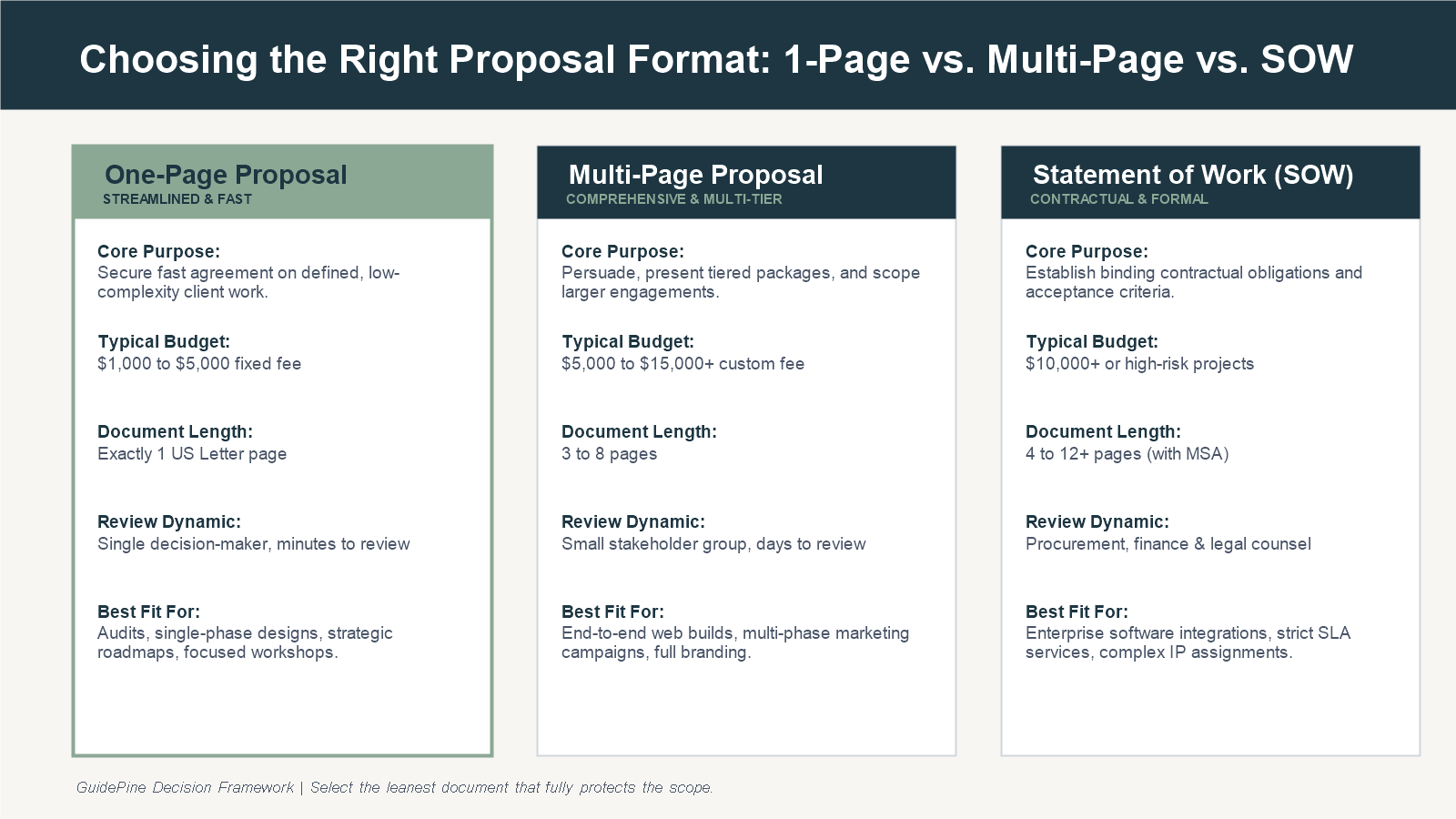
These three documents overlap, but they do different jobs. The table below shows where each one fits.
| Feature | One-Page Proposal | Multi-Page Proposal | Statement of Work (SOW) |
|---|---|---|---|
| Purpose | Win quick agreement on a small, defined job | Persuade and scope a larger, custom engagement | Define contractual obligations and acceptance criteria in detail |
| Typical length | 1 page | Several pages | Several pages, often attached to a master agreement |
| Best used for | Fixed-scope work from about $1,000 to $5,000 | Multi-phase work from about $5,000 to $15,000 and up | Complex or higher-risk work that needs formal control |
| Complexity level | Low | Medium to high | High |
| Time for the client to review | Minutes | Longer, often a full read and discussion | Longest, may involve legal or procurement review |
The dollar ranges are practical guidelines, not rules. A $4,000 project with three stakeholders and a vague scope may still need more than one page, while a clearly defined $6,000 job with a single approver might not.
The 5 Essential Sections Every One-Page Proposal Must Include
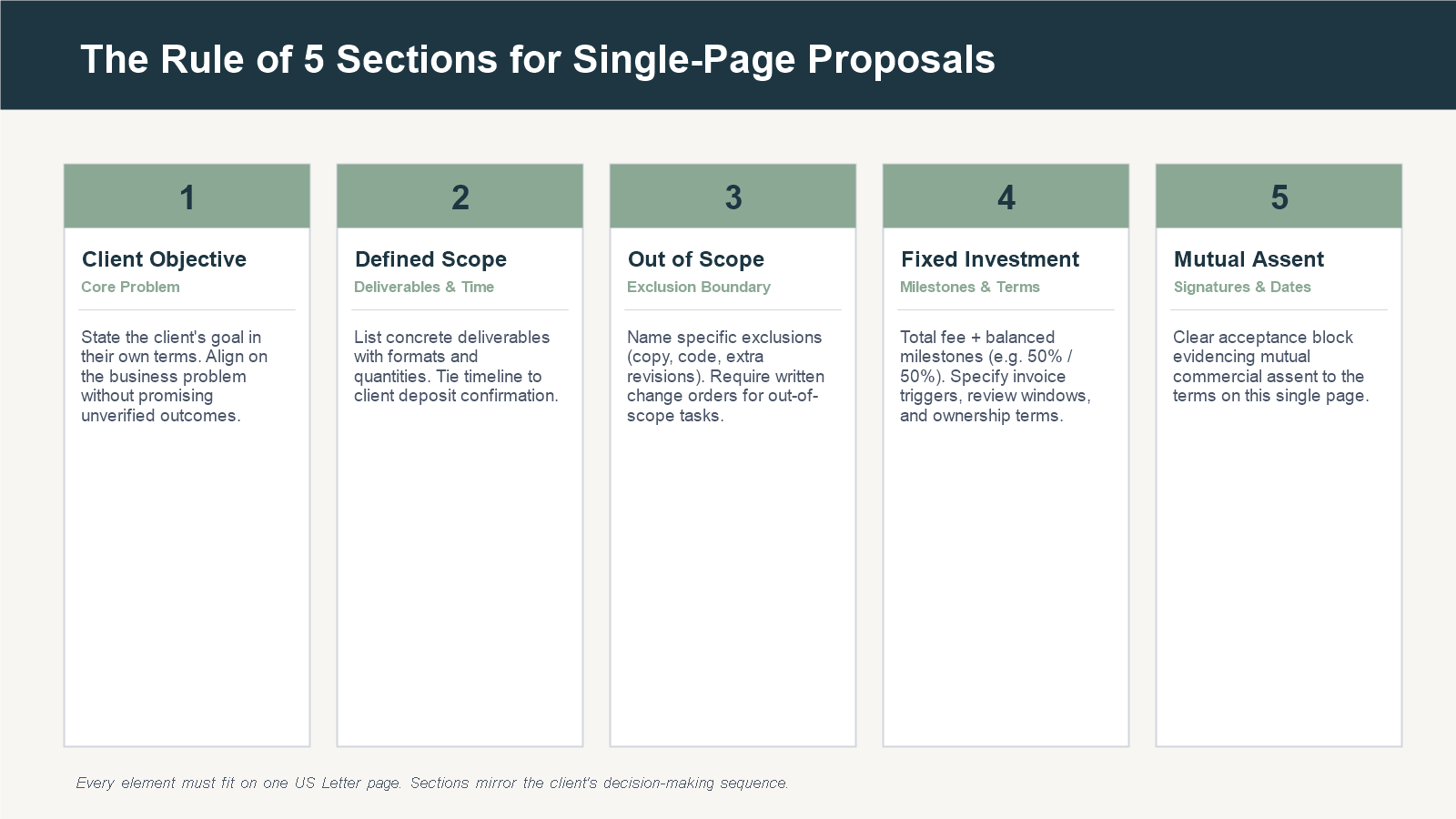
A single page leaves no room for filler, so the structure matters more than the design. We use what we call the Rule of 5 Sections. Each section answers one question the client will ask before signing, and each one prevents one common source of disagreement later.
The five sections are the client objective, the scope and deliverables, the out-of-scope exclusions, the fixed investment with milestone terms, and the acceptance block. Keep them in this order, because it mirrors how a client thinks: what problem we are solving, what I get, what I do not get, what it costs, and how we start.
1. Client Objective and Core Problem
Open with one or two sentences that restate the client’s goal in their own terms. This is the part that tells the reader you listened. It also gives both sides a reference point if the project drifts.
Write the objective around a business outcome the client cares about, such as understanding why a site converts poorly or producing a launch-ready set of pages. Avoid promising a result you cannot control. “Identify the technical and structural issues limiting organic conversion efficiency” is a defensible objective. “Double your sales” is not.
Keep this section to a short paragraph. If you need more than four or five lines to explain the problem, the project may be too complex for one page.
2. Defined Scope and Specific Deliverables
This is the core of the document. List each deliverable as a concrete item with a format and a quantity where possible: a 15-page audit report, a checklist, a 60-minute presentation. Vague phrases such as “ongoing support” or “full optimization” invite disputes.
State the timeline here as well, tied to a trigger the client controls. “14 business days from deposit confirmation” is clearer than “two weeks,” because it tells the client that the clock starts when they act.
Add your revision terms in this section. A common structure is a limited number of consolidated revision rounds within a set window after delivery, with additional rounds billed at an agreed hourly rate. These are negotiated commercial terms, not industry rules or legal requirements, so adjust them to fit your work and your client.
3. Explicit Out-Of-Scope Exclusions (the Boundary Line)
Most freelancers skip this section, and most scope disputes start here. A short list of exclusions tells the client what the fee does not cover, before any work begins.
Write each exclusion as a plain statement of fact: “Direct CMS implementation is not included.” Then close the section with a single sentence explaining the process for anything outside the list: work beyond this scope requires a written change order before it starts. The next major section covers exclusions in more detail.
4. Fixed Investment, Milestone Schedule, and Invoicing Terms
State the total fee as a single figure, then break it into milestones that add up exactly to that total. A 50% deposit at signature and a 50% balance at delivery is a common structure for short projects, but it is a choice, not a standard. Some freelancers prefer a smaller deposit and others split into three payments.
Spell out what triggers each invoice and when it is due. If you need a refresher on wording, our guide to payment terms on an invoice covers due dates, late fees, and common phrasing. When you are ready to bill, a sample invoice for hours worked shows how to present hourly add-ons, which is useful if the client requests extra revision rounds that you bill at your agreed rate.
Include a short ownership statement here or state that ownership will be handled in a separate written agreement. The legal section below explains why.
5. Commercial Acceptance and Mutual Assent Block
The last section is where the client agrees. It needs a single sentence stating that both parties agree to the scope, exclusions, fees, and terms on the page, followed by a signature, printed name, title, and date for each side.
Signing is what turns a pitch into a recorded agreement. A signed block shows mutual assent to the project scope, milestones, and fees, which is why both signatures belong on the same page as the terms they approve. Do not link to terms on another page or a website and assume they apply. Everything the client is agreeing to should be visible above their signature.
Why Explicit Exclusions Protect Fixed-Fee Projects
On a fixed-fee project, every hour of unplanned work comes out of your margin. A flat fee only works when both sides understand where the work ends. On a one-page proposal, what you leave out is as important as what you put in, because you do not have room for lengthy contract language to fill the gaps.
An exclusion list works as a boundary line. It converts the quiet assumptions that cause trouble later (the client assumed you would write the copy, you assumed they would) into written statements that both sides have seen and signed.
Common Exclusion Categories
Most small-project disputes trace back to a handful of categories. Check each against your own work and keep the ones that apply.
- Extra revision rounds. Anything beyond the number stated in the scope section.
- Third-party costs and licensing. Software subscriptions, plugins, fonts, and tools the client needs to buy themselves.
- Stock photography and media. Image licenses, video footage, and music.
- Content authoring. Writing, translation, or product descriptions when your deliverable is design, structure, or analysis.
- Implementation. Making the changes you recommend, such as updating a CMS or editing code.
- Ongoing maintenance and support. Updates, monitoring, or retainer work after delivery.
- Additional meetings. Calls and workshops beyond the ones listed.
How to Write Unambiguous Exclusion Statements
Short, flat statements work better than hedged ones. Compare these two versions:
- Weak: “Some additional work may require separate pricing.”
- Strong: “Copywriting is not included. Content changes recommended in the audit are the client’s responsibility.”
The strong version names the task, says it is excluded, and leaves no room for argument. Aim for one line per exclusion and avoid qualifiers such as “generally” or “typically.”
Finish the section with a single process sentence, such as: “Requests outside this scope will be quoted separately and begin only after written approval.” That sentence gives you a polite, pre-agreed way to say yes to extra work without absorbing it for free.
Copy-Ready One-Page Proposal Template
The template below uses generic bracketed placeholders. Replace each bracket with your own details, then trim or expand sections until the whole document fits on one US Letter page. The structure follows the five sections described above.
Blank One-Page Proposal
Copy the template into Word, Google Docs, or your preferred editor.
[YOUR BUSINESS NAME]
[YOUR NAME], [YOUR TITLE] | [YOUR EMAIL] | [YOUR PHONE]

PROJECT PROPOSAL FOR: [CLIENT BUSINESS NAME]
Prepared for: [CLIENT CONTACT NAME], [CLIENT CONTACT TITLE]
Date: [PROPOSAL DATE]
Valid until: [EXPIRATION DATE]

1. CLIENT OBJECTIVE AND CORE CHALLENGE
[CLIENT BUSINESS NAME] wants to [PROJECT OBJECTIVE]. The current challenge
is [CORE PROBLEM IN ONE OR TWO SENTENCES].

2. SCOPE AND DELIVERABLES
[YOUR BUSINESS NAME] will provide:
  * [DELIVERABLE 1, WITH FORMAT AND QUANTITY]
  * [DELIVERABLE 2, WITH FORMAT AND QUANTITY]
  * [DELIVERABLE 3, WITH FORMAT AND QUANTITY]
Timeline: [NUMBER] business days from [START TRIGGER, SUCH AS DEPOSIT CONFIRMATION].
Revisions: Up to [NUMBER] rounds of consolidated feedback submitted within
[NUMBER] business days of delivery. Additional rounds are billed at
[HOURLY RATE] per hour with written approval.

3. OUT OF SCOPE
The following items are not included:
  * [EXCLUSION 1]
  * [EXCLUSION 2]
  * [EXCLUSION 3]
Work outside this scope requires a written change order before it begins.

4. INVESTMENT AND PAYMENT TERMS
Total fixed fee: [TOTAL FEE]
Milestone 1: [AMOUNT] ([PERCENT]%), due [TRIGGER, SUCH AS SIGNATURE]
Milestone 2: [AMOUNT] ([PERCENT]%), due [TRIGGER, SUCH AS DELIVERY AND ACCEPTANCE]
Payment method and terms: [PAYMENT METHOD AND DUE DATE]
Ownership: [OWNERSHIP STATEMENT, OR "TO BE ADDRESSED IN A SEPARATE WRITTEN AGREEMENT"]

5. ACCEPTANCE
By signing below, both parties agree to the scope, exclusions, fees, and
terms stated on this page.

[CLIENT BUSINESS NAME]                 [YOUR BUSINESS NAME]
Signature: ____________________        Signature: ____________________
Name: [CLIENT SIGNER NAME]             Name: [YOUR NAME]
Title: [CLIENT SIGNER TITLE]           Title: [YOUR TITLE]
Date: ____________                     Date: ____________
Before you send it, read the page once as the client would. Every number should match, every deliverable should have a quantity, and the exclusion list should cover the things you would otherwise end up doing for free.
Free One-Page Proposal Downloads
Choose a blank template or a completed example. Available as an editable Word document or a print-ready PDF. No signup required.
Blank Proposal Template
Start with a clean five-section proposal and customize it for your client.
Filled Proposal Example
See a completed $3,500 client proposal with scope, exclusions, payment milestones and signatures.
Worked Example: Website Conversion and SEO Audit Proposal
The example below is entirely fictional. It shows a boutique digital consultant, Harbor Lane Digital, pitching a $3,500 fixed-scope audit to an e-commerce client, Northfield Outfitters. The consultant wants a quick yes on a clearly bounded job, so the proposal stays on one page.
Notice how each of the five sections takes only a few lines, and how the exclusions and the milestone math do the heavy lifting.
Website Conversion & SEO Audit
HARBOR LANE DIGITAL
Jordan Ellis, Principal Consultant | jordan@example.com | (555) 010-0142

PROJECT PROPOSAL FOR: Northfield Outfitters
Prepared for: Dana Whitfield, Head of E-Commerce
Date: November 17, 2026
Valid until: December 1, 2026

1. CLIENT OBJECTIVE AND CORE CHALLENGE
Northfield Outfitters wants to improve organic conversion efficiency on its
online store. Product and category pages draw search visits, but the site
architecture and technical setup may be limiting how many of those visits
turn into orders.

2. SCOPE AND DELIVERABLES
Harbor Lane Digital will provide:
  * A 15-page diagnostic audit covering site architecture, technical SEO,
    and conversion paths
  * A prioritized technical fix checklist
  * A 60-minute findings presentation with Q&A
Timeline: 14 business days from deposit confirmation.
Revisions: Up to 2 rounds of consolidated feedback submitted within 7
business days of delivery. Additional rounds are billed at $125 per hour
with written approval.

3. OUT OF SCOPE
The following items are not included:
  * Direct CMS implementation
  * Code fixes or theme changes
  * Copywriting or content creation
  * Ongoing SEO retainers or monitoring
Work outside this scope requires a written change order before it begins.

4. INVESTMENT AND PAYMENT TERMS
Total fixed fee: $3,500
Milestone 1: $1,750 (50%), due upon signature
Milestone 2: $1,750 (50%), invoiced on delivery of the final report and
findings presentation, due upon acceptance or at the close of the 7
business day review window, whichever comes first
Payment method and terms: Bank transfer or card, invoices payable on receipt
Ownership: The audit report and checklist may be used by Northfield
Outfitters for its internal business purposes. Any broader transfer of
rights requires a separate signed agreement.

5. ACCEPTANCE
By signing below, both parties agree to the scope, exclusions, fees, and
terms stated on this page.

NORTHFIELD OUTFITTERS                  HARBOR LANE DIGITAL
Signature: ____________________        Signature: ____________________
Name: Dana Whitfield                   Name: Jordan Ellis
Title: Head of E-Commerce              Title: Principal Consultant
Date: ____________                     Date: ____________
Checking the Numbers
Before a proposal goes out, reconcile every figure. In this example, the two milestones are $1,750 + $1,750 = $3,500, which is 100% of the fixed fee. The timeline of 14 business days begins when the deposit is confirmed, so the client controls the start date. The 2-round revision cap and the 7 business day window work together: the client has one week after delivery to send consolidated feedback, and anything beyond two rounds is billed at $125 per hour only after written approval.
None of these terms are standard. The 50% deposit, the 14-day timeline, the 7-day window, and the 2-round cap are negotiated commercial provisions. A different freelancer could reasonably choose a 30% deposit, a three-week timeline, or three revision rounds. What matters is that the terms are visible, specific, and agreed to before work begins.
Legal Considerations: What a One-Page Proposal Can and Cannot Do
A short proposal can be a real agreement, but it is not a substitute for a full contract in every situation. The points below explain the limits. This section is general information, not legal advice. Contract rules vary by state and by circumstance, so talk to a licensed attorney about anything high-stakes.
Mutual Assent and Enforceability
Under U.S. common law, a binding contract generally requires an offer, acceptance, consideration, and legal capacity. The Cornell Law School Legal Information Institute’s overview of contract law walks through these elements. A signed proposal that names the work, the price, and both parties can evidence that the two sides agreed on scope, milestones, and fees.
That does not mean a one-page proposal resolves every legal question. It does not automatically address liability limits, confidentiality, data handling, indemnification, or what happens if the relationship breaks down. For simple services, a clear signed page can be enough. For anything with meaningful risk, it should be paired with, or replaced by, a more complete agreement.
Intellectual Property and Copyright Transfer
Creative and technical deliverables, such as designs, code, and written content, usually involve copyright. Under 17 U.S.C. § 204, a transfer of copyright ownership requires a written instrument or note of the transfer that is signed by the owner of the rights being conveyed.
In practice, this means that paying an invoice or signing a one-page proposal does not transfer copyright by itself. If you intend to give the client ownership, say so explicitly in writing, and make sure the statement is signed by you as the rights owner. If you only intend to license the work for a specific use, say that instead. The worked example above takes the licensing route and defers any broader transfer to a separate signed agreement. For anything more than a simple arrangement, have an attorney draft the assignment language.
Independent Contractor Work and "Work Made for Hire"
Many clients assume that anything they pay a freelancer to create belongs to them automatically. The U.S. Copyright Office explains in Circular 30 on works made for hire that work by an independent contractor is not automatically a work made for hire. It qualifies only if it fits specific statutory categories and the parties expressly agree in a signed written document.
If a client asks for “work for hire” language on a one-page proposal, treat it as a legal request, not a formatting preference. The label has real consequences for ownership, so check whether it applies to your type of work before agreeing to it.
When to Move to an MSA or Call an Attorney
Consider a longer agreement, such as a master services agreement, when any of the following is true:
- The project value or risk grows beyond what a single page can responsibly cover.
- You will work with the client repeatedly and want shared terms for every job.
- The client requires liability, confidentiality, or data-protection terms.
- Ownership of the deliverables is complex or commercially important.
- The client’s legal or procurement team asks for a formal contract.
A one-page proposal can still serve as the commercial summary that sits on top of a longer agreement. Our guide to proposals versus statements of work explains how the two documents work together.
How to Transition from an Accepted Proposal to Active Work
A signature is the start of delivery, not the end of the sales process. A short, consistent handoff keeps the project moving and prevents small misunderstandings from growing.
- Confirm receipt of the deposit. Check that the payment has cleared, since your timeline in the example starts at deposit confirmation, not signature. Note the confirmation date and write it down.
- Issue a receipt or confirmation. Send a brief written acknowledgment stating the amount received, the date, and the project start date. This also creates a clear record of when the 14 business day clock began.
- Request onboarding assets. Ask for the access, files, and contacts you need, such as analytics access, brand files, or a named point of contact. Set a short deadline, and note that delays on their side may push the delivery date.
- Set communication channels. Agree on where updates and feedback will go (email, a shared folder, a project board) and who will send consolidated feedback for the client.
- Share the plan. Turn the milestones and timeline from the proposal into a simple schedule. If the project needs more structure, our project management plan example shows how to break an agreed scope into tasks and dates.
What to Do When the Client Asks for Out-Of-Scope Work
It will happen. A client sees the deliverable, likes it, and asks for one more thing. Because your proposal lists exclusions and a change-order process, you already have a response ready.
Acknowledge the request, confirm that it falls outside the signed scope, and offer a short written quote. Pause the extra work until the client approves in writing. If the request is small, you may choose to include it as a courtesy, but say so in writing so it does not become the new expectation.
The same approach applies to revision requests beyond the cap. Point to the agreed number of rounds, offer the additional round at the stated hourly rate, and wait for written approval before you start.
Frequently Asked Questions About One-Page Proposals
Can a one-page proposal be legally binding?
Yes, it can be, if it contains the basic elements of a contract and both parties sign. Contract law generally looks for an offer, acceptance, and consideration, and a signed proposal that states the work and the price can meet that test for a simple service. However, it will not cover complex liability, confidentiality, or intellectual property issues on its own. Treat it as a commercial agreement for straightforward work and involve an attorney for anything larger or riskier.
How do I fit all necessary information on a single page without making it unreadable?
Cut anything the client does not need to make a decision. Use short bullets for deliverables and exclusions, keep the objective to a couple of sentences, and use a compact font size that is still easy to read. Put the signature block at the bottom and the fee in a clearly labeled line. If you cannot fit the essentials without shrinking the type to an uncomfortable size, the project probably needs the longer format.
Should I include multiple pricing tiers on a one-page proposal?
Usually not. Tiered options add length and give the client another decision to make, which works against the purpose of a quick yes. If you want to offer options, choose a single recommended package and mention optional add-ons separately, or move to the multi-page format described in our freelance proposal template guide.
What happens if the client asks for more revisions than the proposal allows?
Refer back to the signed revision terms. In the worked example, the client gets up to 2 rounds of consolidated revisions within 7 business days of delivery, and extra rounds are billed at $125 per hour with written approval. Offer the extra round at that rate, confirm the cost in writing, and begin only after the client agrees. These specific terms are examples, so set your own cap and rate before you send a proposal.
Is a one-page proposal suitable for hourly or retainer work?
It can work for a short hourly engagement if you state the rate, an estimated or capped number of hours, and how you will report time. It is a poor fit for open-ended retainers, because the value of the format comes from a fixed scope and a fixed fee. For ongoing work, a longer agreement that covers monthly deliverables, notice periods, and renewal terms is a better choice.