
When and How to Follow Up on a Proposal
Send one short note three or four business days after the proposal goes out, a second note a few days later that adds something useful, and a final note on or just after the proposal’s real deadline. That is the whole rhythm. Each message is brief, each has a reason to exist, and each can be dropped the moment the client replies or gives you a date.
Treat this as a working example, not a law of nature. Nothing in this article proves that three touches beat two or four. What matters more is how the client reviews proposals, what you agreed to when you sent yours, and how long the proposal is actually good for. If a client says they will decide by the 20th, the 20th is your calendar.
Done well, a follow-up is service rather than pressure. Proposals land in crowded inboxes, get forwarded to people you have never met, and sit behind other priorities. A good follow-up confirms the document arrived, answers a question before it turns into a stall, and makes the next step easy to take. Done badly, it sounds like a debt collector. The difference is usually tone and timing, and both are fixable.
Here is the cadence at a glance:
| Touchpoint | Timing | Objective | Tone | Next Action |
|---|---|---|---|---|
| Send | Day 0 | Deliver the full proposal and state next steps, contacts, and any real decision date | Clear and organized | Note the send date and count forward in business days |
| Touch 1 | 3-4 business days after sending | Confirm receipt and invite questions about scope | Warm and brief | Wait for a reply, or follow the date the client gives you |
| Touch 2 | 7-8 business days after sending | Share one relevant, project-specific point and ask about the decision process | Helpful and curious | Adjust to the client’s timeline, or move to Touch 3 |
| Touch 3 | On or shortly after the stated proposal deadline | Close the loop and invite the client to reconnect | Gracious and final | Close the proposal in your pipeline and release any availability you actually held |
One distinction before the details. Some dates in a proposal are about your calendar, such as when you can start and how long your quote assumes your current workload. Other dates can matter more formally, because a time limit written into a proposal can affect how long the client has to accept it. The first kind is planning. The second is a legal question, and the part below on what to settle before you send covers it briefly.
Why Clients May Delay After a Proposal
A quiet inbox after a proposal rarely has a single explanation. Several ordinary things can slow a decision, and from the outside you usually cannot tell which one you are dealing with.
Other priorities may have pushed your proposal down the list. More than one person might need to review it, and one of them is traveling. The budget could exist on paper but not be approved until the next quarter. The scope may have raised questions that nobody has gotten around to asking. Or the client’s interest may have cooled, or they may have gone another direction and not said so yet.
These are possibilities, not a ranking. This article does not claim that any one reason is the most common. Silence is not a yes, and it is not automatically a no either. That is why the first follow-up asks a question instead of assuming something about the client’s intent. “Did this reach you, and is anything unclear?” is easy to answer honestly. A message that implies they have been ignoring you is not.
One more thing to check before you send anything: did the client already give you a decision date? If so, that date overrides this schedule. Reminding someone before their stated review window is over tells them you were not listening. Put the date in your calendar and write your first follow-up for a day or two after it passes.
A Respectful Three-Touch Follow-Up Timeline
Counting is the fiddly part. Business days means workdays, so weekends and relevant U.S. holidays do not count, and 3-4 business days is not the same as 72-96 hours. Here is how the example plays out for a proposal sent on Monday, March 1, 2027, with a stated validity period of 14 calendar days:
- Send: Monday, March 1
- Touch 1: Thursday, March 4 or Friday, March 5 (3 or 4 business days later)
- Touch 2: Wednesday, March 10 or Thursday, March 11 (7 or 8 business days later)
- Proposal deadline: Monday, March 15 (14 calendar days after the send date)
- Touch 3: Monday, March 15 or Tuesday, March 16
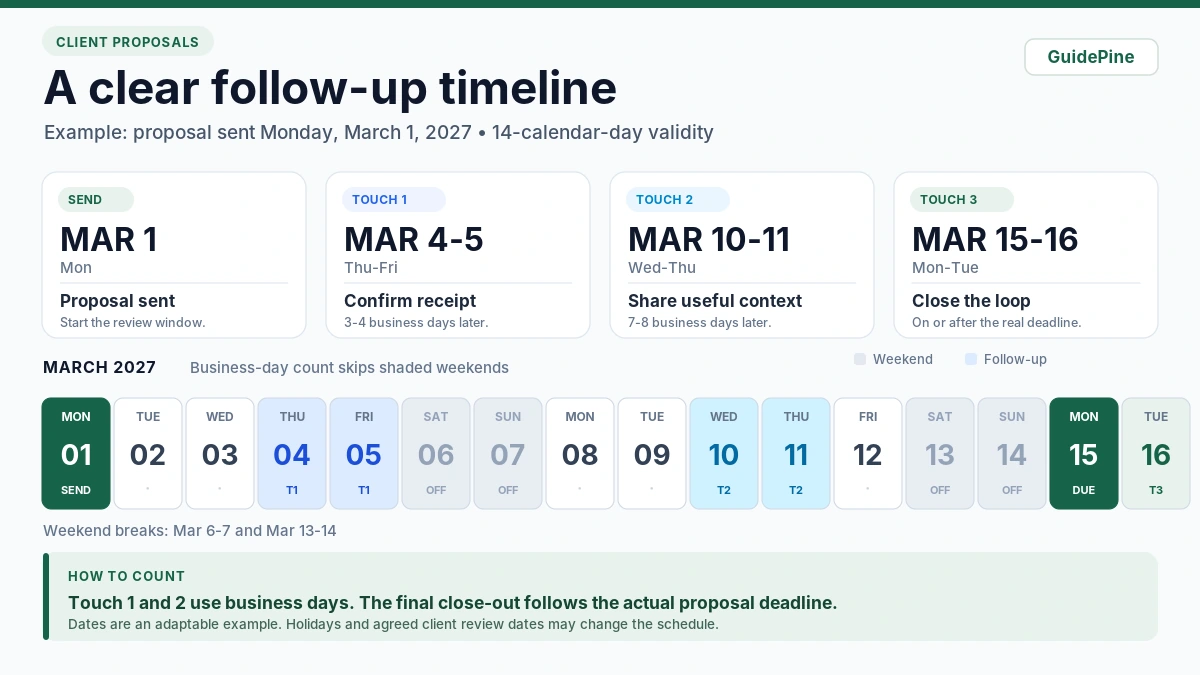
Change the send day and the picture shifts. Sent on Thursday, March 4, the third business day lands on Tuesday, March 9. That is five calendar days later, not three. A holiday inside the window pushes the count back another day.
Also, 14 days is not special. If your proposal is good for 30 days, there is no reason to close it on Day 14. Tie the third touch to whatever date your proposal actually states, and space the first two to fit. Writing the date itself (“valid through March 15, 2027”) beats writing a number of days, because nobody has to count.
Before You Send: Settle the Follow-Up in Advance
The easiest follow-up is the one you planned before the proposal left your outbox. Confirm the scope the client expects, who approves the work, whether they have a decision date, and how much time you can realistically hold open. Put any date in both the email and the document so nobody has to guess. If you are still building the document itself, the freelance proposal template covers a full structure, and the one-page proposal template suits smaller jobs.
A validity period of 14 or 30 days is an optional business practice, not a legal requirement. It has a legal side only in some situations. When a proposal works as a formal offer, the Restatement (Second) of Contracts, section 41, says the client’s power to accept ends at the time the offer specifies, or after a reasonable time if it names none. Cornell’s Legal Information Institute describes an offer as something stated and delivered so that a reasonable person would expect a binding contract once it is accepted. Whether a particular proposal meets that description depends on its wording, the circumstances, and the law that applies. Do not assume that yours does, or that it does not. This is general information, not legal advice, so if a proposal’s legal status matters to you, ask a lawyer.
Touch 1: Receipt and Clarification (3-4 Business Days)
The first message does one job. It confirms the proposal arrived and invites questions. It does not ask for a decision, and it should be short enough to read on a phone.
Checking that the [PROJECT NAME] proposal reached you
Sent 3 to 4 business days post-send. Verifies receipt and invites scope questions.
Subject: Checking that the [PROJECT NAME] proposal reached you

Hi [CLIENT NAME],

I wanted to make sure the proposal I sent on [PROPOSAL DATE] for [PROJECT NAME] arrived and opened without trouble.

If anything in the scope, timeline, or pricing is unclear, I am glad to walk through it. A short call or a few written questions both work.

If you already have a review timeline in mind, tell me and I will follow your schedule.

Best,
[YOUR NAME]
Adapt the middle paragraph to the client’s world. With a larger company, you might offer a version formatted for other reviewers. With a solo founder, a quick call may feel friendlier than another document.
Touch 2: One Useful, Project-Specific Point (7-8 Business Days)
The second message earns its place only if it gives the client something. Pick one point that is true and specific to their project, such as an assumption in your schedule, a dependency you noticed, or a question the proposal left open. Do not produce free deliverables to get a reply, and do not quote a benchmark unless you can name where it came from. If the client gave a later decision date, hold this touch until that date has passed.
One note on the [PROJECT NAME] schedule
Sent 7 to 8 business days post-send. Adds one true, project-specific observation.
Subject: One note on the [PROJECT NAME] schedule

Hi [CLIENT NAME],

While rereading the proposal I sent on [PROPOSAL DATE], I noticed the delivery dates assume we confirm the scope by [DATE]. A later start is fine, but it would shift the timeline, and I wanted you to have that before your team compares options.

Is there anything about your decision process I should know, such as who else is reviewing it or when you expect to decide? I can adjust my follow-up to match.

Best,
[YOUR NAME]
The example point here is a scheduling dependency. Swap in whatever is genuinely true about your project. If nothing is, send a plain check-in or skip this touch.
Touch 3: A Gracious Close-Out (on or Just After the Real Deadline)
The final message closes the loop around a deadline that was actually stated. If your proposal said it was valid through a certain date, that date is the natural moment. If it had no firm deadline, you can still close it, but describe it accurately as something you are doing in your own pipeline, not as a legal expiration. Do not claim reserved capacity you never reserved. If you did hold time for this project, add one sentence saying you are releasing it. If you did not, leave that sentence out.
Closing out the [PROJECT NAME] proposal
Sent on or shortly after proposal deadline. Gracious close-out and capacity release.
Subject: Closing out the [PROJECT NAME] proposal

Hi [CLIENT NAME],

The proposal I sent on [PROPOSAL DATE] was open through [DATE], so I am closing it on my end for now. I have not heard back, which is completely fine. Priorities shift, and I do not want to keep sending reminders that are not useful.

If the project is still on your radar, reply any time and I will tell you my current availability and whether the scope and pricing still hold. If the timing is off, a quick "not now" helps me plan, and I am happy to stay in touch for later.

Thank you for considering it.

Best,
[YOUR NAME]
If the proposal included no expiration date, replace the opening of that email with: “I am following up once more on the [PROJECT NAME] proposal I sent on [PROPOSAL DATE]. Since we have not set a next step, I am closing it in my pipeline for now.” That describes your own administrative decision, not a legal expiration.
If the client answers, or gives you a new review date, at any point in this sequence, stop and adjust. A new date resets the clock. Sending Touch 3 to someone who just told you their team meets on Friday is how a polite process becomes a nuisance.
How to Reply to Three Common Client Objections
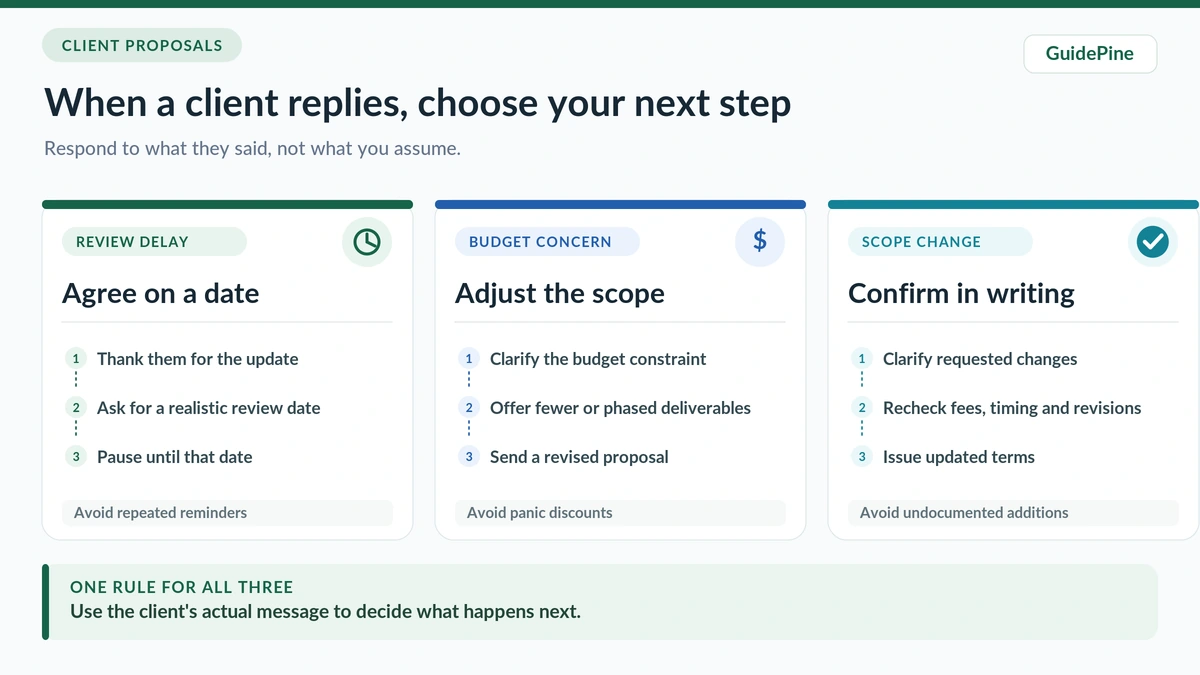
An objection is information, not a verdict. A client who pushes back on price may be interested, or may be gathering a number to compare, and you cannot tell which from one sentence. Reply to what they actually said, keep it short, and answer in the same email thread. That is why the scripts below have no subject lines.
"We Are Still Reviewing This Internally."
Acknowledge it, ask for a realistic date, and then wait until that date. Asking when is not pushy. It hands you a real date to follow, which beats guessing.
Reply: “We are still reviewing this internally.”
Sent in existing thread. Sets an agreed calendar checkpoint and pauses outreach.
Hi [CLIENT NAME],

Thanks for the update, and take the time you need. Would it help if I checked back in around [DATE]? If questions come up on your team before then, send them my way and I will answer quickly.

Best,
[YOUR NAME]
"The Price Exceeds Our Budget."
Take the number seriously without reflexively discounting. The honest options usually involve the work itself: phasing the project, trimming deliverables, changing the service level, or making some pieces optional. No single pricing approach is right for every professional, but whichever you choose, be open about what changes when the fee does. A lower price for identical work, offered the moment someone pushes back, can leave the client wondering about the first number.
Reply: “The price exceeds our budget.”
Sent in existing thread. Proposes phased delivery or trimmed scope without reflexive discounting.
Hi [CLIENT NAME],

Thanks for being straightforward about the budget. I would rather find a version that works than leave it where it is.

A few options: we could phase [PROJECT NAME] so it starts with your highest priority piece, trim some deliverables, or adjust the level of service, such as the number of revision rounds. Each of those changes the scope, so I would send a revised proposal instead of only a lower number.

Which direction feels closest to what you need?

Best,
[YOUR NAME]
"Can We Change the Scope?"
Usually yes, with one condition: the change gets written down. Adding or removing work can affect the fee, the schedule, the number of revision rounds, or the milestones. Confirm the changes in writing and send a revised proposal or statement of work, so both sides are reviewing the same document.
Reply: “Can we change the scope?”
Sent in existing thread. Welcomes adjustments and commits changes to a revised written proposal.
Hi [CLIENT NAME],

Happy to adjust. Send me what you would like added or removed from [PROJECT NAME]. Changes to scope can affect the fee, the schedule, and the number of revisions, so I will put the updated version in writing for you to review before anything moves forward.

If it is easier, we can talk it through first and I will follow up with the revised proposal.

Best,
[YOUR NAME]
Follow-Up Mistakes That Can Damage Trust
Most follow-up mistakes come from impatience, and each has a plain fix.
- Passive-aggressive wording. Phrases like “just bumping this again” or “as per my last email” put the client on the defensive. Write each message as if it were the first, with one clear purpose.
- Frequent, uninvited pings. Three uninvited messages in a week can feel like pressure, even when they are politely worded. Space your touches by business days, respect any date the client gives you, and stop after the close-out unless they reply.
- Panic discounts. Cutting the fee with no change in scope can make the original number look soft. Offer a phased or trimmed version instead, or hold your price and explain what it covers.
- Contacting them everywhere. An email, then a LinkedIn message, then a text, none of them invited. Use the channel the client used with you or asked you to use.
- Starting speculative work without agreed terms. Free samples and early drafts can leave you with no agreement on payment or ownership. Settle the terms first, in writing, then begin.
These mistakes are easy to make when a quiet inbox creates uncertainty. A planned schedule helps avoid them.
What to Do if the Client Accepts
First, agree on what counts as acceptance and how it will be documented. For some projects a clear written “yes” is enough. For others you will want a signed document. A separate signed statement of work is often a sensible protection, but it is not a universal legal condition for every service contract. The guide on the difference between a proposal and a statement of work explains when each one earns its place.
Whatever format you choose, write down the points that tend to cause disagreements later: scope, deliverables, dates, fees, payment timing, cancellation, revision terms, and who owns the finished work, as relevant to your project. A deposit before work begins is a negotiable commercial policy, not a legal prerequisite. Follow whatever you and the client agreed, and see the guide on payment terms on an invoice for ways to state them.
Ownership deserves a careful sentence. Under U.S. copyright law, a transfer of copyright ownership generally needs a written instrument signed by the owner or the owner’s authorized agent, as 17 U.S.C. section 204(a) provides (Copyright Office text). That statute does not say the transfer waits for full payment. If you want ownership to pass only after you are paid, that is something you and the client write into your agreement. Nonexclusive licenses are treated differently, and the Ninth Circuit’s model jury instructions note that a nonexclusive license need not be in writing. Other rules can apply to some arrangements, so have a lawyer review your contract language. This is general information, not legal advice.
Once the project is confirmed, a project management plan example can help you lay out milestones and check-ins.
Proposal Follow-Up Checklist
- Confirm the scope, the approver, and any real decision date before you send.
- Count business days from the send date and add a day for holidays.
- Touch 1: confirm receipt and invite questions.
- Touch 2: share one true, project-specific point and ask about the decision process.
- Touch 3: close out on or just after the actual deadline, and claim only what is true.
- Stop or adjust whenever the client answers or gives a new date.
- Confirm acceptance and the key terms in writing.
If you want a line to adapt for your own proposals, this one is optional: “This proposal is valid through [DATE]. If you need more time to review it, just let me know.” It is a convenience, not a requirement.